The opening editorial announces the separation of the sewing-machine and typewriter groups and the creation of the first independent society devoted to antique sewing-machine collectors.
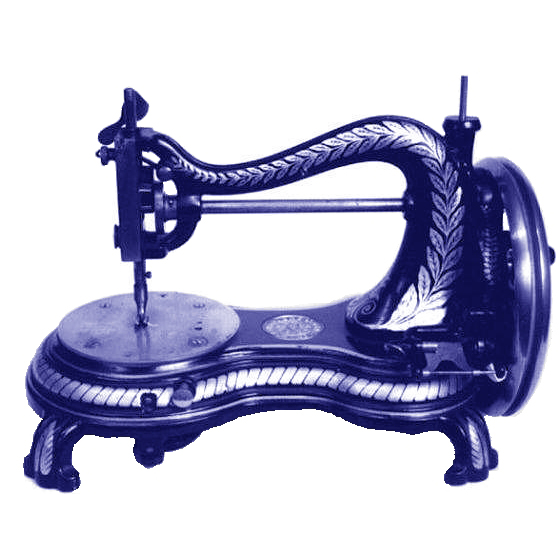
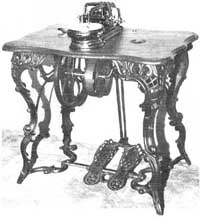
A report on the Luton gathering, centered on Carol Head's Whight and Mann display and comparisons among Alberta, Excelsior, Columbia, Prima Donna, Wanzer, Hurtu, So-All, and other unusual machines and stands.
Graham Forsdyke's ten-point scale for describing a machine's cosmetic condition, from factory-fresh examples to parts-only machines, while requiring broken or missing mechanical parts to be stated separately.
Reports from Christie's and the Luton sale record condition grades and hammer prices for Bradbury, A. W. Taylor, Weir, Willcox and Gibbs, Moldacot, Dorman, Grover and Baker, and other collectible machines.
A contemporary patent abstract and diagram explain George Whight's double-loop chain-stitch mechanism, including the rocking upper needle, lower looper, and hook that hold and form the interloop stitch.
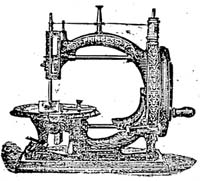
A company history tracing Whight and Mann from Gipping Works in 1859 through the Excelsior, Alberta, Princess, Prima Donna, and other models, followed by the George Whight era and German-made imports.
The provenance of a Little Wanzer owned from 1890 by K. M. Robinson, who began work at fifteen as a sleeve-hand sewing black material by gaslight for twelve hours a day.
Company records identify the So-All Lockstitch Sewing Machine Company, its patents and capitalization, the bankruptcy associated with Wilmot Holland, and the firm's dissolution in 1896 after a very short possible production life.
Kim Kelly describes cleaning and restoring a badly neglected ABC machine, touching in damaged black paint, reconstructing its gold and floral decoration, and identifying it through an 1869 advertisement.
Four period inventions illustrate attempts to power sewing machines with miniature steam engines, a paraffin-heated engine, and a water motor from the 1870s through 1913.
A guide to collecting the material surrounding sewing machines, including cases, needle containers, accessories, instruction books, advertisements, trade literature, and other display pieces.
An introduction to toy sewing-machine collecting, the uncertain boundary between toys and small portable machines, and the need for patent records, instructions, advertisements, and identification information.
A German toy-machine sale and a Christie's auction are reviewed, including prices for Vulcan and cast-iron toys and the £1,100 sale of a turned-leg Grover and Baker No. 14.
A rare Anchor machine is compared with Royal Sewing Machine Company designs, followed by an examination of its interchangeable Challenge mechanism and the question of why Royal produced the alternate frame.
Frister and Rossmann's licensed Willcox and Gibbs-type machine is examined as a well-finished competitor sold through drapers for cash rather than through specialist dealers offering hire purchase.