Handy Solutions
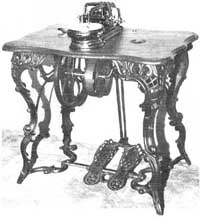
THERE'S A PROBLEM when putting on a show for fellow collectors for the third year running -- how do you make your display look different? Carol Head came up with a neat solution. She concentrated on just one manufacturer. Mind you, Whight and Mann, the maker she chose, produced some of the rarest and most-sought-after models such as the 1868 Alberta machine head smothered with mother-of-pearl and set into a flying-buttress treadle decorated with ladies' head 'gargoyles'. A similar version was the first machine to break the £2000 barrier in Auction -- and that was two years ago.
Another treadle on show was the Excelsior which someone once dubbed the 'village-pump' model and the name stuck. Apart from having a deeper base and worktop it looks almost identical to the 1858-patented West and Willson which Grace Rogers Cooper describes on page 117 of her book. She told how the machine stitched from left to right and the patent covered the peculiar method of operating a spring-looper in combination with an eye-pointed needle to form a chainstitch. I find it difficult to believe the 1861-patented Excelsior was not in someway connected with the West and Willson but have found no evidence to support or contradict this notion.
Among Carol's hand models was an unusual chain-driven Columbia made for G. Whight by the German firm Junker and Ruh and it's possible they also made the German-manufactured New Excelsior. Completing the display was a Prima Donna by George Whight, one of four in the room.
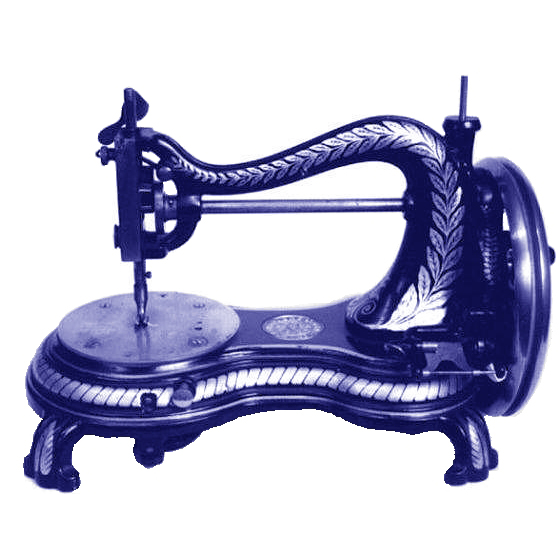
And this is what is interesting about the collectors' get-together. We don't say -- four Prima Donna's, how boring. Everyone was running round comparing machines. For instance, Peter Tarling's was different to the others. The usual lion's paw holding up the stitch-plate was much plainer and the mechanism by the wheel was open rather than closed in, and the decoration was slightly different, though the distinctive brass slider was still in the stitch-plate.
A consensus opinion made it an earlier version than the others, though as there was no manufacturer's name, we can't be sure whether it was really a Prima Donna or another manufacturer's copy. Kim Kelly's Prima Donna was resplendently displayed on a tripod treadle and Brian and Vera Matthews' version nearly got lost in their vast array of around 20 machines -- including sparkling-condition Greshams, Princess of Wales and their super-rare Handy which shares the Cookson patent. We saw most of their models last year but it's still a very impressive display and first-time visitors appeared quite shellshocked by the variety. They were helped by the Matthews' captions on each machine -- and Carol included copies of contemporary advertisements and information on her machines.
Following the theme idea I could have put together a fun collection using the idea of hands, starting with Diana and Peter Herbert's Sellers Allen machine of London and Keighley, West Yorkshire. It incorporated two cast-iron hands in the design, one supporting the top-drive shaft, the other coming from underneath and holding the stitch-plate.
It was so very different to the two Starley machines I brought along which have a hand and forearm forming the tops of the frames and four hands instead of claw feet at the base. Yes, I did say two models -- I got another one a few weeks ago. When I bought it by telephone I thought it was a duplicate which could have been passed on to some lucky member -- but it was a different version, narrower with a raised stitch-plate, though the gold Greek-key decoration and distinctive green border were the same. However, there was no Coventry Machinists 'European' trademark with a naked Lady Godiva riding her horse on this second model. I wish I knew how to find out which came first.
Then I'd add the Malloney's cast-iron-toy Nuremburg Lady which is cast in the shape of a woman wearing a long dress with the needle clamped in one of her hands. Jack and Anita drove down from Manchester with a car load. They put on sale a monopod-treadle Wanzer, two Shakespeares and various middle-of-the-road machines.
As well, they are looking for a red Moldacot tin to complete a set of three -- the others being blue and green. They will buy or exchange for a good-condition and, incidentally, rarer green tin. However Jack -- or more accurately Anita -- won't be parted from the Nuremburg Lady even though it isn't in the best condition having languished a decade or so in a rain-trough and suffered a re-paint. But it's still a special machine and one most collectors would give their right hand for.
And for no other reason than its name I'd have to add to my 'hands' collection the Matthews' Handy.
Bill and Norma Burleigh brought along a good-condition Wanzer on its one-legged treadle -- which I call a monopod though the instruction book calls a tripod. We must really produce a standard for these things to prevent confusion. Look at the illustration above and see if you can work it out. At the time the extra stand cost £1–1–0d and the firm claimed it gave increased power and speed and enabled the operator to use both hands for guiding the work.
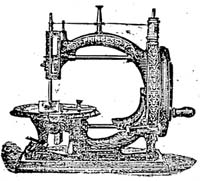
Another beautiful monopod treadle featured dolphins in the castings, mirroring the dolphin on its Newton Wilson Princess of Wales. The Herberts, who owned the machine, also had a PoW advertisement illustrating the combined models, and it would be easy to assume the two were made to go together. However, I have an advert showing this same treadle holding up, of all things, the humble Weir. Graham Forsdyke has a theory that this is a generoal-purpose stand suitable for many models and will air his views at another time.
The Herberts also displayed an odd-looking machine called a So-All which is considerably rarer than you may at first think. Australia- bound lan and Claire MacGillicuddy also have this model which is at the moment on the high seas with the rest of their collection and household effects.
This adventurous couple came to the meeting to bid farewell to their collecting friends and the next day were heading out to Australia the hard way by train through Russia and China. But so we won't forget them they've left some information they researched on the So-All which will appear in a later magazine. Incidentally, they've paid their subs and will catch up on the news when they arrive in about two month's time. We wish them bon voyage.
Bernard Williams (who was a founder member of the original society and its secretary/treasurer) brought along an unusual Wilson with a front-facing wheel in the treadle. (Wilson appears to have been a popular name in SM-manufacturing circles.) It incorporated a machine box cover that folded down flat to make a work-table top.
Bernard also brought his desirable hand Grover and Baker illustrated in S&R14 and his French Hurtu and Hautin showing 1862–68 patent dates on the slider cover. Bernard's machine is a treadle but he props it up on bobbin-like legs à la Grover and Baker and leaves the rather plain stand in his garage.
My machines tended to get scattered round the room, two of them ending up on the competition tables, one of them in a black plastic bag. The other was a Hurtu labelled 'la Productive' in the French instruction book. To complete the Hurtu trio I displayed l'Abeille, pictured opposite, which shared the same patent-date details as Bernard’s, and was also shown in the same instruction book as la Productive. So we can assume these two were manufactured simultaneously and Bernard’s one at least from 1868. I tried hard on a couple of occasions to get information on French machines from the Bibliothèque in Paris and their Science Museum, the Arts et Métiers, but without success.
This was the best-attended and most interesting and enthusiastic meeting in our three-year history. And though not everyone displayed machines there were many SM members looking and talking and learning. Let's hope SM members can keep up the tradition and show those more experienced and well-heeled typewriter boys that we can make it on our own.