
Everyone Loves a Willcox & Gibbs
This article has been adapted from the original ISMACS News layout for web presentation; line-break hyphenation and formatting have been normalized.
Back in the days when I strutted my stuff on London’s Portobello Road antiques market, the most commonly available antique machine was the Willcox & Gibbs. It was a rare Saturday that I didn’t have one on display, and rarer still that it didn’t find a new home. I think, during the heydays of the 1980s, I often moved on at least one W&G each week.
Condition, more often than not, was a 9 on Graham Forsdyke’s condition scale, or at least a good 8+, and they usually came with a rectangular box with several finishes that varied between unfinished pine to highly polished mahogany.
Of course, then, they were very cheap to buy and sell. And the overseas antiques dealers loved to take them back to their own shops and markets usually, in those days, to mainland Europe.
Inevitably it was one of the first machines newbie sewing-machine collectors bought, as in pristine condition they are very shiny and pretty and, of course, the rocking arm rocked their boats. They are so very quiet in use - the company’s literature promoted it as a Silent machine. And if buyers insist on a working model, this is the one, albeit one that uses a chain stitch.
In fact, of all the machines in my own collection - at one time it topped 600 if you included all the toys - it’s the only one I ever used. Total output was one Calvin Kline blouse from a Vogue pattern - it took three days to make and a very achy right arm - followed by a Halloween wall hanging and an apron, competition entries at a couple of American ISMACS Conventions.
All this came to mind this week when we visited retired collectors in the depths of the Suffolk countryside - an excuse to escape the traffic chaos of the 2012 Olympics near Graham’s home in East London.
The only machine they kept after selling up on moving house around two years ago was a lovely W&G. It retained all its gilding and its totally-complete name across the arm - a rarity indeed. We tried to buy it, but they wouldn’t part with it for love or money.
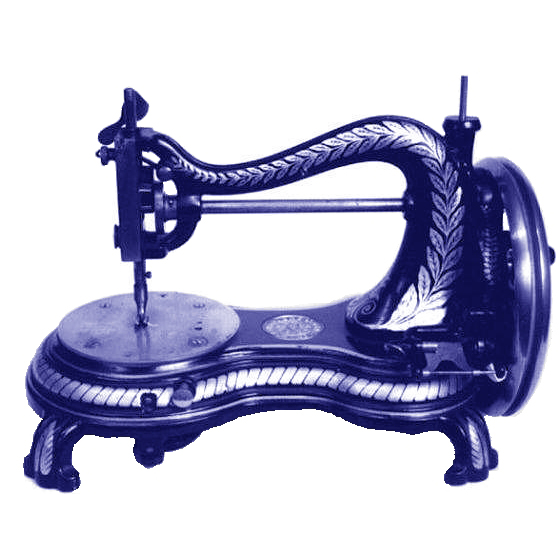
And I don’t blame them. Of all the hundreds that have passed through my hands over the years, I also kept just two: the one I use and one of the earliest offered by the UK arm of the American Company with an ornate gantry. It’s known among collectors as the glass-tensioner model and came on a deep walnut base hollowed out so it fitted over an accessory tray in the base of the custom-designed box.
When W&G decided to export machines from their Rhode Island factory to the UK they had the sense to realise that hand-crank models would be in demand in Europe - treadle versions were more popular in America. The leading iron founders at the time were in Coalbrookdale on the English/Welsh border - the world’s first iron bridge is nearby.
The founders were commissioned to come up with a hand-crank system consisting of a wheel and gantry, all to be mounted with the machine on a walnut base. They went a little overboard with the first design which, although perfectly made and oh-so-ornate, must have been reckoned a little over the top by the Willcox executives for it soon gave way to a simpler and more-streamlined design, and eventually to the one which went into mass production for over 70 years.
The gantry on the machine pictured is one of the first versions. The serial number is 63902 and dates to around 1864, which is the last patent date stamped onto the stitch plate. I’ve only ever handled two or three of these, usually with very little decoration remaining. But the one I kept is in superb condition as you can see in the pictures.
The more-common Silent Automatic with the removable thread holder was introduced in 1875.
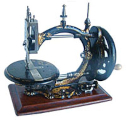
Berlin-based Frister & Rossmann also offered its own version of the Willcox, but with a very different finish. The rocking arm and wheel rim were plated, the company logo was painted into the circular base and the machine was mounted on a heavy wide base. The veneered box had a concealed drawer which held accessories.
I once appeared on a British TV show called “The secret life of machines” and demonstrated a number of my more-exotic models and, though not the rarest of collectable machines, I also included my Willcox & Gibbs.
That was the one the director and cameramen concentrated on the longest. They thought it was very pretty and loved the way the arm rose and fell with a satisfying cushioned thud - the very qualities that made collectors choose to buy it in the first place. (MS)
Images
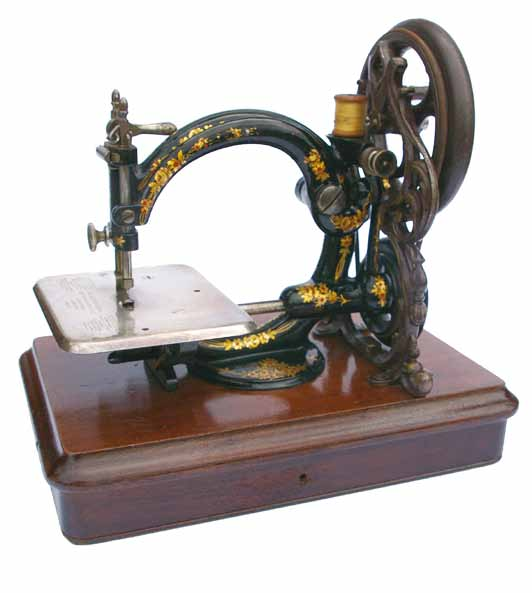
Above right: one of the first W&Gs to hit Europe - the heads from the US; the gantry, wheel and base added in the UK
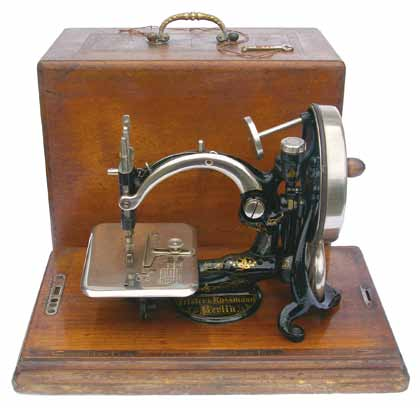
Right: Frister and Rossman’s cloned version
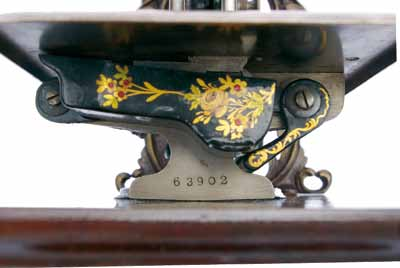
The serial No. 63902 dates this early machine to around 1864, which is the patent date on the stitchplate
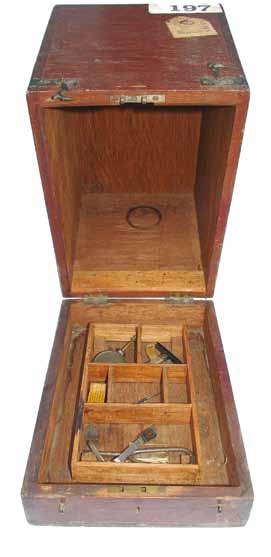
The heavy, early box with hollow mahogany base and accessory tray
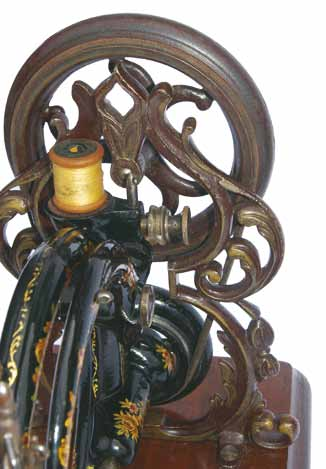
The less common early, very ornate gantry
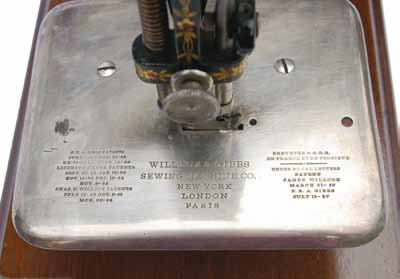
The serial No. 63902 dates this early machine to around 1864, which is the patent date on the stitchplate