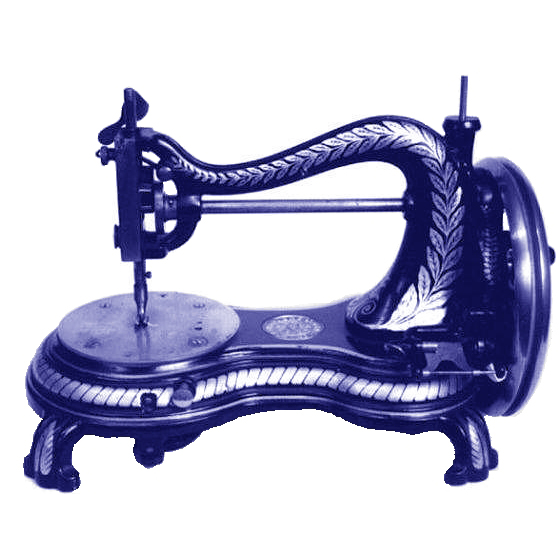
The New York Favorite Sewing Machine
ISMACS News Number 153 Cover Image
Secret Singer Sewing Machines
Part 1
Why would I. M. Singer & Co. and the Singer Manufacturing Company manufacture a ma- chine that did not have their name on it and was not sold as a Singer sewing machine? Besides the obvious answer, that there must have been some financial gain, there are two main reasons. First, because the machine was being manufactured for someone else, or second, because Singer didn’t want the public to know of their involvement, so they could sell a machine that couldn’t tarnish their reputation.
Machines Manufactured by Singer for Other Companies
The Boudoir Sewing Machine
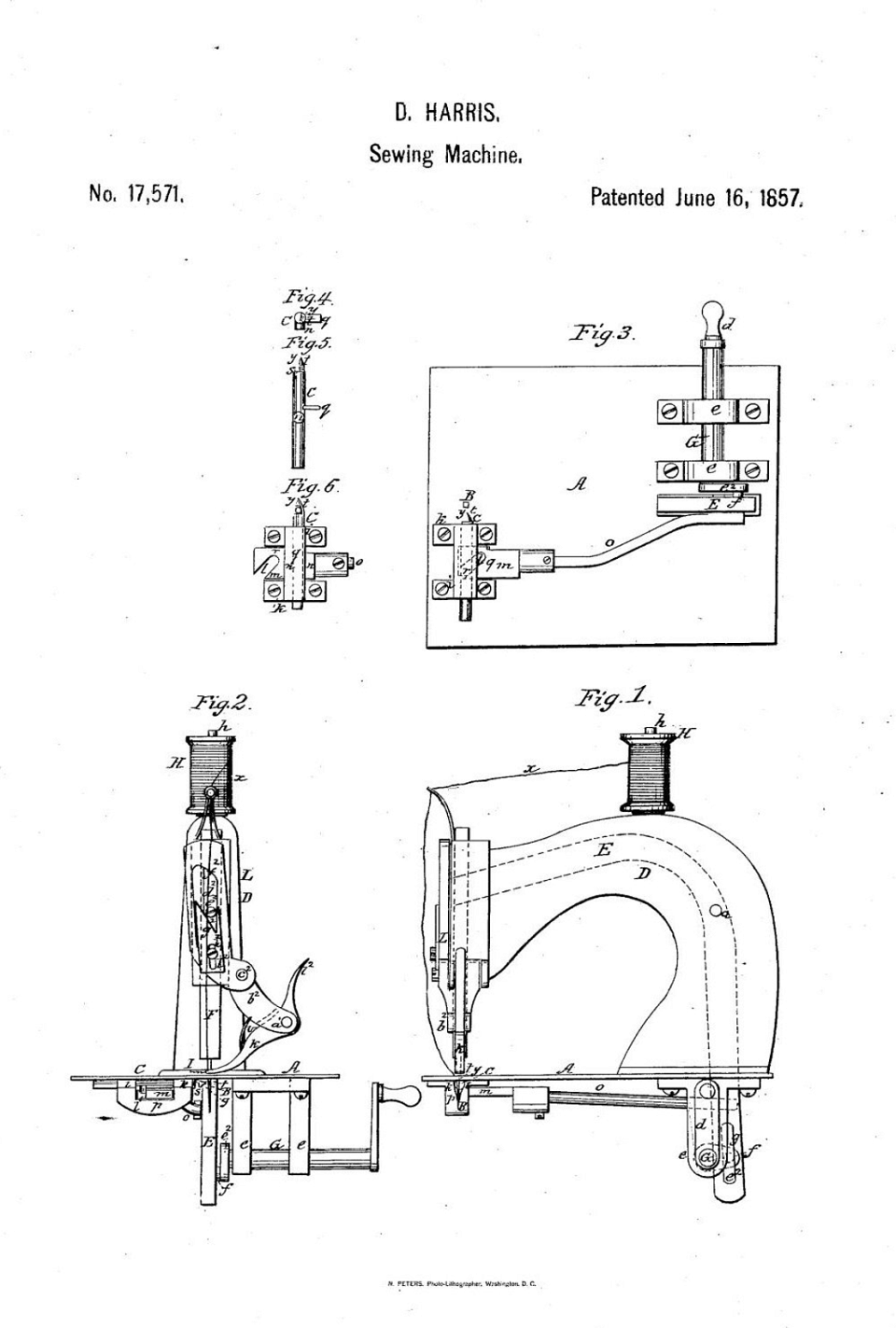
Figure 1:
Daniel Harris's patent 17,571
Just six years after the establishment of I. M. Singer & Co., the company began manufacturing the Boudoir sewing machine for L. A. Bigalow under Daniel Harris’s patents.1 Bigalow was one of the witnesses to Harris’s three patents for this machine, which are patents 17,508 and 17,571 (patent 17,571 appearing in Figure 1),2 both dated June 9, 1857, and patent 19,141, dated January 19, 1858.
The Boudoir machine was initially a single thread chain stitch machine, which was, according to Grace Rogers Cooper, author of The Sewing Machine: Its Invention and Development,3 “manufactured primarily by Bennett in Chicago in 1859, it also may have been produced in the East.”
Between November 1857 and July 1858, twenty-four Boudoir sewing machines were manufactured at the Singer factory in New York City, so Cooper was correct. According to an advertisement in The New Englander and Yale Review, 1860,4 the machine had been before the public for three years, and several thousand had been sold. That indicates the first machines were made in 1857, so Singer was possibly the first manufacturer of the Boudoir. This is despite an advertisement in the St. Johnsbury, Vermont Caledonian, 5 dated November 14, 1857, just three days after Singer shipped their first machine to the Albany office, which stated “It has never been advertised, but several hundred have already been sold.” This claim is definitely suspect. The advertisement also let the public know it was the only chain stitch machine protected by licenses.
A later advertisement in the Clearfield Republican, 6 September 4, 1861, states the machine was then being manufactured by Charles W. Howland of Wilmington, Delaware. The image shown (Figure 2)7 of a machine in a fancy cabinet is a later 1863 advertisement, as amusingly, the early ads show only a closed cabinet, not the machine.
During the time frame in which just twenty- four Boudoir machines were shipped, over five hundred Singer family machines and many more industrial machines were manufactured and sold by I. M. Singer & Co., so it’s no surprise the relationship didn’t last longer.
Table 1 shows the Boudoir sewing machines Singer shipped. Francis Gould purchased two on March 30, 1858 for $30 each, and advertised in Emerson’s Magazine and Putnam’s Monthly8 in May that he was an agent and was selling them for $40.
It is possible one of the machines made by I. M. Singer & Co. was the Boudoir sewing machine that Newton Wilson demonstrated in England in the Fall of 1858.9
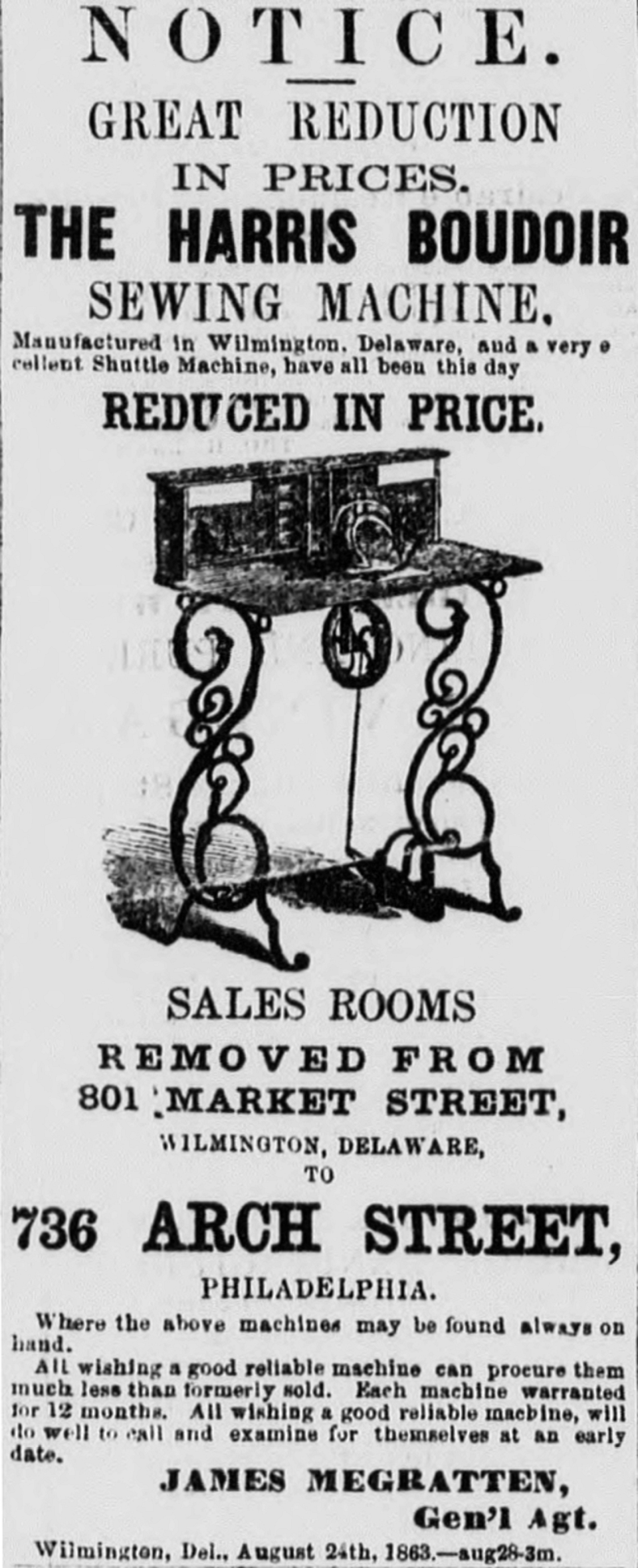
Figure 2:
Newspaper advertisement from The Delaware State Journal & Statesman,7 January 8, 1864
| Date | Sold To | Location | Model | Price |
|---|---|---|---|---|
| 10-Nov-1857 | Albany Office | Boudoir machine | $40.00 | |
| 18-Nov-1857 | Laage & Barnum | Boudoir machine + cover | $35.50 | |
| 23-Nov-1857 | M. Knight | Boudoir machine | $30.00 | |
| 24-Nov-1857 | New Haven Office | Boudoir machine | $40.00 | |
| 04-Dec-1857 | [Unknown Office] | Boudoir machine | $40.00 | |
| 05-Dec-1857 | R. B. Norvell | Huntsville, Ala. | Boudoir machine | $30.00 |
| 10-Dec-1857 | Laage & Barnum | Quincy, Ill. | Boudoir machine | $30.00 |
| 17-Dec-1857 | R. B. Norvell | Boudoir machine + cover | $35.00 | |
| 11-Jan-1858 | Boudoir machine + box | $31.00 | ||
| 11-Jan-1858 | Smith & Whaley | Boudoir machine + cover + box | $36.50 | |
| 13-Jan-1858 | New Haven Office | Boudoir machine | $40.00 | |
| 04-Feb-1858 | L. Mulkey | G. W. Dasher, Macon, Ga. | Boudoir machine + box | $31.00 |
| 04-Mar-1858 | Boudoir machine | $31.00 | ||
| 04-Mar-1858 | Boudoir machine | $31.00 | ||
| 05-Mar-1858 | P. P. Lewis | Tallahassee | Boudoir machine + cover + box | $35.00 |
| 05-Mar-1858 | L. Mulkey | Fort Valley | Boudoir machine + box | $31.00 |
| 30-Mar-1858 | Francis Gould | Boudoir machine | $30.00 | |
| 30-Mar-1858 | Francis Gould | Boudoir machine | $30.00 | |
| 21-Apr-1858 | P. P. Lewis | Boudoir machine + box | $30.00 | |
| 21-Apr-1858 | P. P. Lewis | Boudoir machine + box | $35.00 | |
| 15-May-1858 | L. Mulkey | Boudoir machine | $36.00 | |
| 17-May-1858 | returned | Boudoir machine | ($20.00) | |
| 28-May-1858 | L. Mulkey | Boudoir machine + box | $30.00 | |
| 28-May-1858 | J. H. Watson | Boudoir machine + cover + box | $35.00 | |
| 15-Jul-1858 | P. P. Lewis | Boudoir machine + cover | $35.00 |
The Domestic Sewing Machine
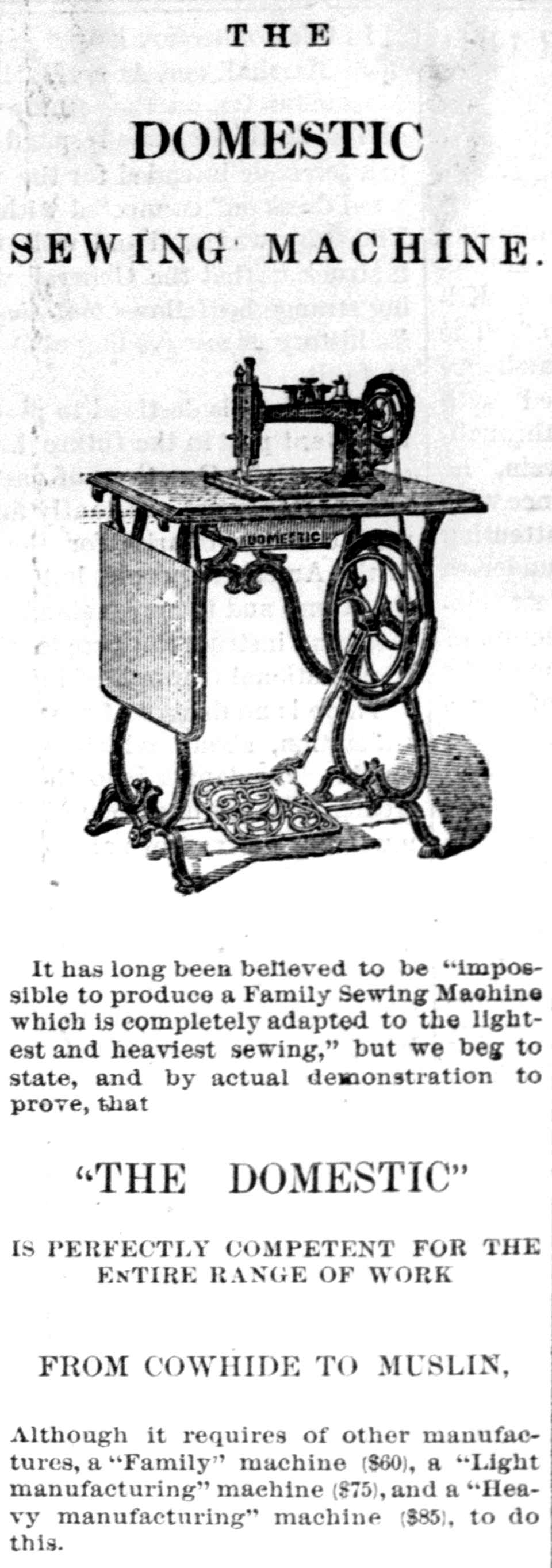
Figure 3:
Newspaper advertisement from the Rutland Weekly Herald, April 4, 187210
At a board meeting on Dec. 26, 1868, Inslee Hopper, President of the Singer Manufacturing Company, reported:
"The company has assumed the manufacture of the Domestic Machine at Norwalk, Ohio at a profit of ten dollars a machine without any risk to the company."1
The Domestic machine had originally been produced by William Mack under a patent he obtained in 1861 for a vibrating shuttle machine.
In January 1871, the company was incorporated as the Domestic Sewing Machine Co., and at roughly the same time, the initial agreement with Singer expired. A second contract was signed, and as a cost-saving measure, the manufacturing was moved to the Providence Tool Co. of Providence, Rhode Island. Singer paid Providence Tool eleven dollars for each machine head with attachment set and billed them to Domestic at fourteen dollars.
In 1873, Orlando Potter of the Grover & Baker Sewing Machine Co. entered into an agreement with William Mack of the Domestic Sewing Machine Co., but a financial panic towards the end of the year caused a drop in sales of sewing machines in the US, and the Domestic SMC struggled to stay in business. Their salesmen were no longer able to offer their "easy terms"1 system of instalment sales; instead, they were instructed not to make sales unless they could get at least one-half the retail price in cash. According to one Singer Manufacturing Co. executive, "They have sold heretofore for anything down, balance at convenience of purchaser”1
The agreement between Potter & Mack fell through, and the officers of the Singer Mfg. Co. debated whether or not they wanted to continue making the Domestic machine. They finally decided that they would agree to its manufacture as long as their business did not incur any expenses or responsibility, and they further agreed that the Domestic Sewing Machine Co. could have a year to pay their royalties.
Singer’s officers were continually unhappy with the quality of machines produced by the Providence Tool Co.,11 and terminated the contract as of January 1, 1874. The tools and machinery were purchased from Providence Tool, and production was moved to the Domestic Sewing Machine Company’s newly established factory in Newark, NJ The manufacturing portion of the business was then done under the name of the Domestic Manufacturing Company. Factories aren’t built overnight. Singer’s own factory in Elizabethport took two and a half years from the time the land was purchased until all divisions were moved to the new buildings, so the Domestic move had been planned for some time.
By 1875, the relationship between the Singer and Domestic companies appears to have dissolved, and the Grover & Baker and Domestic sewing machine manufacturers finally combined their companies.
Over the six years that the Singer Mfg. Co. manufactured the Domestic sewing machine, Singer made $420,111.38 in profits.12
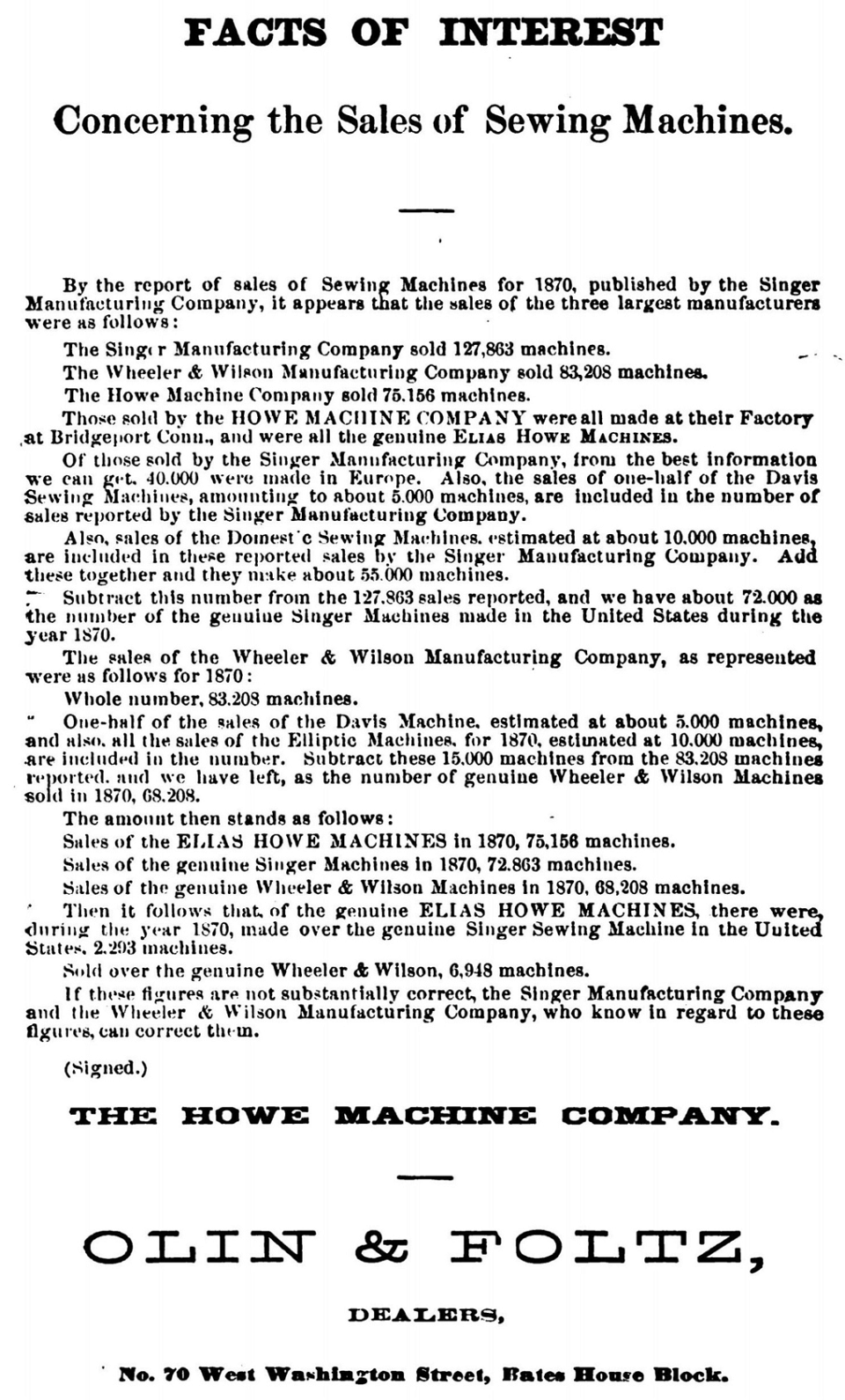
Figure 4:
Advertisement from Ladies Own Magazine, 187213
The Davis Sewing Machine
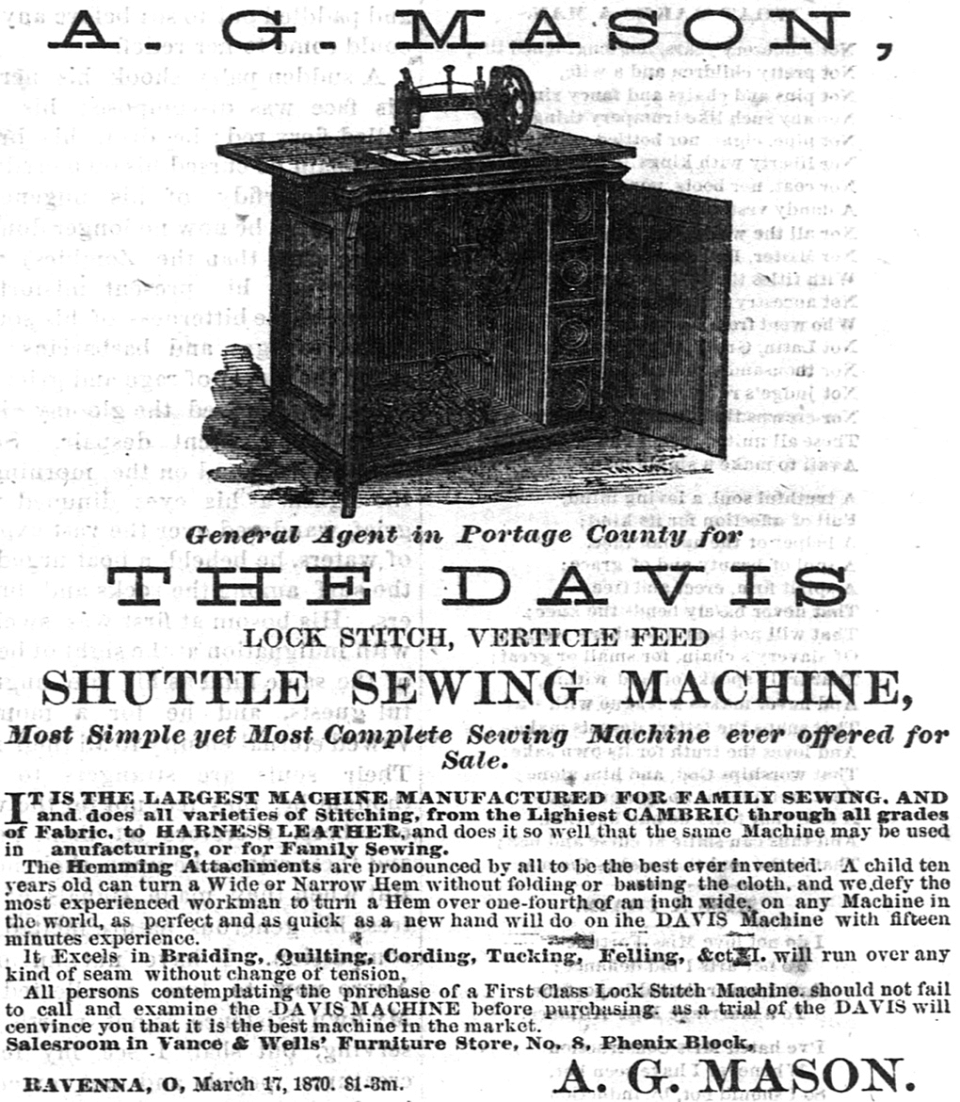
Figure 5:
Newspaper advertisement from the Democratic Press, Ravenna, Ohio, March 17, 187014
In 1869, soon after they took control of the manufacture of the Domestic sewing machine, Singer, along with the Wheeler & Wilson Manufacturing Company, also took over the manufacture of the Davis sewing machine. Orlando B. Potter, president of the Grover & Baker SMC, had entered into an agreement with the young Davis Sewing Machine Company, based in Watertown, NY, to produce their machines, after a flood in April had destroyed the Davis company’s buildings. Other firms had been employed to make their castings and woodwork. When Potter was unable to fulfil the contract, Singer and Wheeler & Wilson stepped in.
The Singer and W&W companies agreed to build 30,000 Davis sewing machines over two years, but the relationship lasted about five years. Hopper, the president of the Singer Mfg. Co., reminded Potter in 1873:
"The Davis machines pay no royalties, and it remains to be seen whether the W&W Co. and this Co. will not lose many thousands in doing what they generously relieved you from (on account of your ill health) for the ‘joint good’ of all the companies."1
To add insult to injury, Potter asked that the Davis machines be included in the yearly totals of those made by Singer and Wheeler & Wilson, which would mean Potter would not be paying the litigation expenses on these machines, licensed under the extended Bachelder patent. President Hopper’s response was:
“At present this Company are paying nearly one half of the litigation expenses while they are receiving only one third of the direct income from the Patents. They have however not complained preferring to let the relation with the other companies remain undisturbed but if the questions raised by you are to be insisted on, it might be well to have a general stirring up.”1
The Howe Machine Company advertised in Ladies Own Magazine (Figure 4)13 that Singer’s yearly totals were greatly inflated by the fact that Davis, Domestic, and Singer’s international sales were included, and Wheeler & Wilson’s totals were inflated by Davis and Elliptic machines. Howe’s math indicated they deserved top honour for the most sales in 1870.
Hopper was pleased when the contract with the Davis Sewing Machine Company finally ended. Business between the two companies had been pretty smooth, with only minor disputes over which company was responsible for the expense of machinery and gauges, but all involved were uncomfortable with the fact that it had been a forced partnership. Hopper wrote to the Singer agent at Watertown:
"We understand that the Davis Company have been hoping that we would find it to our interests to soon discontinue the manufacture of their machines and they inform us that for this reason they have not undertaken to exercise much control over the factory, but that now as the work will undoubtedly continue they will give more attention to it. What they mean by this we cannot say, but our impressions are that they desire most, to reduce expenses." 1
Due to an impending lawsuit between the Singer SMC and the Florence Sewing Machine Company regarding the allowance by the Sewing Machine Combination for a license to Davis for machines, which were in direct competition with the Florence, and a separate similar case against Grover & Baker, the Singer Manufacturing Company continued its involvement in the Davis machine. At a March 1874 board meeting of the Singer Manufacturing Co. it was recorded:
“Mr. Hopper reports that the litigation with the Florence Sewing Machine Co. has been settled, so that we can now stop the manufacture of the Davis Sewing Machine, and notice had already been given to that effect.”1
Early Singer Machines Without the Singer Name
The main reason the Singer Manufacturing Company manufactured machines that did not carry their name and were not sold through Singer agents or agencies was to allow the company to enter markets where customers prioritised cost above quality, without hurting the reputation of the Singer name.
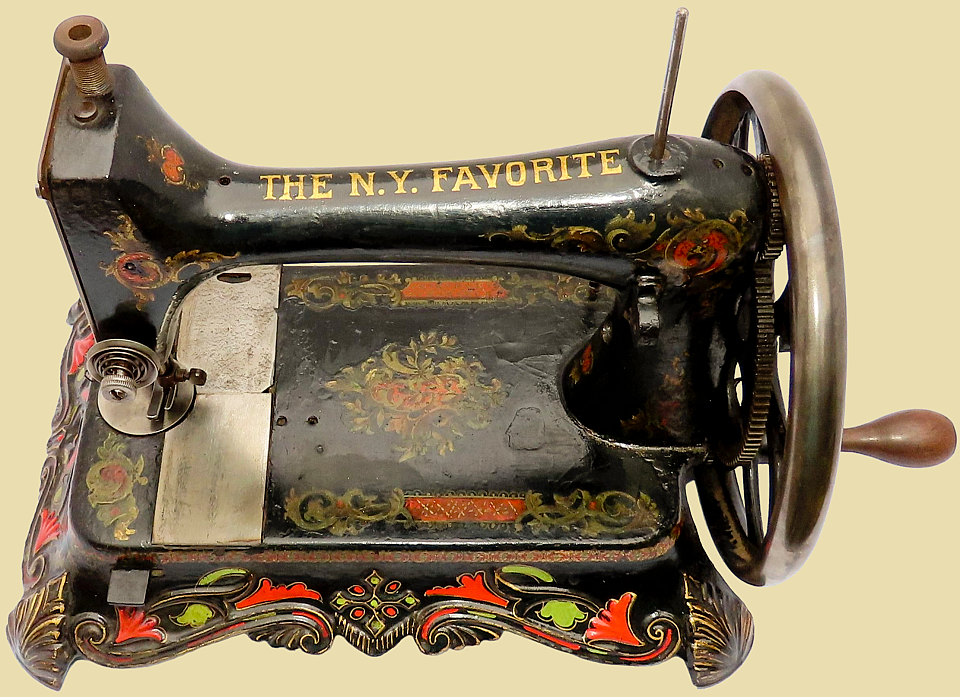
The New York Favorite Sewing Machine
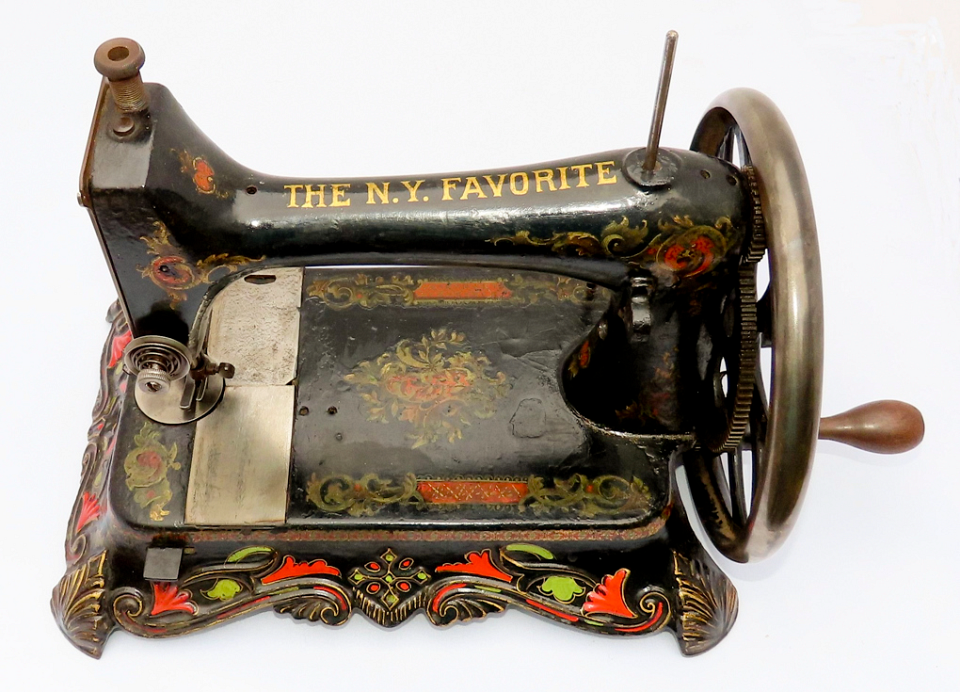
Figure 6:
The New York Favorite sewing machine. It has no serial number
Introduced in the mid to late 1880s, Singer’s New York Favorite sewing machine (Figure 6) was developed to compete with small, inexpensive German-made, hand-driven machines. It was made exclusively for the Export Agency. At first, it was mainly to be sold in Latin American countries. Because they were not labeled as Singer machines, the usual sales and territory restrictions did not apply, and when the Hawaiian Hardware Co., Ltd. asked for 250 New York Favorite machines, the machines were promptly shipped. Upon receipt of the machines, they advertised:
“The New York Favorite is a machine built by the original Singer Manufacturing Co., at their extensive works in New Jersey and upon identical lines as the improved Singer. We import them from the factory in car loads . . .”15
One has to wonder if the Singer Manufacturing Company executives approved this ad.
The only US dealer that was told of these machines was W. B. Fry in San Francisco, as he acted as an intermediary between Singer and the company in Hawaii. When one of his agents complained of unfair competition, as he often sold Singer machines in the Hawaiian territory, he was told to explain to customers it “was in no sense a Singer machine”.1 Singer did allow that agent a small quantity of the New York Favorite machines, to be sold only in Hawaii, to meet this competition.
Machines were soon sent from Elizabethport to the United Kingdom to be distributed to European countries. An 1886 factory price sheet sent to a foreign agent shows his cost for a New York Favorite head on an iron base to be about half the cost of a plain New Family head on a wood base. A portable case was optional. Internal documents refer to this machine both as ‘New York Favorite’ and ‘N.Y. Favorite’, but no number designation.
The original hinged bed plate on the machine was changed in 1888 to a one-piece design, with the head integral to the bed. One of these, carefully selected to be a very good example, was shipped to Singer’s Clydebank factory in September 1888 to be used as a model for a pattern to make the N.Y. Favorite sewing machines at that location. Alexander Anderson, manager at the Clydebank factory, had suggestions for improvement,1 and so did George Neidlinger, the company’s manager in Germany, who had sold some of the earlier version of the machine.
Suggestions for changes to the machine included:
- Making the machine look heavier and more attractive
- Making the presser foot broad enough to cover the feed dogs
- Having a better fitting shuttle, a heavier presser bar spring with screw adjustment on top of the arm similar to the V.S. No.2
- Marking the gear wheels for easy reassembly
- An improvement to the needle clamp, including allowance to admit the use of regular sizes of I.F. and V.S. No.2 needles
Since so few of these machines have been found, it is unknown how many of these suggestions were implemented. The machine shown in Figure 6 (which is missing the bobbin winder and shuttle) does have the screw adjustment on the top of the presser bar, so it is assumed this is one of these later machines.
Although communications between New York and Clydebank suggested the machine was to be produced in Clydebank, it is unknown if this actually occurred.
The general managers of the Singer Manufacturing Company were enthusiastic about the initial orders for the New York Favorite sewing machine, and felt it answered demands in certain countries for a machine of this type, but by 1895, it had been discontinued, and no more were in stock at Elizabethport.
One machine has been found that appears to be identical to the machine shown, except it has the name ‘Singer’ on the arm instead of ‘N. Y. Favorite’.16
The Meteor Sewing Machine
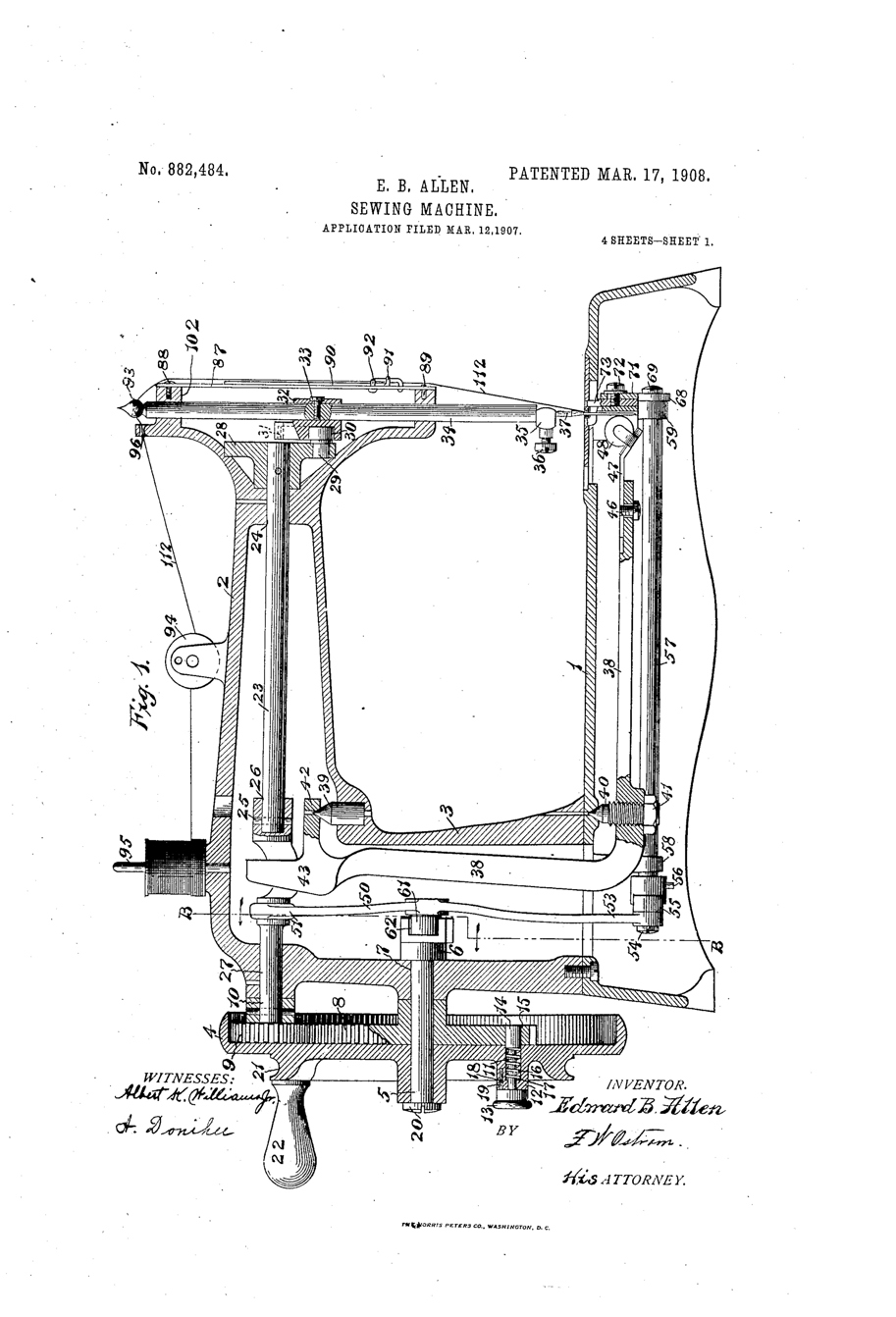
Figure 7:
Patent No. 882,48418 for the Meteor sewing machine
In September 1906, the lawyers of the Singer Manufacturing Company were asked to research trademarks for names being considered for a vibrating shuttle hand sewing machine in development. It was intended to compete with both American and German manufacturers of cheap machines:
“to secure a character of business that we felt could not be obtained by us in any other way and which could be gotten without injury to the sale of Singer machines.”1
This machine would not be sold as a Singer- branded sewing machine, and not sold through Singer dealers. The reply they received was that ‘Star’ was substantially anticipated by the Domestic Sewing Machine Co., and the ‘Victor’ was too close to the ‘Victory’ registered by the Davis Sewing Machine Co., but ‘Comet’, ‘Meteor’ and ‘Arrow’ all appeared to be entirely new. It was decided to immediately register ‘Comet’ and ‘Meteor’ as trademarks for sewing machines, parts, and attachments. The company’s lawyer advised that it would be necessary for the marks they sought to be registered to have been in actual use, so they applied both of these names to sewing machines. Only a few machines were produced with the name ‘Comet’, to appease the patent office, while ‘Meteor’ was the one chosen to be applied to the machines sold to the public. It is possible these names were considered because of the upcoming return of Halley’s comet in 1910.
One machine with the Comet name and three with the Meteor name were part of the collection the West Dumbartonshire Libraries and Museum inherited when the Clydebank factory closed in 1980.17
Trademark applications were submitted on October 27, 1906. After an initial rejection, with amendments they were approved on February 12, 1907. “Comet” was US registration number 60,580, and “Meteor” was 60,581. In November 1905, Singer had acquired control of Wheeler & Wilson by paying $68.75 per share for the entire capital stock. These registrations were taken out in the name of the Wheeler & Wilson Mfg. Co. in the United States, but later registrations, such as in Australia, dated November 1, 1907, were in the name of the Singer Manufacturing Company.
At least two versions of the machine were made. Similar to the New York Favorite machine, one version had the machine hinged to a wood base, and the other had a simplified paw foot design with the head integral to the cast iron base.
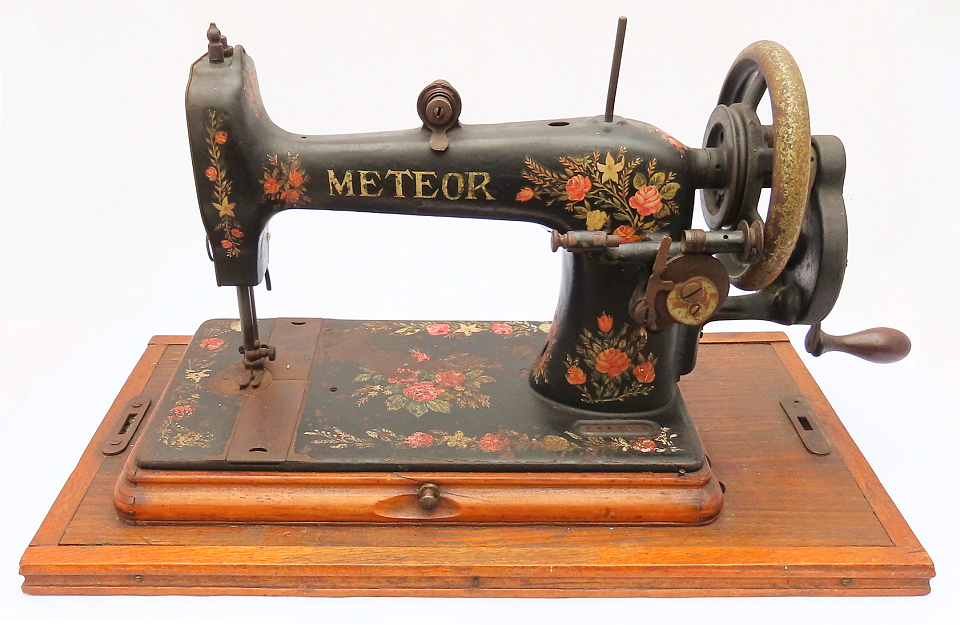
Figure 8:
Meteor sewing machine, serial F44612
The Meteor machines were manufactured at the W&W factory in Bridgeport, Connecticut, with the intention that they would be sold through the W&W export agencies, since at the time, Singer expected the Wheeler & Wilson Manufacturing Company to continue its existence. But by the time the trademarks were approved, Samuel H. Wheeler, the president of Wheeler & Wilson, and son of founder Nathaniel Wheeler, had decided to retire, and Singer was working on a deal to purchase all the assets and dissolve the company. This meant the Wheeler & Wilson export agency would be discontinued and that W&W-manufactured machines would be sold as Singer machines through Singer agencies. So having lost their distributing avenues for the Meteor machine, the company struggled with what to do. They still believed there was a market for a machine of this type, but sales had been disappointing. Did they need to give it more time? Did the machine lack mechanical qualifications? Was it priced too high?
It's unknown exactly what decisions they made, but by 1912, the machine was discontinued. The total production of the Meteor sewing machine at the Bridgeport factory between 1906 and 1912 was 26,339 machines.
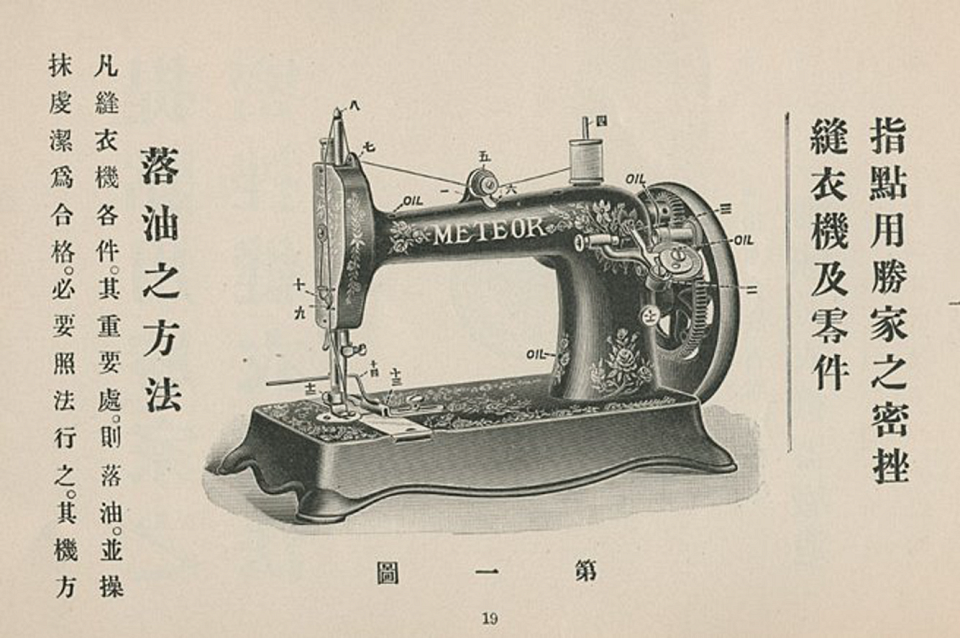
Figure 9:
Chinese Meteor instruction manual showing the paw foot version of the machine. It is dated March 17, 1908, and has the Wheeler & Wilson logo on the back cover.19
The Hexagon Sewing Machines
Despite neither the New York Favorite nor the Meteor being very successful, Singer made yet another attempt at a non-Singer-branded sewing machine to challenge lesser-priced competitor’s machines. In 1916, sample machines were made individually in both the Elizabethport and the Clydebank Singer factories. In September, an Elizabethport example was sent to Clydebank, and one made in Clydebank was shipped to Elizabethport. Instead of collaborating, as they had on the New York Favorite, each location decided to produce machines using their own original samples, however, the UK version would have to wait, as World War I was interfering with their production of machines. The US-made machine had a distinct hexagonal arm and hexagonal pillar that, although based on the model 28 machine, could not be mistaken for a Singer machine. The commonly replaced parts were intentionally not interchangeable with the 28.
It was decided to call the machine the ‘Hexagon’ in reference to the arm shape. Laurence Otho Harnecker, the Singer company’s director in charge of Latin America, wrote,
“I consider the word ‘Hexagon’ a most happy choice, . . . one that would probably attract more attention than any other that could be chosen—if only for the reason that it is so entirely different from other names used in the sewing machine trade.”1
Previous attempts to compete with lesser- priced machines concentrated on hand-crank portable machines. It was estimated that 75% of the South American trade would be from sales of this kind, but an entire range with stands and woodwork was planned. The company intended to eventually introduce additional machines based on Singer’s 27, 15, and 16 model machines.
In November 1916, the Hexagon Sewing Machine Company of 85 Liberty Street, New York City, NY, was formed to oversee the marketing of the machine in Central and South America. As far as the public was concerned, it would be an entirely independent organisation. The Singer Manufacturing Company’s separate selling organisation, the Singer Sewing Machine Company, had central offices throughout Latin America. The plan was to eventually have a man in each Singer SMC office, but working for the Hexagon Sewing Machine Company, who could act as a wholesale salesman of Hexagon machines, selling strictly to dealers. The officers of the Hexagon Sewing Machine Company were Douglas Alexander and Franklin A. Park, who just happened to be the President and the Vice President of the Singer Manufacturing Company.
In the past, German-made machines had been the biggest competition in Latin America, but American-made machines were the current competitors because of the lack of exports from Germany since the start of World War I. It was estimated the average annual importation of sewing machines into Brazil, not including Singer machines, was 30,000 machines. An optimistic letter to the agent in Brazil stated:
“The Hexagon Company will be prepared to sell its product at such prices and on such terms as will put them in a position to get practically the whole of this trade.”1 To prevent inevitable shipment delays from New York affecting business, Singer intended to maintain a very large stock in South American ports.
Hexagon No.1
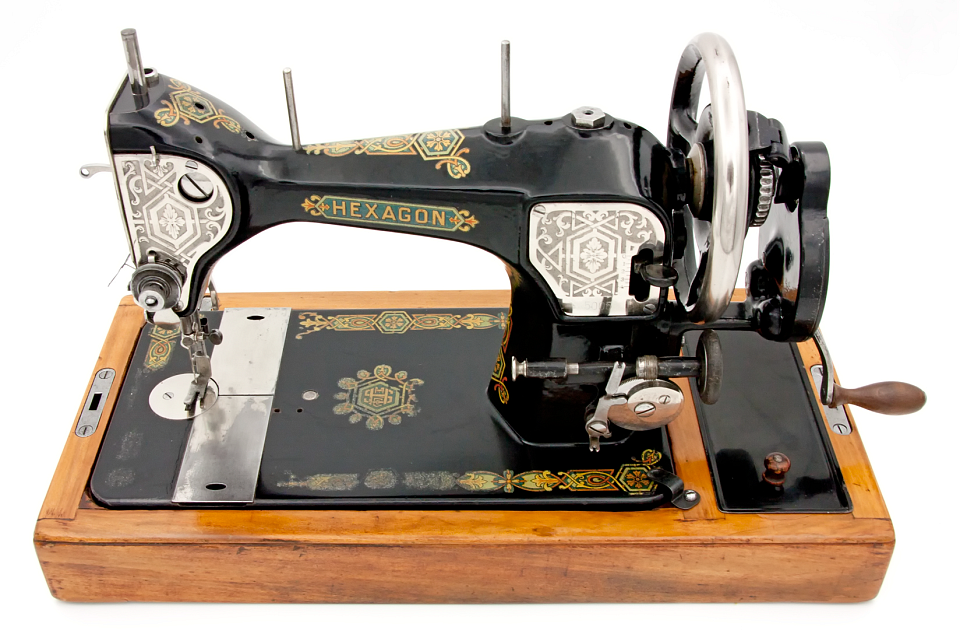
Figure 10:
Hexagon No.1, serial 5005
The first Hexagon sewing machine, the No.1 (Figure 10), was a very simple, poorly finished, vibrating shuttle machine. Except for the nickel plating, it offered no concession to luxury. The bobbin winder and crank assembly appear to be the same as that used on Singer’s earlier Meteor sewing machine.
The first two thousand machines were shipped to South America in January 1917. Elizabethport also shipped five hundred machines to Spain despite the high freight cost, but there were no plans to ship machines to other European countries from the US; this would have to wait until Clydebank could begin production.
Included with each machine were six needles, a screwdriver, five shuttle bobbins, a foot hemmer for a 5/64" seam, a filled oiler, a lock key, a cloth guide and thumb screw, and an instruction book.
By June 1918, the war was having major consequences on the company’s production. Singer’s Russian factory had been converted to making munitions a few months earlier, and manufacturing at Clydebank was greatly restricted. This put a great burden on the Elizabethport factory, and expecting the government to make demands on them for war work they deemed it:
“. . . unwise to run the risk of crippling the output of our regular product by any great extension of our cheap machine program.” 1 Singer’s manager in Paris had been looking forward to introducing the Hexagon but wrote: “At the present time nothing can be done, as all men have joined the army and we have no employees left.”1
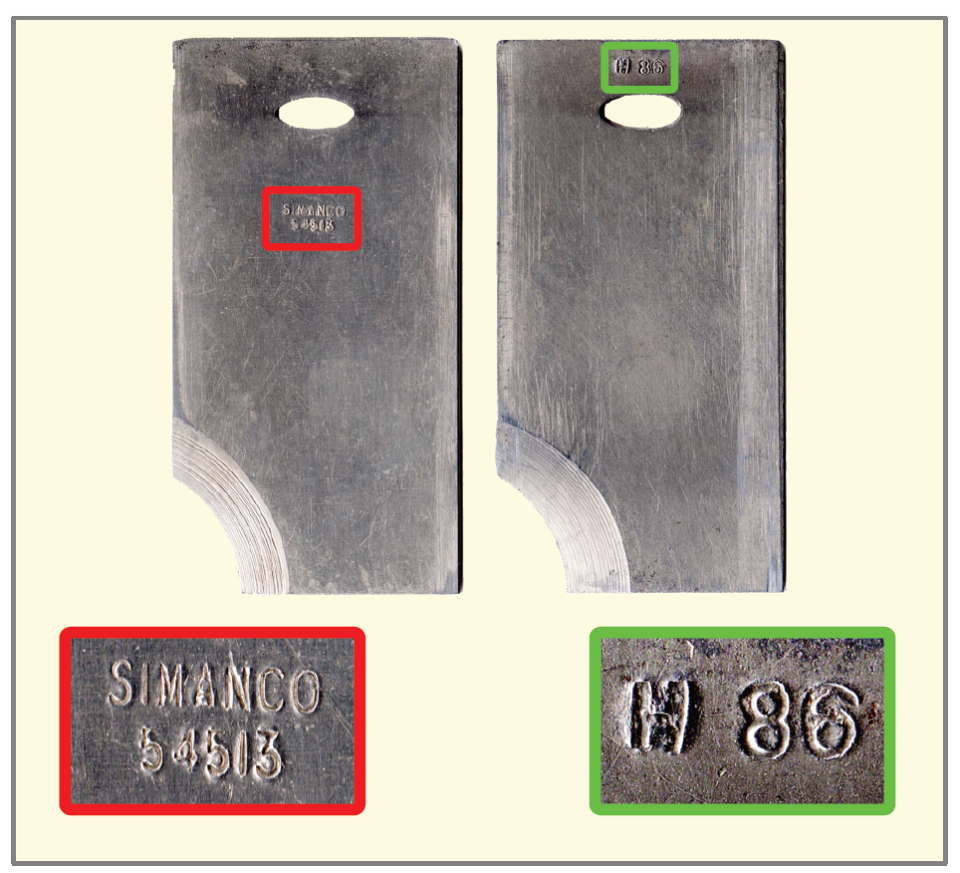
Figure 11:
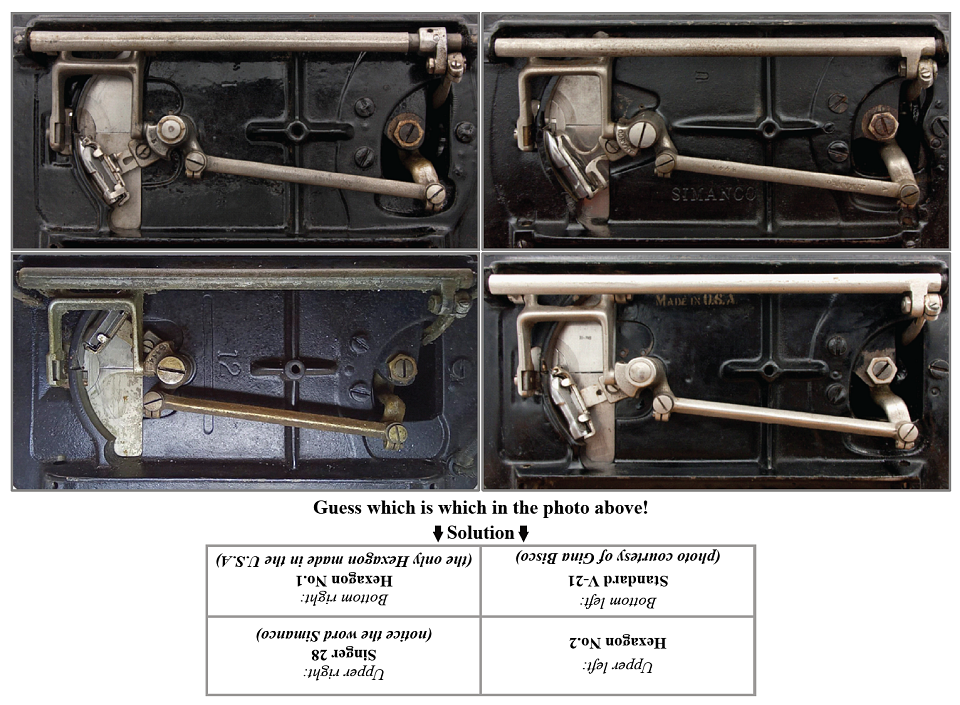
The slide plate part number on a Singer 28 (left) and on a Hexagon No.1 (right)
There are indications that various locations of the Hexagon Sewing Machine Company in Latin America were still in business in November 1918, after the end of the First World War, but they were most likely selling old stock, as the Hexagon Sewing Machine Company was no longer listed as a subsidiary of the US-based Singer Manufacturing Company when they filed their taxes for the year 1919.1
Singer tried to hide the Hexagon machine’s origin; thus, none of the Hexagon No.1 parts have Singer/Simanco numbers, Instead, they have their own numbering system stamped, such as H*** (Figure 11)
Few surviving Hexagon No.1 machines have been found. Serial numbers range from 142 to 204283, but it is doubtful that over 200,000 of this model were produced. It was in production for only two years or less, and one hundred thousand machines per year for a new machine from an unknown company seems excessive. If that many machines had been sold, the Singer Manufacturing Company would likely have reintroduced the Hexagon sewing machine in Latin America after the war, or never would have stopped production to begin with. The actual figure is most likely just a few thousand sold.
The decals on this machine were extremely thick, so much so, that the protective gloss coat didn’t adequately protect them and all surviving examples found thus far are extremely worn. If you find one in good condition, don't hesitate to buy it; this is a very uncommon machine!
Hexagon No. 2
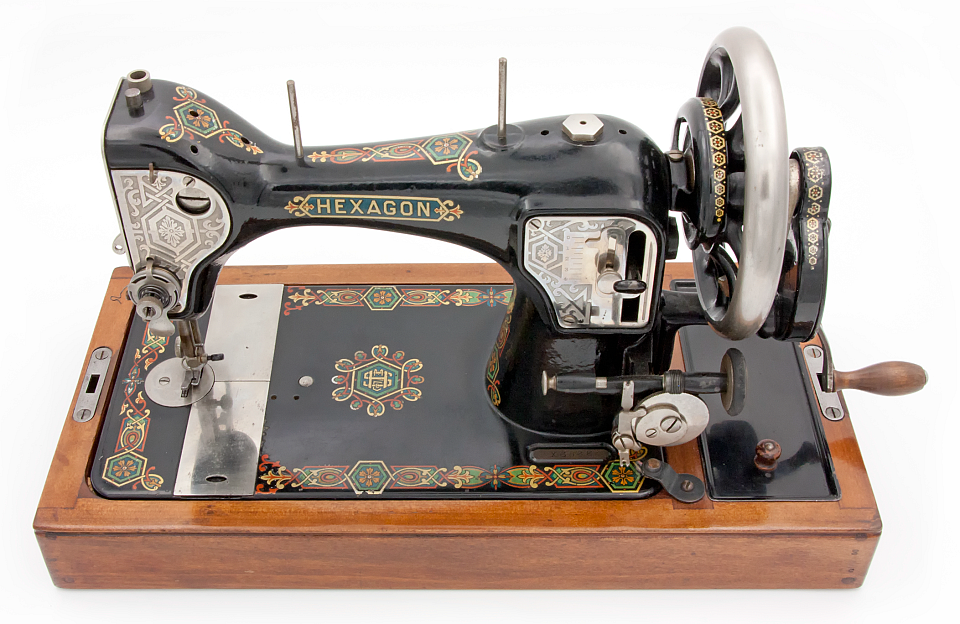
Figure 12:
Hexagon No.2, serial X6568
Finally, on May 16, 1919, with the war behind them, the Hexagon Sewing Machine Co., Ltd., 69 Fleet Street, London, was formed. George Henry Emmerson, J. Laird Busk, and James Everett, men of high ranking in Singer’s UK organisation, were named directors. By July, the new Hexagon machine, the No.2, was available for sale in England on a wholesale basis.
The No.2 Hexagon sewing machines (Figure 12) made at Singer’s factory in Scotland were not the hexagonal arm machines previously made in America, but they weren’t the same as the machine designed in 1916 at the Clydebank factory either. The new machine was basically a model 28 machine, with a handful of new parts, including a distinctive stitch length regulator plate that resembled, but was larger than, the one on the American-made Hexagon No.1. For many years, the German-made machines that the Hexagon was designed to compete with were believed to be inferior and of low-class appearance, but the high quality of recent machines meant the Hexagon needed to be at least equal in looks and quality to the German machines. Differences between Hexagon No.1 and No.2 models are detailed in the comparison chart (Figure 13).
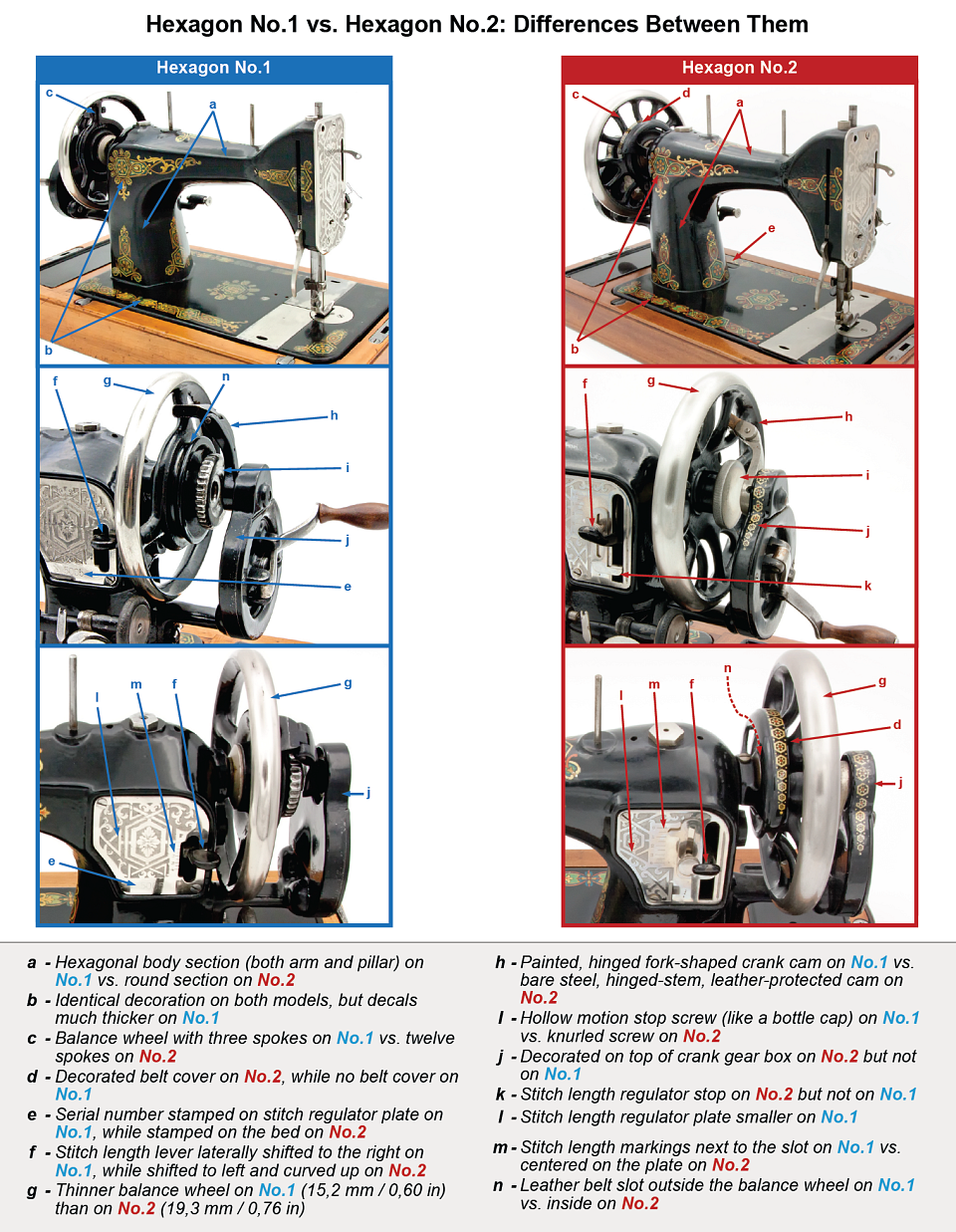
Figure 13:
Comparison chart of Hexagon No.1 to Hexagon No.2
Busk believed the bulk of the UK sales would be supplied by a hand machine, and that only models similar to Singer’s 28 and 27 machines would be necessary.1
Singer’s managers assumed that after the war, their main competition for their lowest priced machines would once more be German made. It was decided the best way to pre-empt the German competitors from getting a head start was to focus on capturing their export trade.
It turned out they didn’t need to worry much about German competition in England, at least temporarily. After the war, items made in Germany were initially unpopular with the public. When German-made sewing machines did begin to appear on the market, a large (but temporary) reparation tax soon curtailed their import. Instead, an unexpected new threat appeared, the Vickers sewing machine, in part because of the company’s selling methods.
The Vickers company offered machines to retailers on consignment, and if the machines didn’t sell, Vickers would take them back. This would, according to Busk, “. . . choke the market up with their machines and prevent any other machines being sold.”1 Singer’s officers were determined to sell the Hexagon machine at any price to give them the advantage needed to dominate the market, which would hopefully result in a large number of returns to Vickers. Vickers later poached Hexagon’s manager in charge of foreign markets, making him an offer he couldn’t refuse, but this turned out to be a blessing for Singer/Hexagon, as it was soon discovered his bookkeeping was in utter chaos.
In February 1920, a contract was made with Associated Holders, Ltd. to sell Hexagon machines in France, but a year later the contract was canceled, as A. H. Ltd. reported it was practically impossible to sell the Hexagon sewing machine there due to the rapid decline of the French franc and the low prices of German made machines.
Singer and Hexagon sales steadily increased after the war due to a post-war economic boom, but a serious recession hit the UK towards the end of 1920.20 Over eleven thousand Hexagon sewing machines were shipped by the factory in 1920, but only 254 machines left the factory during 1921.21 The Singer Mfg. Co.’s shipments of machines with the name ‘Singer’ on them were roughly half what they were the year before, so they fared much better. Busk wrote in July 1921 to New York that trade in the country had been held up by a prolonged coal strike and:
“to eyes accustomed to the figures of 1919 and then looking at the figures now one almost requires a microscope.”1
With business so poor in England, in June 1921, the company tried once more to establish an outlet for their machines in France. This time, instead of using an outside firm, they employed a salesman and bookkeeper, and set them up in an office in Paris.
Dealers buying large numbers of Hexagon machines had the option to have any name affixed to the arm that they wanted, but all retailers had to sell the machines at a price agreeable to the Hexagon SMC. Harrods department store was bound by an agreement to sell their ‘Harrodia H6’ Hexagon sewing machine at no less than 6 pounds, but during sales, they priced them at £4 19s 6d, and Harrods was reminded of the paper they signed. Some of the names used on the Hexagon machines by other dealers were ‘Harris No.5’, ‘The Berkeley’, ‘The Referee’, ‘The Morton’, ‘Nelson’s 61’, and ‘Collier No.8’.
The beginning of 1922 was as difficult for the Hexagon Sewing Machine Co., Ltd. as the previous year had been. J. Laird Busk died in February, and the company went into liquidation on the first of May.22 A balance sheet, dated the end of April,1 shows the company was technically bankrupt, however, the economy quickly improved and we know that they did bounce back, at least temporarily. Over sixty- eight hundred machines were shipped in 1922.
The No.2 model was produced from 1919 to 1924. Like all Hexagon sewing machines produced at Clydebank, this model has a serial number preceded with the letter “X”.
Hexagon No.3
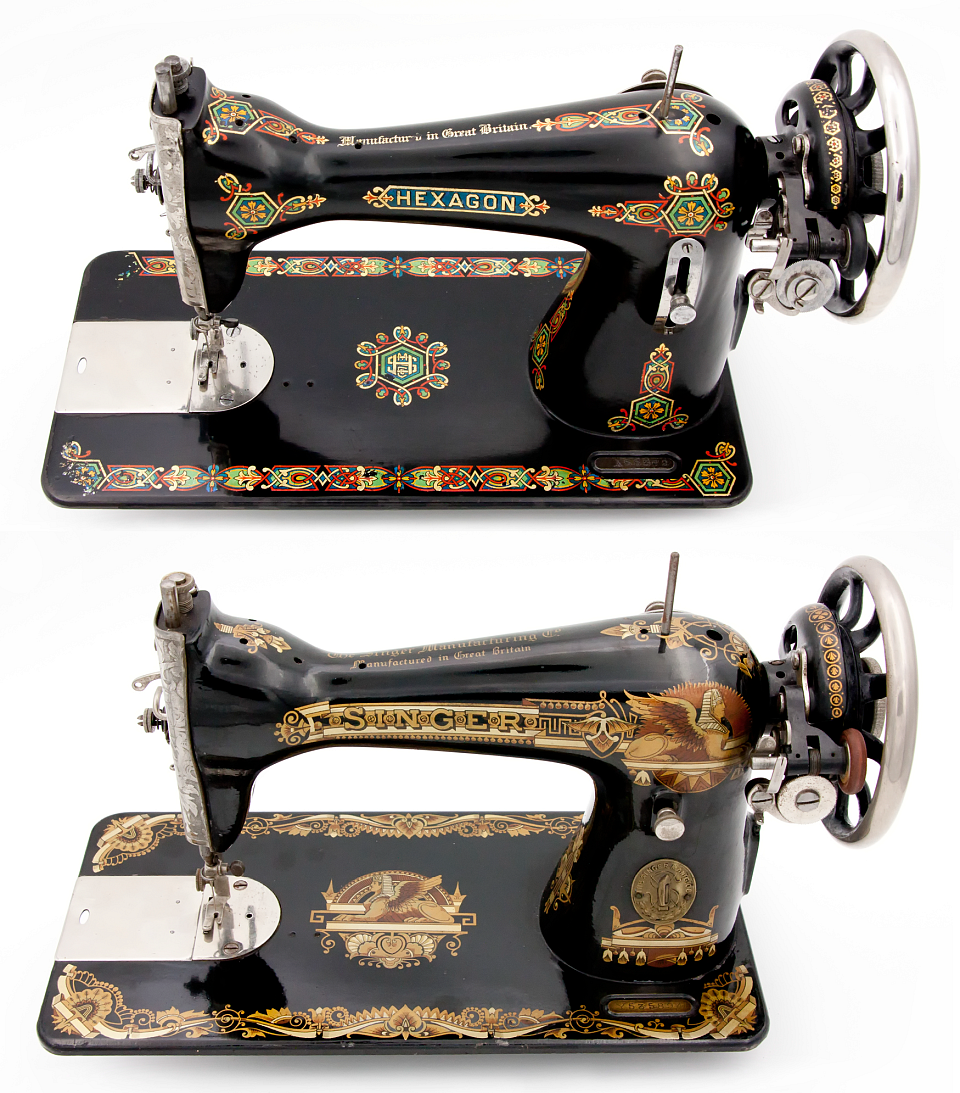
Figure 14:
Hexagon No.3, serial X55362 (top), compared to a Singer 15K26, serial Y535894 (bottom), dated 1922f
The Hexagon No.3 was manufactured in Clydebank between late 1922 and 1924. There is evidence that this machine was marketed in France, Italy, and Spain (where it was sometimes referred to as the "H.23"). It is possible that it was sold in other European countries as well.
The Hexagon No.3 is a central bobbin or oscillating hook (There is some disagreement in the sewing machine community regarding the terms "oscillating shuttle vs. “oscillating hook". The authors' original wording is used here.—Ed.) type machine, very similar to its contemporaries, Singer 15K26 and 15K30. In fact, compared side by side with a 15K26 dated 1922, they only differ in the decoration and the stitch length regulator, which is much more prominent and has a longer slot on the Hexagon machine. As a result, the arm pillar has a much larger protuberance than that of Singer’s 15K26 model (Figure 14). Even though they were sister machines, Singer tried once again to hide this Hexagon model’s origin, as was done with both previous Hexagon models; all No.3 parts have Hexagon numbering (H***). The Hexagon No.3 also has the same serial numbering as the No.2 (X*****).
Hexagon No.4
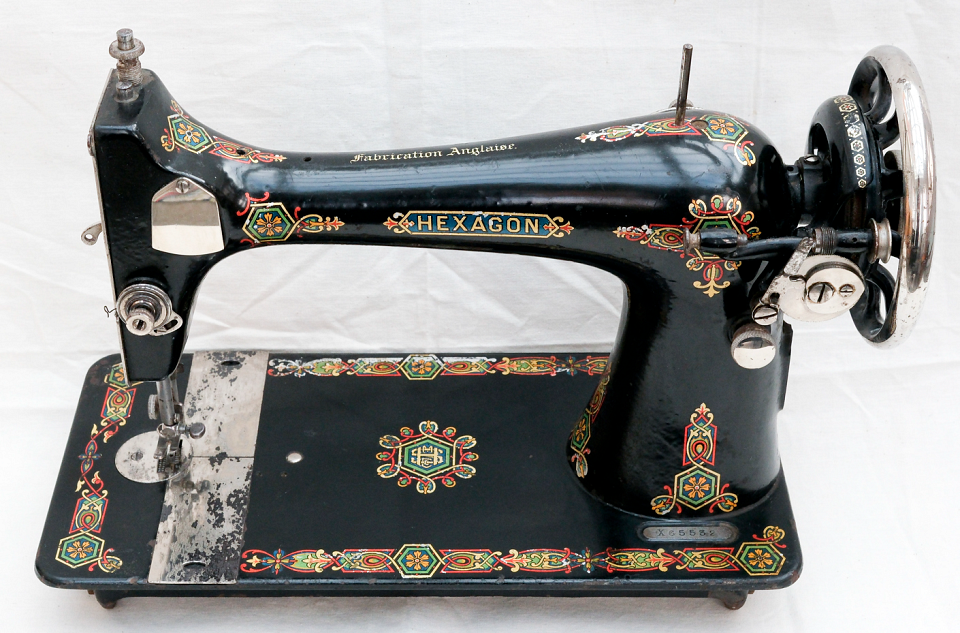
Figure 15:
Hexagon No.4, serial X66532, with permission from David Best (sewmuse.co.uk)
The Hexagon model No.4, which, is nothing more than a Singer 127 in Hexagon livery, is, without a doubt, the scarcest of all the brand's models.
Only one surviving Hexagon No.4 has been found (Figure 15). It is owned by David Best and shown on his sewmuse.co.uk website. As explained there, this particular machine was sold in France and has a “Fabrication Anglaise” decal applied on top of its arm. Unlike other Hexagon machines, this one has parts with “SIMANCO” on them, indicating they were made by the Singer Manufacturing Company to be used on Singer- branded machines.
This machine was also marketed in Italy as evidenced by the brochure shown in Figure 16. It is unknown if it was sold elsewhere.
Without locating more units of this model, it is impossible to guess how many were made, but it must have been in production a very short time, a few thousand units, or maybe only a few hundred. Indeed, the serial number of the only known machine, X66532, is between that of two identified No.3 machines (X62941 and X69151), which greatly limits the possible quantity manufactured if only one series of numbers were assigned. This also indicates that both models were manufactured simultaneously, with the No.4 machine most likely manufactured in 1923.
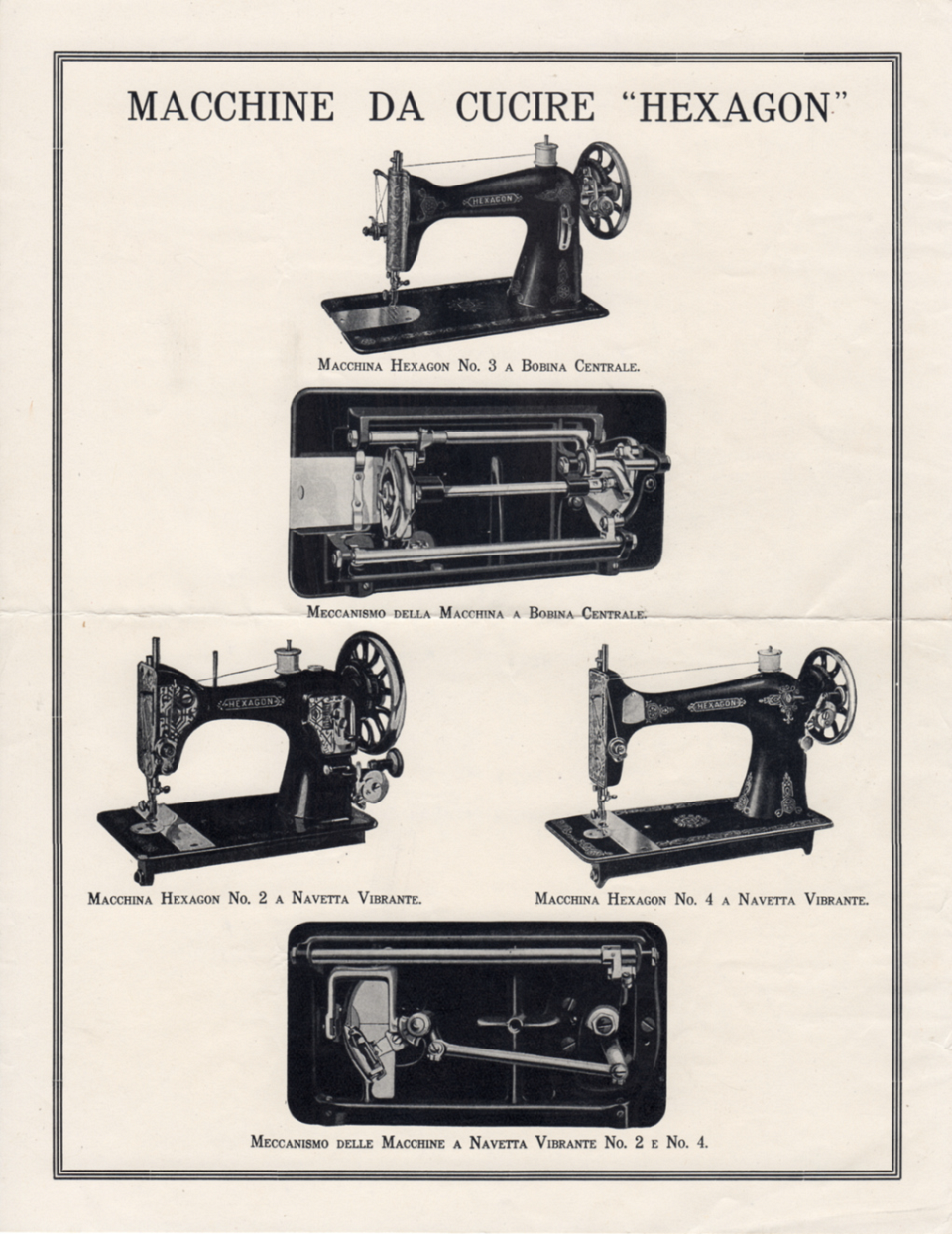
Figure 16:
Italian brochure picturing the three British versions of the Hexagon sewing machine
The End of the Hexagon Sewing Machine Co., Ltd.
On January 1, 1925, the Fleet Street office of the Hexagon Sewing Machine Co., Ltd. was transferred to a solicitor in charge of the company’s dissolution.
The name ‘Hexagon’ in connection with sewing machines had been trademarked around the globe, including in Bulgaria, Czecho- Slovakia, New Zealand, India, China, Germany, various African countries, and many, many more. In some countries, such as Poland, Japan, and Palestine, registrations had begun but hadn’t yet been granted at the time the liquidation began, which indicates the decision to close may have been a hasty one. Despite the large number of countries the name was registered in, it is unlikely it had been shipped to more than a handful.
Even though the No.2, No.3, and No.4 Hexagon sewing machines were made at Singer’s factory in Clydebank, the Hexagon Sewing Machine Co., Ltd. was legally a separate company. Hence, during liquidation, when the Singer Manufacturing Company decided to keep the trademarks active because they felt it was a unique situation with “immense potential value,”1 , papers were drawn up for the Singer Manufacturing Company to acquire the Hexagon SMC and pay them, at least on paper, an amount commensurate with the valuable rights involved. It was estimated that the cost to make the large number of worldwide transfers of trademarks from Hexagon to Singer would be £3,000.
The liquidation was lengthy due in part to that transfer of trademarks, but also because although no machines were shipped by the factory after 1924, there would have been a stock of unsold machines to dispose of, and advertisements for these machines have been found dating as late as 1926.23
The total number of Hexagon sewing machines shipped from Clydebank between 1919 and 1924 was 55,686 machines. This is in vast contrast to the over 4 million machines shipped from Clydebank during the same period with the Singer name, and was very likely the largest factor in the company’s demise.
Known serial numbers for the No.2 Hexagon range from X6568 to X33516. The serial numbers of the surviving No.3 machines found to date range from X51720 to X70376. Only one No.4 is known, and the quantity produced of this model is most likely negligible. Since we know that only 55,686 machines were shipped, we can estimate approximately 35,000 No.2 and 20,000 No.3 Hexagon machines were made. Why then the gap between serial numbers X35000 and X50000? These may be numbers assigned to the No.2 machine that were never used before the company went out of business.
In 1950, Percy W. Bullock, one of the company’s directors, wrote an unpublished manuscript for the upcoming Singer centennial in 1951, titled “Historical Notes of Singer Business in Great Britain.”24 In it, he refers to an earlier history he wrote of the Hexagon Sewing Machine Co. Ltd. It is unknown where that manuscript is today, but if found, it will surely shed additional light on this story.
The Standard Sewing Machine Company Connection
The “Hexagon 2½”
For years, there has been speculation that the Hexagon sewing machine was made by the Standard Sewing Machine Company. Although not true, there is a connection: the “Hexagon 2½”. This model never existed; it is the nickname we have given, jokingly, to models derived from the Hexagon No.2 that were launched a decade after it disappeared from Europe, but which did not bear the Hexagon name.
In 1934, the Singer Manufacturing Company acquired the Frederick Osann Company. A new company was formed, the Osann Corporation, with Frederick Osann listed as the president. Many of the employees appear to have continued working for the new corporation. By July, the Frederick Osann Company’s patents had been transferred to the Singer Manufacturing Company. As a result of this union, the Singer Mfg. Co. inherited the Standard sewing machines that the Frederick Osann Company had acquired a few years previously, with its takeover of the Standard Sewing Machine Company.
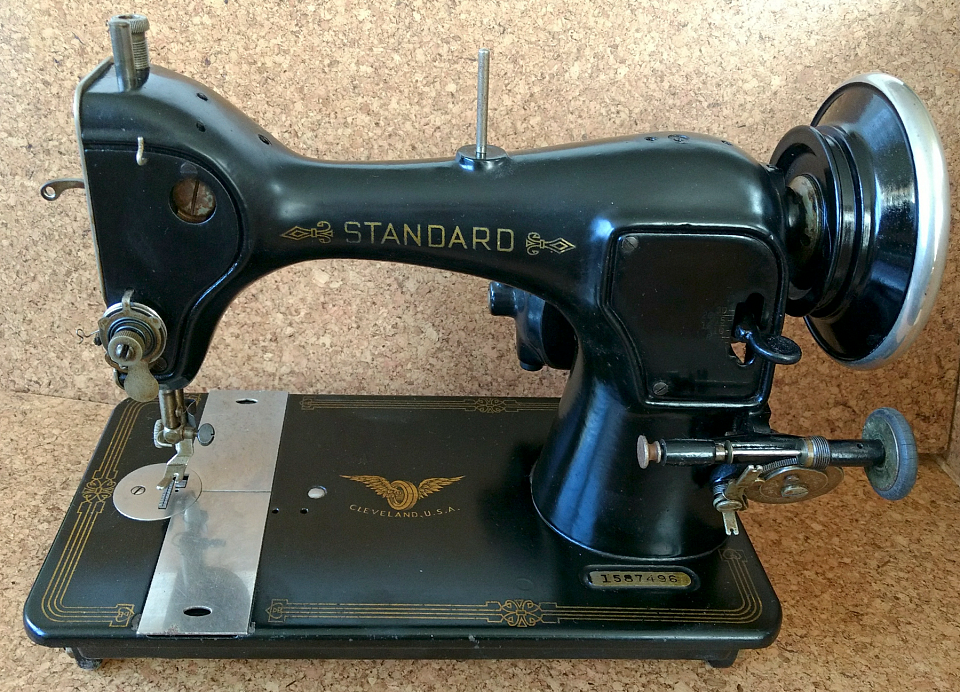
Figure 17:
Standard V-21, serial 1587496, from the collection of Gina Bisco
The Singer Manufacturing Company used this opportunity to develop five new machines to be sold by the new Osann Corporation’s Standard Sewing Machine Division. These machines were inexpensive to make, plus they would have been easy to develop, since all were based on previous machines that Frederick Osann, Standard, or Singer had manufactured. It is likely that these machines were manufactured at Singer’s factory in Elizabethport, alongside machines with the Singer name on them.
Interestingly, two of these machines used a couple of crucial parts from Singer’s much earlier Hexagon No.2; the distinctive arm and the front cover, which made this machine look new and decidedly different to the American public. But how is it possible that twelve years after production of the Hexagon No.2 ended in Scotland, the machine was revived in the United States? Were moulds shipped from Scotland? Or is it possible that the factory in New Jersey had prepared for the manufacture of the Hexagon No.2 machine for the Latin American market after WWI? Hopefully, these questions can be answered in the future.
Since the original Hexagon No.2 had been based on Singer’s model 28, the majority of other parts on these two new machines also came from the 28/128, but with mostly Osann Corp. part numbers. A few parts, such as motors and lights, came from Osann. These were hybrid machines, and as such, Singer’s patent department declared nothing was new and patentable, nor were there concerns about other patents being infringed upon.
The manual for one of these machines, the model V-21, was dated March 1935, and the machine was most likely first available for sale around that date, or shortly after. The Osann Corp. produced machines under the Standard name only until 1938, so they had a very short production run.
The model V-21 (Figure 17), had a black japanned finish, graduated stitch length markings, an Osann OSV motor, and an Osann lighting attachment. It was available as a portable machine or in a cabinet. At first glance, it is so similar to the Hexagon No.2, that with the name ‘Standard’ on the arm, it is easy to see how speculation began that the Standard Sewing Machine Co. manufactured the Hexagon sewing machine. The ‘V’ in the model number indicated this was a vibrating shuttle machine.
Only a few Standard V-21 machines are currently known. The lowest serial number is 1587496, and the last known serial on a Standard sewing machine made before Singer’s involvement, is 1581692, so it appears the Standard company’s serial numbers were continued on the Osann Corp. Standard sewing machines. Only a few thousand of the V-21 sewing machines were likely made.
The second of these machines, model V-22 was referred to in documents as the “Arrow”. It differed from the V-21 in that it had a wrinkle finish, and the graduated stitch length markings together with the Osann lighting attachment were eliminated. It was to have an Osann OSV motor, but this was changed to an OSVB, which has a wrinkle finish. To date, no V-22 model machines have been found, so it is unknown if “Arrow” may be the name on the arm of the machine, or if this machine was even produced. If it had been, it may have been the first machine for home use made by Singer with the wrinkle finish.
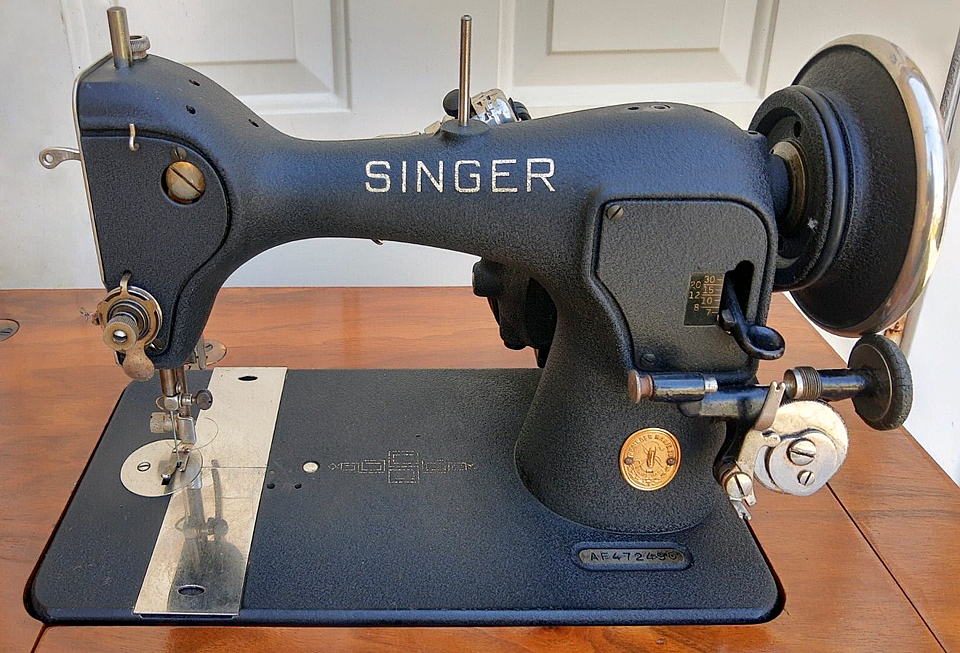
Figure 18:
Singer 128-8 serial AF472490, with permission from irmtova_93 (eBay.com)
It is quite possible, however, that this V-22 model became the basis for Singer’s model 128-8 machine (Figure 18), which Singer described as:
“Machine 128-8, regularly furnished with a BS motor and spotlight, has disc balance wheel, a stitch adjusting lever and stitch indicator but is without the usual thread take-up lever cover and shuttle ejector. It is finished in black wrinkle with bed ornamentation #497 (Gilt).“1
The Standard V-21 and the Singer 128-8, so similar in appearance, were mechanically identical to the legacy 28/128 class, with slight cosmetic differences, as shown in Table 2. The 128-8 had Singer/Simanco part numbers, while the V-21 had predominantly Osann Corp. part numbers, but at least one V-21 machine has Singer/Simanco numbered slide plates.
| Model | Finish | Motor | Lighting | Label | Stitch Length Markings |
|---|---|---|---|---|---|
| V-21 | Japanned | Osann OSV | Chromium-plated Osann | Standard | Yes |
| V-22 | “Black” wrinkle | Osann OSVB 1 | None | Standard | No |
| 128-8, early | “Black” wrinkle | Singer B.S.7 2 | Chromium-plated Osann | Singer | Yes |
| 128-8, late | “Black” wrinkle | Singer B.S.7 2 | Black Bakelite Osann-like | Singer | Yes |
- The “B” stands for wrinkle finish
- Externally, both Singer B.S.7 and Osann OSV/OSVB motors look identical
The earliest known 128-8 machine has an allotment date of March 8, 1938. If no earlier allotment date is discovered, then production may have begun around the time the V-21 ended. The last known allotment date for the 128-8 machine was April 2, 1940.
More Standard Sewing Machines
In addition to the V-21 and V-22, Singer developed three more household machines to be sold under Osann Corp’s Standard Sewing Machine Division. The ‘R’ in the model numbers indicated these were rotary hook machines. The first, model R.P.30, was the well-known portable electric Sewhandy sewing machine. Sewhandy machines made under the Osann Corp. name, and hence, considered Singer sewing machines, are japanned black and have a decal on the base that reads: “Manufactured by The Osann Corporation New York, N.Y. Successors to The Standard Sewing Machine Company.”
Another machine was the R-25, which was described as:
“The regular Singer 115 class machine fitted with an Osann OSVA motor and an Osann lighting attachment No.176952.”1
This machine was an electric cabinet model. Documents show a manual for it was dated October 1935, but neither a machine nor a manual has yet been found.
The last machine, the R-35, was according to Singer documents:
“, . . the old and well known Standard rotary- hook gear driven machine which has been Singerized and fitted with an Osann OSR motor and an Osann lighting attachment No.176952.”1
The R-35, with its gear drive, was based on the Standard Model G, the last in a long line of "well-known" Standard rotary sewing machines. Both the R-35 and the Model G versions of these gear drive machines are uncommon. A couple of R-35’s are known, but unfortunately, photos could not be obtained for this article.
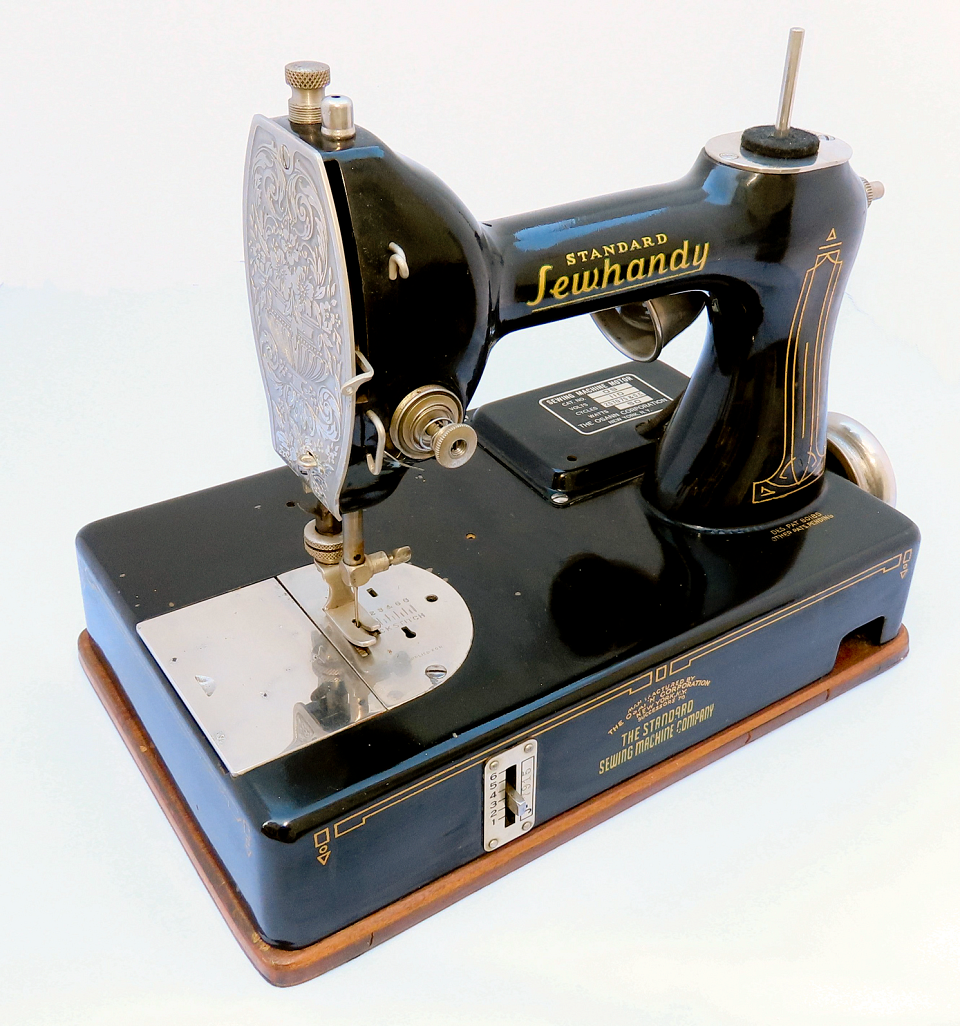
Figure 19:
Model R.P.30, Singer / Osann Corp’s version of the Sewhandy
Semi-Conclusion
So, we know of three instances in the nineteenth century when I. M. Singer & Co. and the Singer Manufacturing Company produced sewing machines for other companies. They must have learned some lesson from this, since when asked in the twentieth century by Sears, Roebuck & Co. to produce machines to be sold through their mail order catalog, the answer was a very decided “No”.
We also have the New York Favorite, the Meteor, various Hexagon models, and a handful of Standard sewing machines, all of which are machines that until recently were not known to have any connection, or maybe just a tenuous or speculative one, to the Singer Manufacturing Company. Are these examples of just how well an often-secretive company could keep information from the public, or had this knowledge been lost to time, only to be rediscovered? And this begs the question ... what else is out there just waiting patiently to be found?
But wait—there is more! The story of the Hexagon sewing machine is far from over!
To be continued in “Part 2: The Spanish Connection”
Figure 20:
Standard R-35 as shown in the manual, courtesy of Gina Bisco
A Note About the Authors: J. C. and I “met” online in June 2023 on the ISMACS Digest during a brief exchange about the ownership of Hexagon sewing machines. There was an immediate connection of like-minds, and we shared the information we had individually gathered over many years of research. Although J. C. lives in Catalonia, Spain and I live in Delaware, USA, we began “working apart together.” My fascination was unknown Singer machines, J. C.’s was Spanish machines, but our worlds overlapped when it came to the Hexagon machines. At first, we had no idea just how many models of Hexagon machines had been produced, but discovering them was so exciting! Hundreds of emails have been exchanged, and we became obsessed with putting together all the pieces of the puzzle, the result of which we hope you will enjoy. — Krisi
References
- Singer Manufacturing Company Records. U.S. Mss AI, Micro 703 (2002, 2013, 2014, 2019, 2020). Wisconsin Historical Society, Division of Library, Archives, and Museum Collections, Madison, WI.
- Harris, D. (1857). Sewing Machine. U.S. Patent No. 17,571. Washington, DC: U.S. Patent and Trademark Office.
- Cooper, G. R. (1976). The Sewing Machine: Its Invention and Development. Washington, D.C.: Smithsonian Institution Press, p. 82.
- Bigalow, L. A. (1860, August). “The Boudoir Sewing Machine” [Advertisement]. New Englander and Yale Review, 18(71), 850.
- Bigalow, L. A. (1857, November 14). “Boudoir Sewing Machine” [Advertisement]. Caledonian (St. Johnsbury, VT), p. 3. Library of Congress, Chronicling America: Historic American Newspapers.
- Howland, C. W. (1861, September 4). “Harris Improved Boudoir Sewing Machine” [Advertisement]. Clearfield Republican (Clearfield, PA), p. 3. Library of Congress, Chronicling America: Historic American Newspapers.
- Megratten, J. (1864, January 8). “The Harris Boudoir Sewing Machine” [Advertisement]. The Delaware State Journal & Statesman, p. 4. Library of Congress, Chronicling America: Historic American Newspapers.
- Gould, F. (1858, May). “Boudoir Sewing Machine” [Advertisement]. Emerson’s Magazine and Putnam’s Monthly, p. 567.
- Forsdyke, G. ISMACS: William Newton Wilson. Retrieved December 29, 2023, from https://ismacs.net/sewing_machine_articles/william_newton_wilson.html
- Cheney, F. P. (1872, April 4). “The Domestic Sewing Machine” [Advertisement]. Rutland Weekly Herald (Rutland, VT), p. 8. Chronicling America: Historic American Newspapers.
- Hounshell, D. (1984). From the American System to Mass Production, 1800–1932: The Development of Manufacturing Technology in the United States. Baltimore, MD: Johns Hopkins University Press, pp. 97–98.
- Davies, R. (1978). Peacefully Working to Conquer the World: Singer Sewing Machines in Foreign Markets, 1854–1920. New York: Arno Press, p. 56.
- Fultz, H. M. (1872, May). “Facts of Interest” [Advertisement]. Ladies Own Magazine, p. 240. Google Books.
- Mason, A. G. (1870, March 17). [Advertisement]. The Democratic Press (Ravenna, OH), Image 3. Library of Congress, Chronicling America: Historic American Newspapers.
- Hawaiian Hardware Company (1893, August 26). [Advertisement]. The Daily Bulletin (Honolulu, HI), Image 2. Library of Congress, Chronicling America: Historic American Newspapers.
- Larsen, Olaf (personal communication, December 24, 2023).
- Langdon, John (2012, March). Chinese Puzzle. ISMACS. Retrieved December 29, 2023, from https://ismacs.net/wheelerandwilson/chinese-puzzle.html
- Allen, E. B. (1908). Sewing Machine. U.S. Patent No. 882,484. Washington, D.C.: U.S. Patent and Trademark Office.
- Smithsonian Institution Archives. [Instruction manual in Chinese for Meteor model]. NMAH, Textiles Collection, Box 14. Retrieved December 29, 2023, from https://www.sil.si.edu/DigitalCollections/Trade-Literature/Sewing-Machines/NMAHTEX/1759/imagepages/image21.htm
- Wikipedia contributors. (2023, October 30). “Depression of 1920–1921.” In Wikipedia, The Free Encyclopedia. Retrieved December 30, 2023, from https://en.wikipedia.org/w/index.php?title=Depression_of_1920%E2%80%931921&oldid=1182561385
- Singer Company Records, Accession 2207, Box 1. Hagley Museum and Library, Manuscripts and Archives Repository, Wilmington, DE 19807.
- Best, David (personal communication, December 8, 2023).
- Best, David (personal communication, December 8, 2023).
- Bullock, P. (1950). Historical Notes of Singer Business in Great Britain. Unpublished manuscript. Singer Company Records, Accession 2207, Box 1, Hagley Museum and Library, Manuscripts and Archives Repository, Wilmington, DE 19807.
All machines and documents in uncredited photos are from the collections of the authors.