

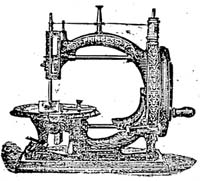
George Washington Gates
and His Sewing Machines
by Martin Gregory
This article has been adapted from the original ISMACS News layout for web presentation; line-break hyphenation and formatting have been normalized.
George Washington Gates was born in New York State in 1830. I have found nothing about his early life or when he left the USA for Canada. He is one of those Canadian sewing machine manufacturers, such as the well-known Charles Raymond and Richard Mott Wanzer, who left America for Canada to open up a new market and escape paying royalties to the Sewing Machine Combination. Other attractions of manufacturing in Canada included freer access to the British and French markets. It is very likely that he worked in the sewing machine manufacturing industry in New England before going to Canada to establish his own business.
G. W. Gates & Co. started production in 1866 and was the only manufacturer to be sited in Toronto, ONT. The company offices were at 37 Adelaide St. West with the factory at 119 Bay St. and a salesroom at 14 King St. East in Toronto. In the 1871 Canadian Census of Industries, the factory was recorded as powered by a twenty horsepower steam engine and employing twenty men and five boys. The number of machines produced in the census year April 1870 to April 1871 was 2500. Woodcuts of the factory in 1872 are shown on the back cover.
Sadly, George Gates died of typhoid fever on January 7th 1876 at the age of 45 and the Company collapsed. A Bailiff’s sale of the goods and chattels seized at the works took place by public auction on May 2nd 1876 suggesting that the Company had been a going concern up to Gates’s death. The inventory of machine tools is basic and assumes that the castings were bought in (there would have been suitable iron foundries in the Toronto area at the time) along with specialist parts like shuttles and the woodwork for tables and machine cases. The sale included 75 finished sewing machines, plus part finished machines and ‘orders in hand’.
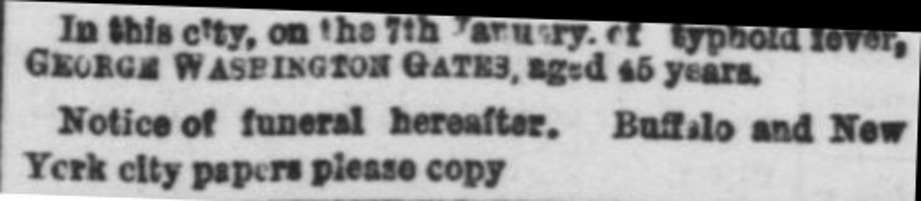
Notice of G. W. Gates’s death, The Globe Newspaper, Toronto, January 8th 1876
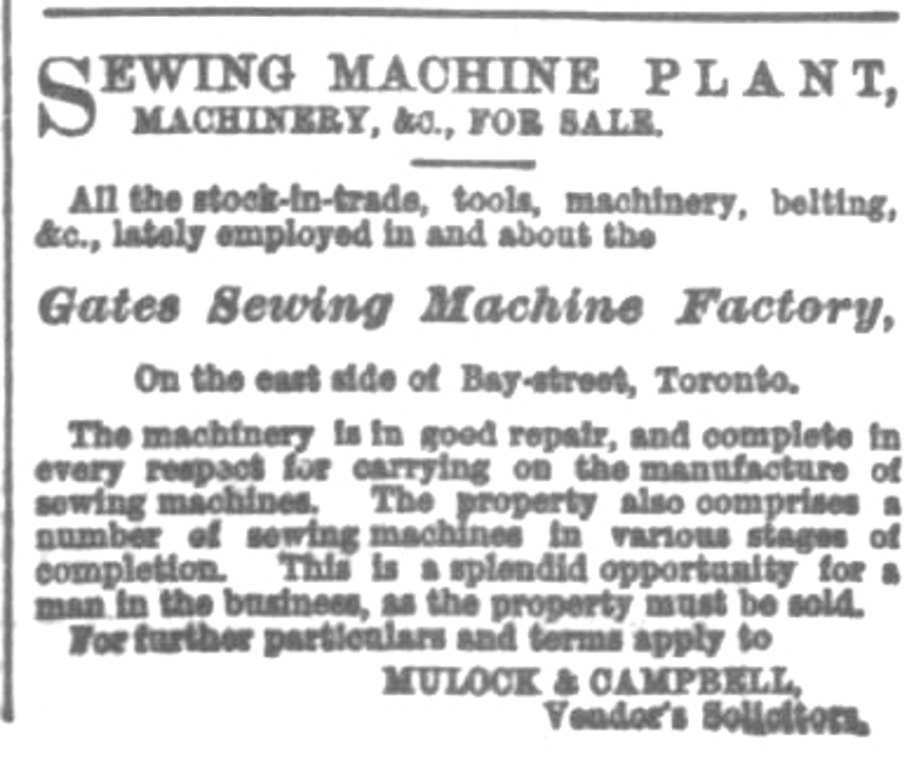
Notice of the sale of Gates’s factory, The Globe Newspaper, Toronto, June 6th 1876
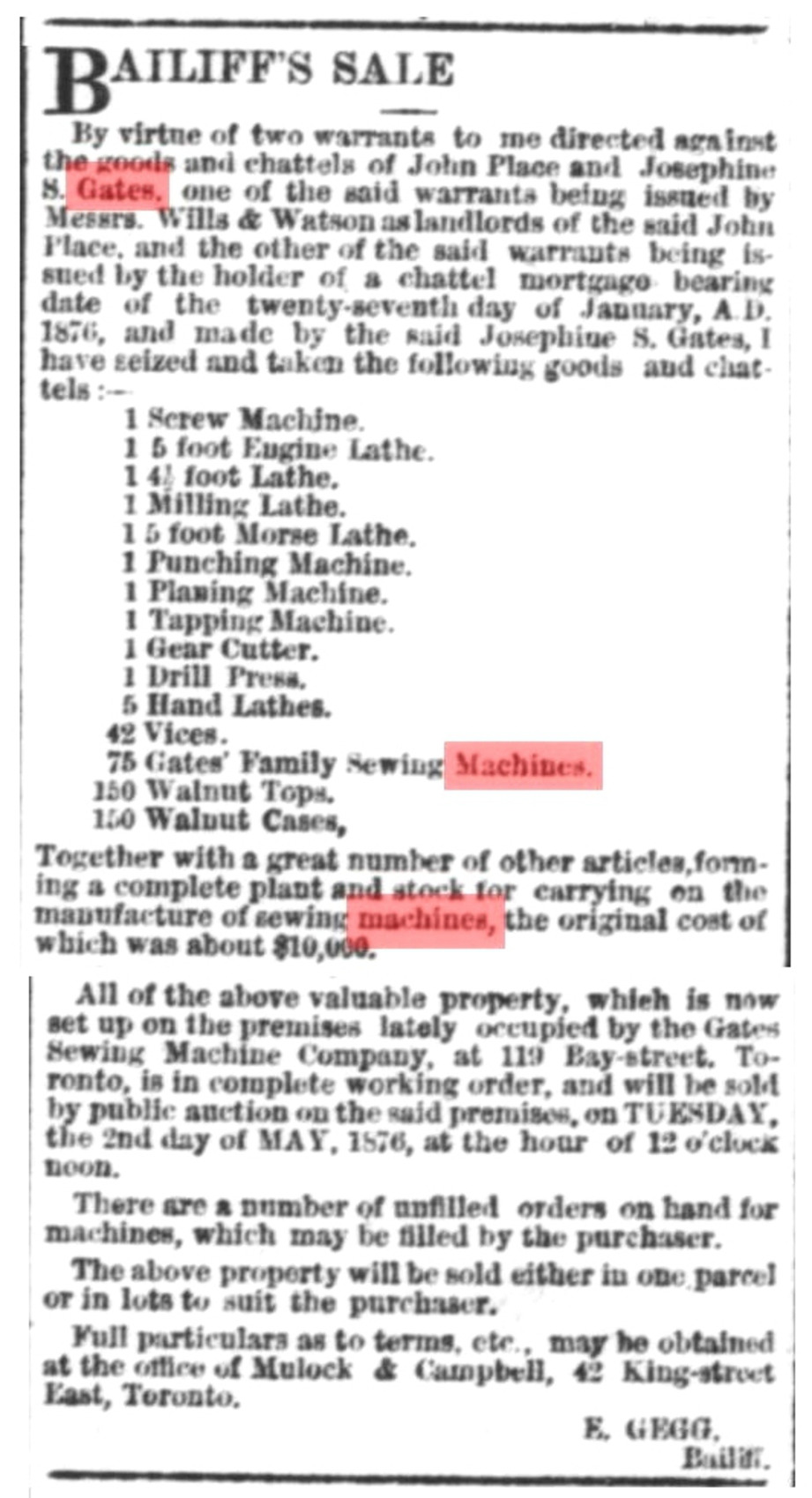
Notice of Bailiff’s sale after Gates’s death, The Globe Newspaper, Toronto, April 29th 1876
So, we have a small factory with a claimed fitting-up cost of $10 000 and making around 50 sewing machines per week for less than ten years. Thus it was a small relation of the manufactories of Raymond and Wanzer. The few advertisements that have been located are full of the ‘puff’ of the Victorian salesmen who operated with no rules over the accuracy of their claims. The company’s products were claimed to have had a good reputation and were prize exhibits at local Ontario Exhibitions in 1866, 1868, 1869 and 1870. One was even claimed to have been sent to the Paris Exposition of 1867. The ‘Family’ machine won the highest medal at a Workmen’s International Exhibition held in London in 1871, showing that he tried to break into the English market. More than a century after the company failed, an article written forty years ago (in 1980) stated that ‘none of its machines has yet been found’. However, forty years of searching by collectors has turned up several so that now a Gates machine is not unknown but is still rare.
The Gates Company marketed two small budget domestic hand chainstitch machines and a larger ‘Family Shuttle Sewing Machine (Lockstitch)’ on Singer’s system. One of the chainstitch machines was called the ‘Victoria’ and the other the ‘Queen’s Elliptic’. The ‘Victoria’ is a very close relative of the Bartlett (American) machine and the design may have been bought in by Gates when he started up. It would provide him quickly with machines to sell while he completed the factory and designed his own machine. The stamp on the cloth plate reads “Toronto C. W.” (Canada West) suggesting it is the first machine he manufactured, starting before the Confederation of Canada in 1867.
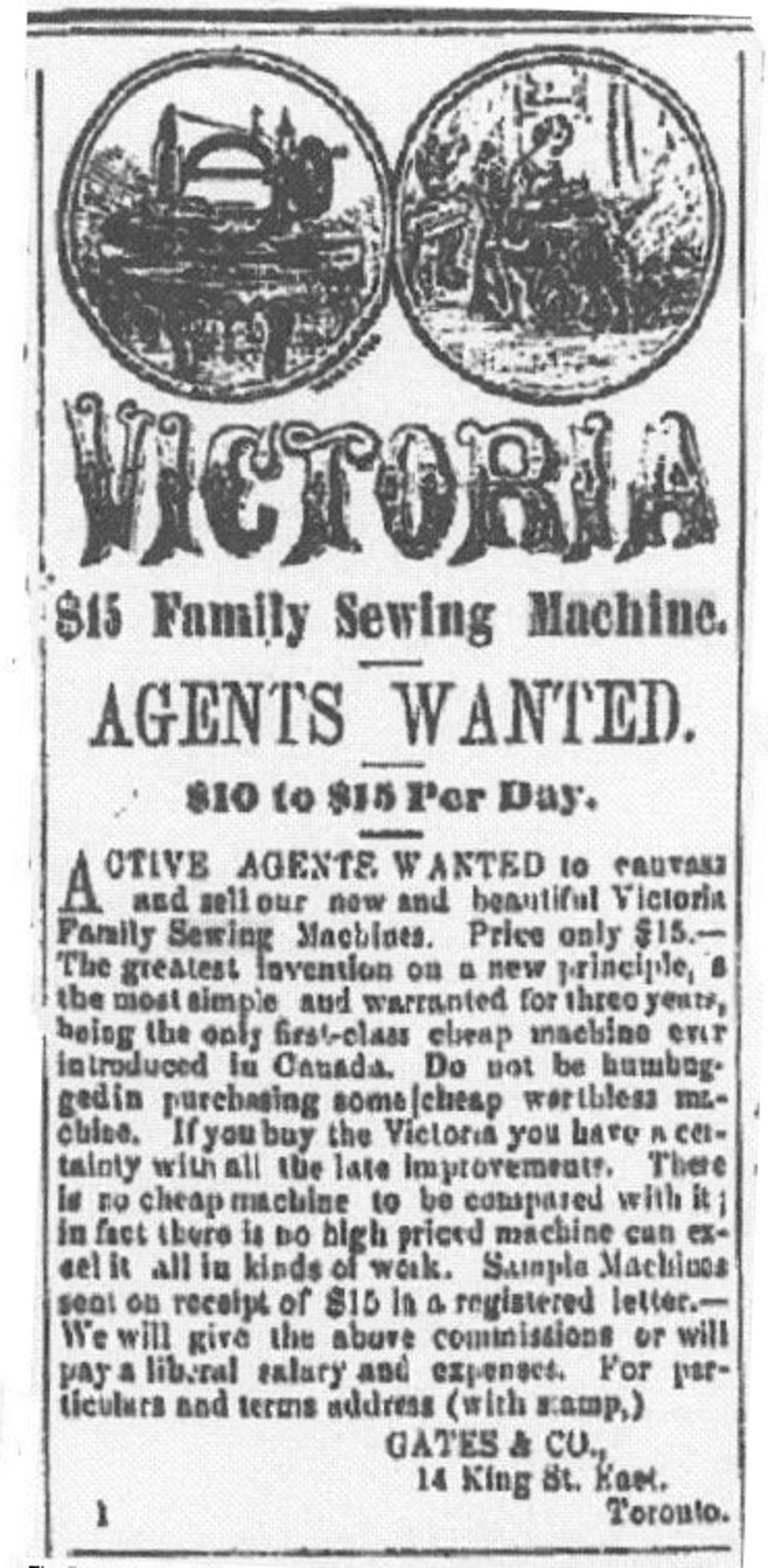
Advertisement for agents to sell the ‘Victoria’, Perth Courier, October 19th 1866
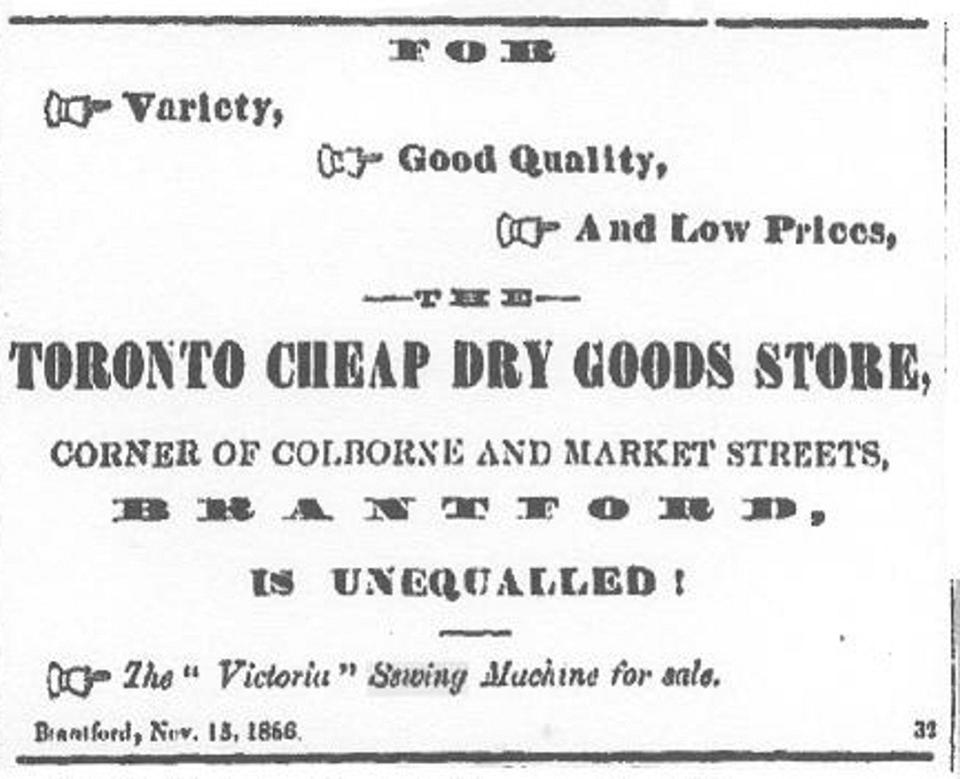
Advertisement for the ‘Victoria’, Grand River Sachem Newspaper, November 21st 1866
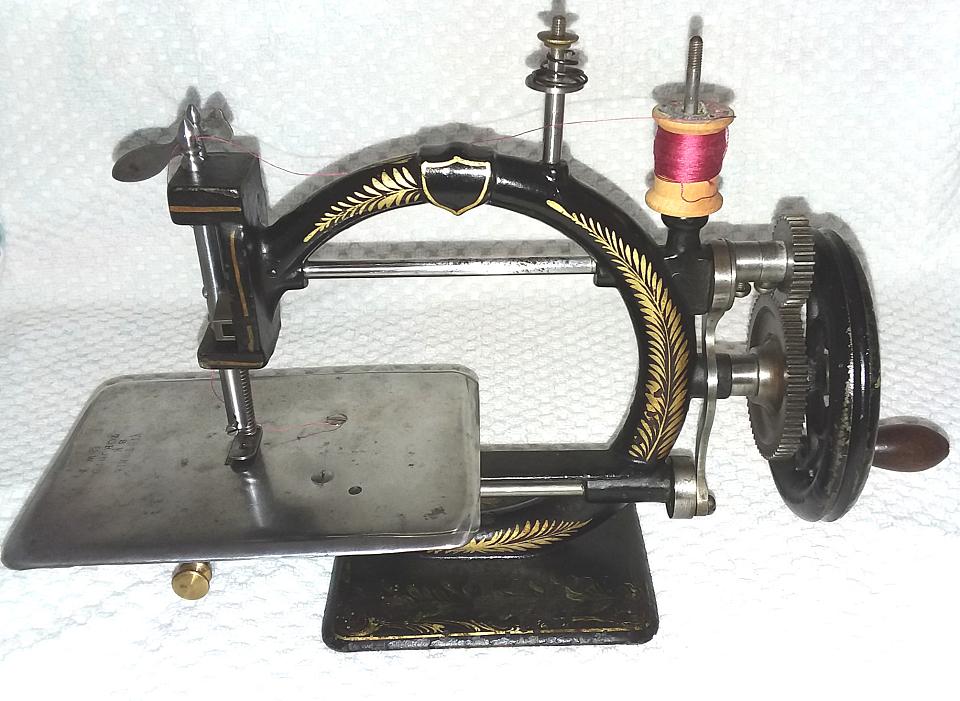
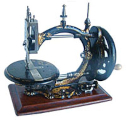
The ‘Victoria’ chainstitch machine (LM)
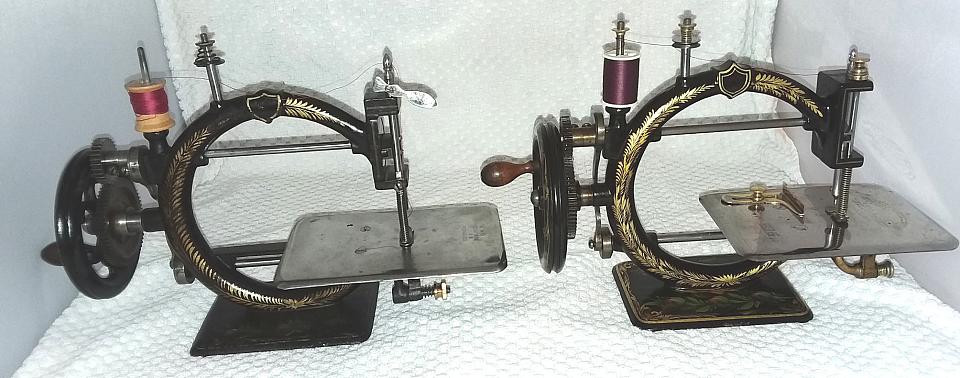
The ‘Victoria’ compared with the ‘Bartlett’ machine (LM)
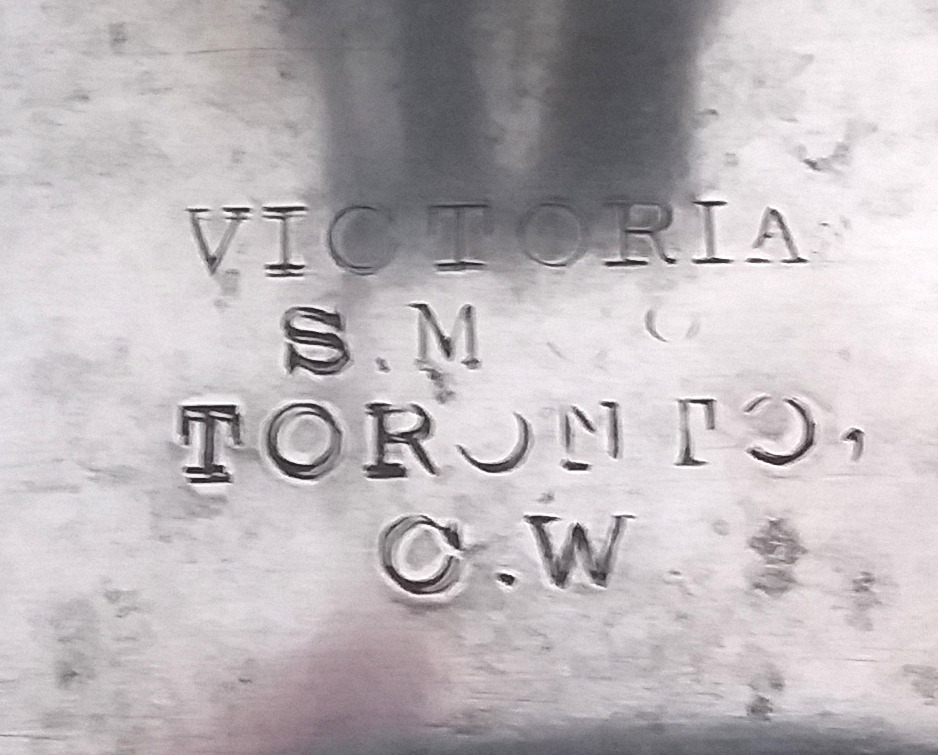
The die stamp on the ‘Victoria’ cloth plate (LM)
The ‘Queen’s Elliptic’ was certainly made by Gates in Toronto. In 1868, it retailed for $15. The ‘Queen’s Elliptic’ initially looks like any other small C-framed domestic machine but it has several points of interest. First, it is a chainstitch machine using a Willcox & Gibbs pattern rotating hook. Second, it has a proper 4-motion cloth feed similar to that of the Willcox & Gibbs. Both of these devices were patented in the USA and England and, in the 1860s, would have incurred patent fees to Willcox & Gibbs or their agent. A third point of interest is the use of a slotted link to drive the lower shaft from the upper shaft which is geared to the hand wheel. The hand wheel has a belt groove so the machine could have been mounted on a treadle table when required. The die stamp on the cloth plate reads “Toronto, ONT”. The Province of Ontario only came into being on 1st July 1867 so production of the Queen’s Elliptic is likely to have started in late-1867 or 1868. The ‘Queen’s Elliptic’ should have been much superior to the ‘Victoria’ which probably went out of production.
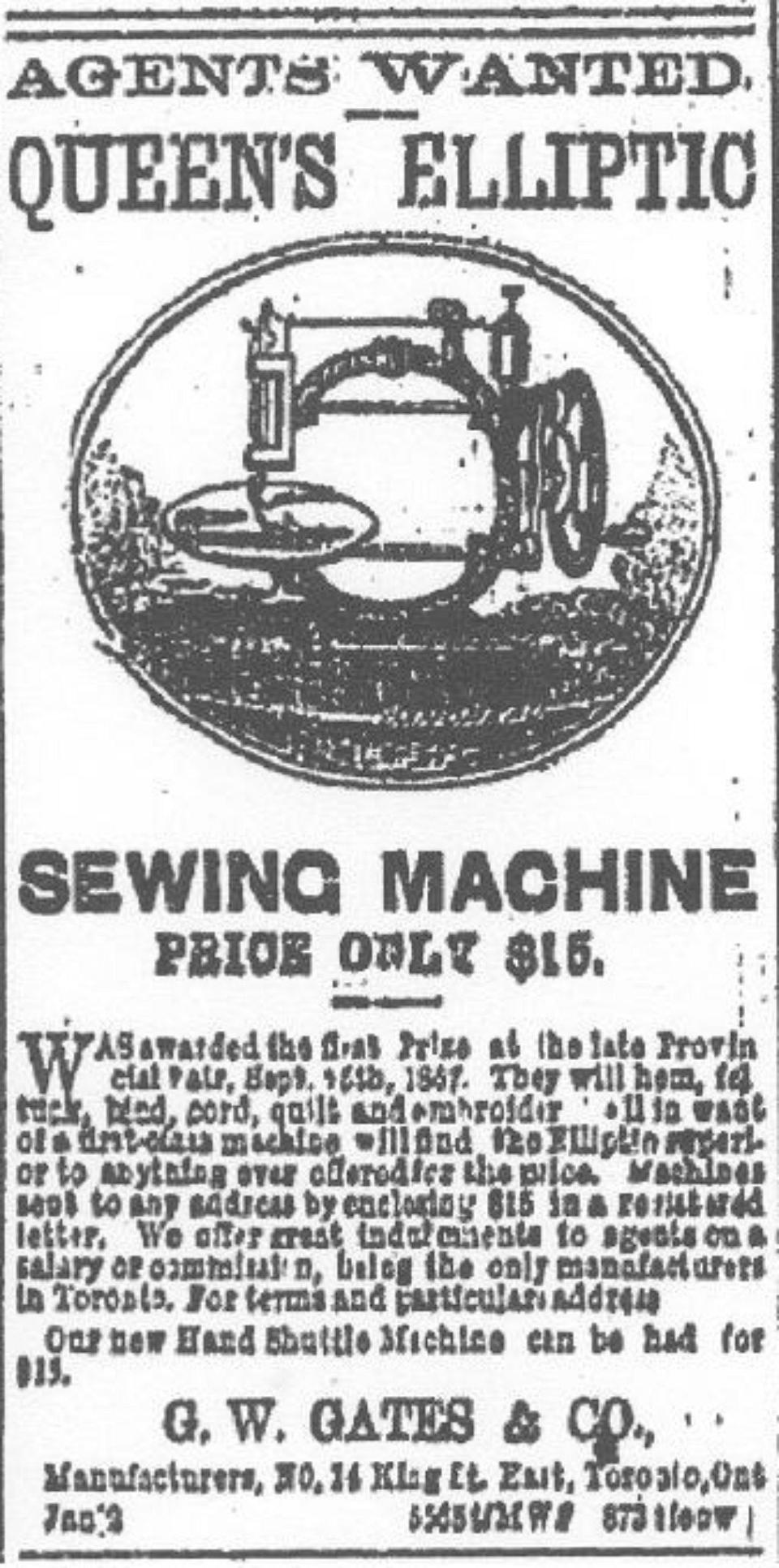
Advertisement for agents to sell the ‘Queen’s Elliptic’, The Globe Newspaper, Toronto, February 21st 1868
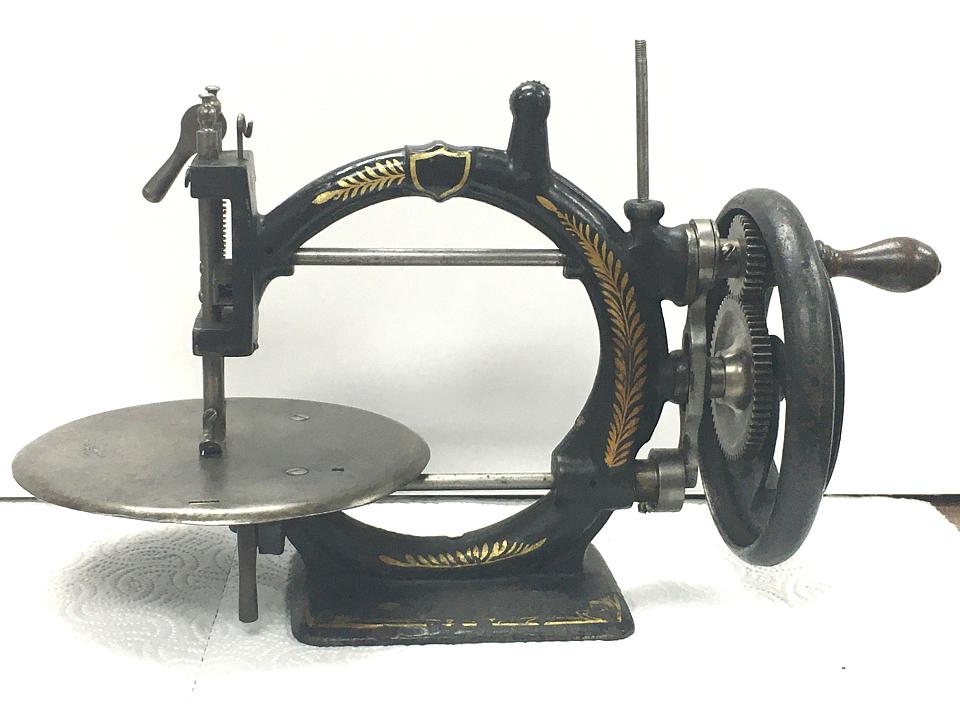
The ‘Queen’s Elliptic’ chainstitch machine, front (HB)
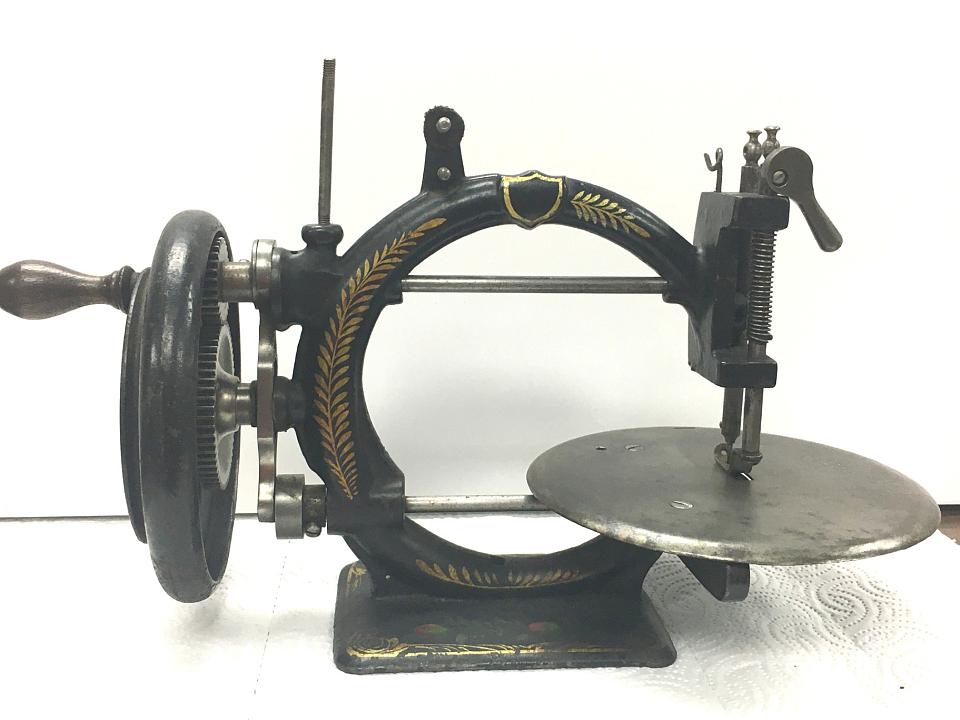
The ‘Queen’s Elliptic’ chainstitch machine, back (HB)
[This is the earliest application of the slotted link between the two shafts that I have seen. It was a well-known mechanism by 1860 and later was widely used on full size machines with rotary shuttles (e.g. Bradbury B2, Standard Rotary etc) and rotary hooks (e.g. Wheeler &Wilson 9, Singer 115, Domestic 69 etc). It has a very desirable attribute: when the top shaft rotates at constant speed, the lower shaft speeds up (when the hook picks up the loop of thread from the needle) and slows down (when retaining the loop whilst the needle is out of the cloth and the feed operates). This was particularly useful with a small hand powered chainstitch machine where it reduced the frequency of dropped stitches, and hence unravelling seams!]
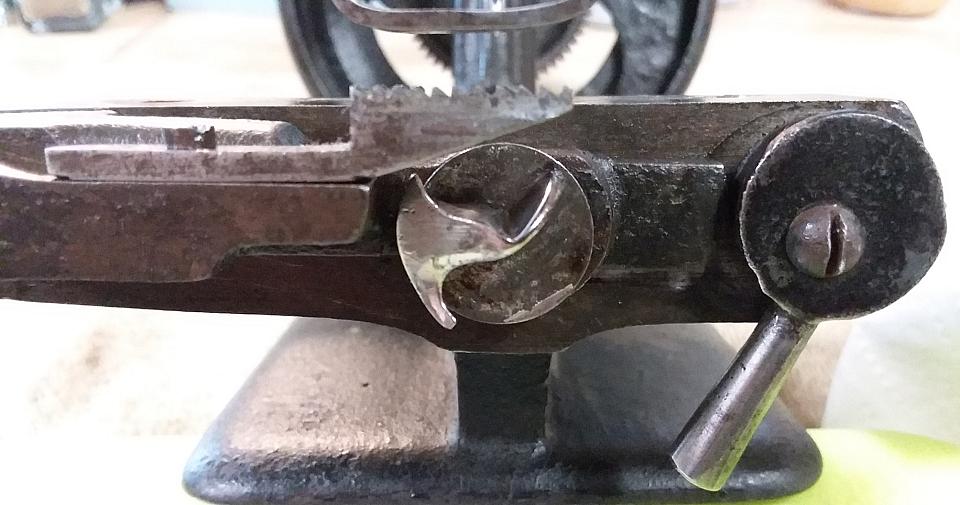
The ‘Queen’s Elliptic’ chainstitch machine, the W&G pattern rotating hook (LM)
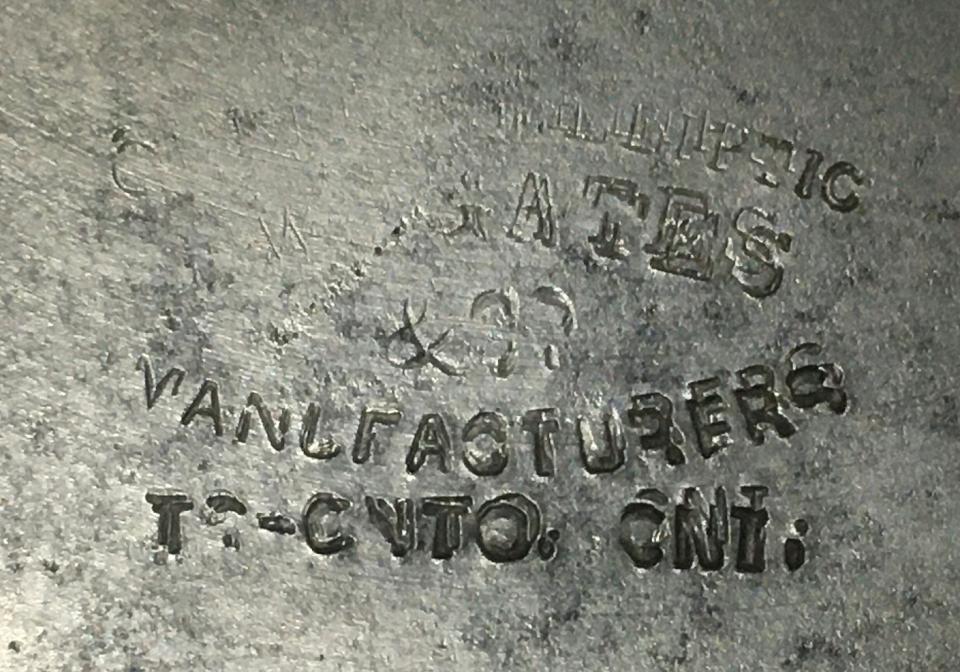
The ‘Queen’s Elliptic’ chainstitch machine, Gates’s die stamp on the cloth plate. The workman did not hold the stamp square-on and the hammer bounced! (HB)
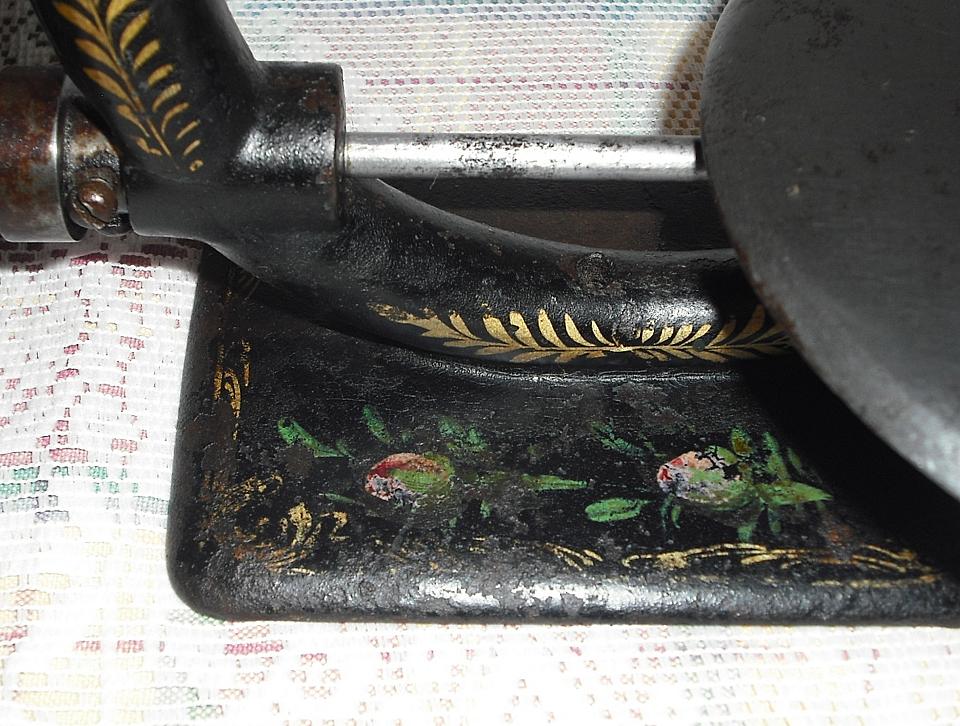
The ‘Queen’s Elliptic’ chainstitch machine, the hand painted rosebuds on the base (DA)
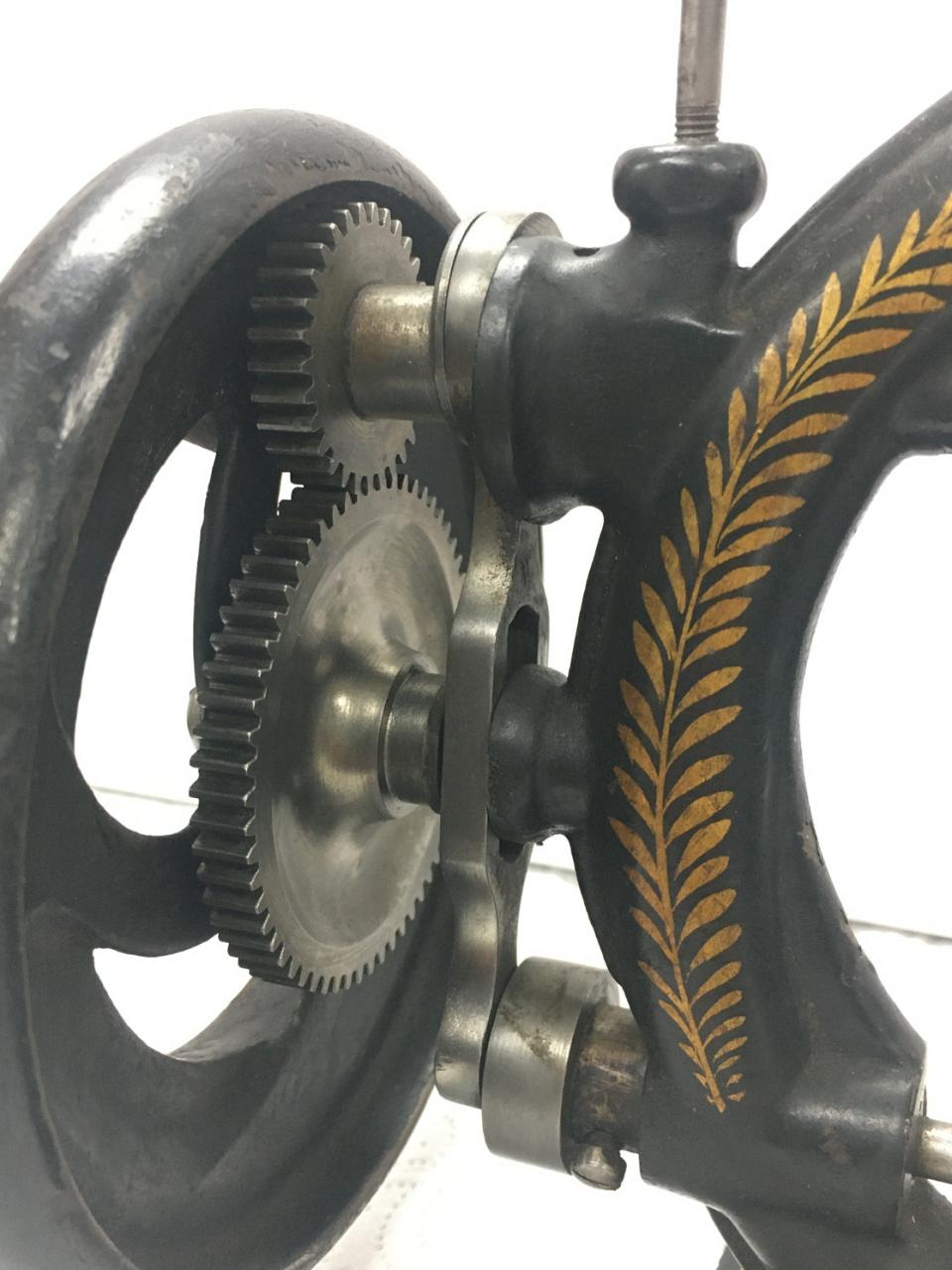
The ‘Queen’s Elliptic’ chainstitch machine, the slotted link drive from the top shaft to the hook shaft (HB)
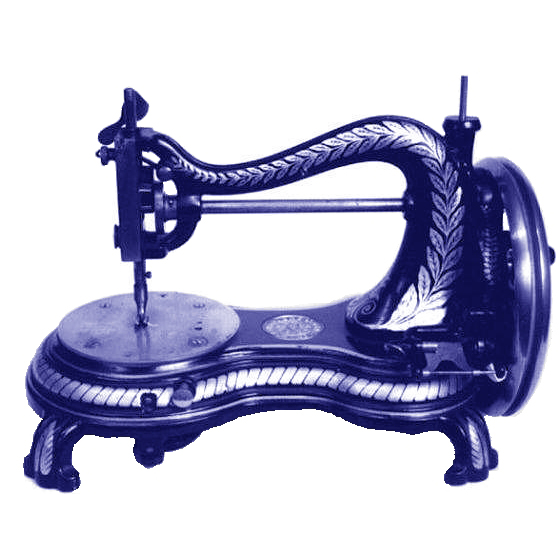
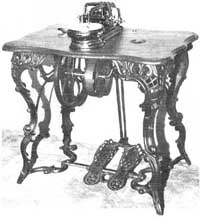
The Family lockstitch machine sold for $22 to $25, or $30 complete with stand and treadle. Gates registered the design of the machine on 28th January 1868 for the Provinces of Ontario and Quebec. The machine is almost identical with an American design but the link is unknown. Putting the machine on the Design Registry would stop local Canadian dealers from importing clones from America. The American machine was marketed in England as the ‘ABC’ by G. W. Jennings from various London addresses, as “the last [perhaps a misspelling of ‘latest’?] American wonder … the best hand and treadle lockstitch machine in the world…” (1869 advertisement). Several almost identical versions have surfaced in England without names, but were any of them made by Gates?
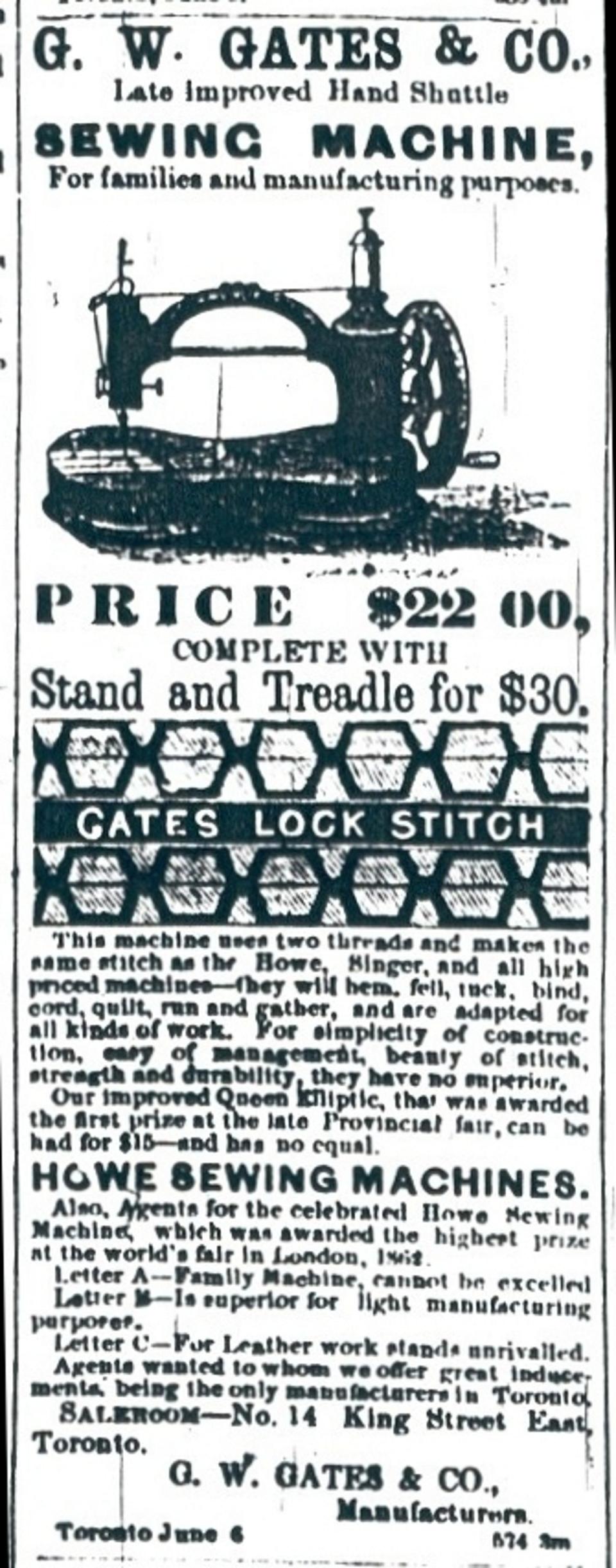
Advertisement for the ‘Family’, Daily Telegraph, Toronto, June 6th 1869
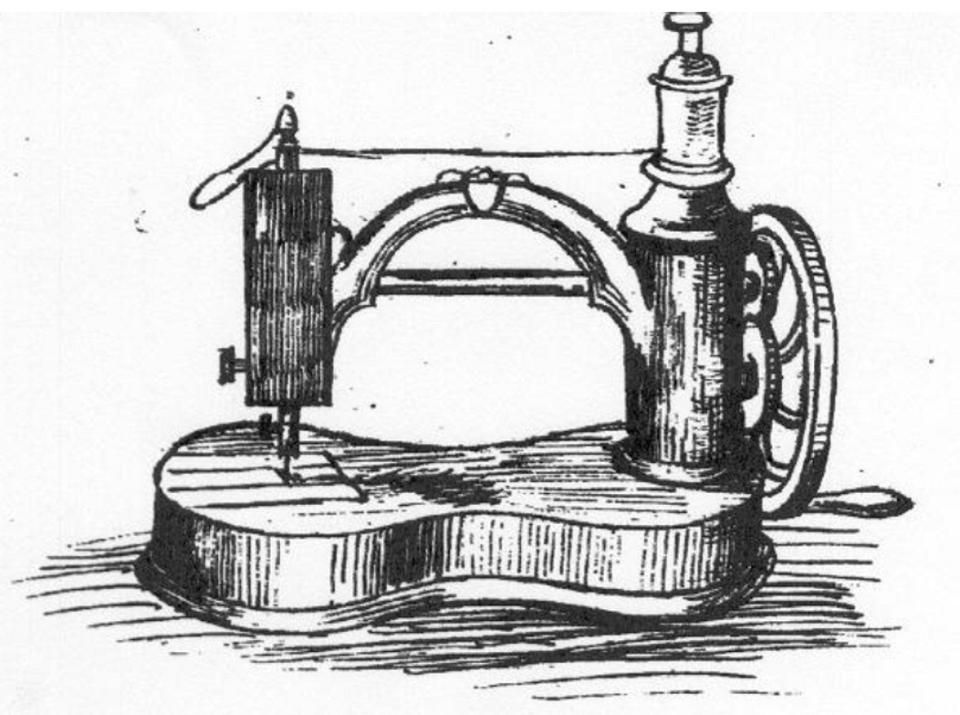
Diagram of ‘Family’ machine in Gates’s Design Registration document, January 28th 1868. The entire document is hand written
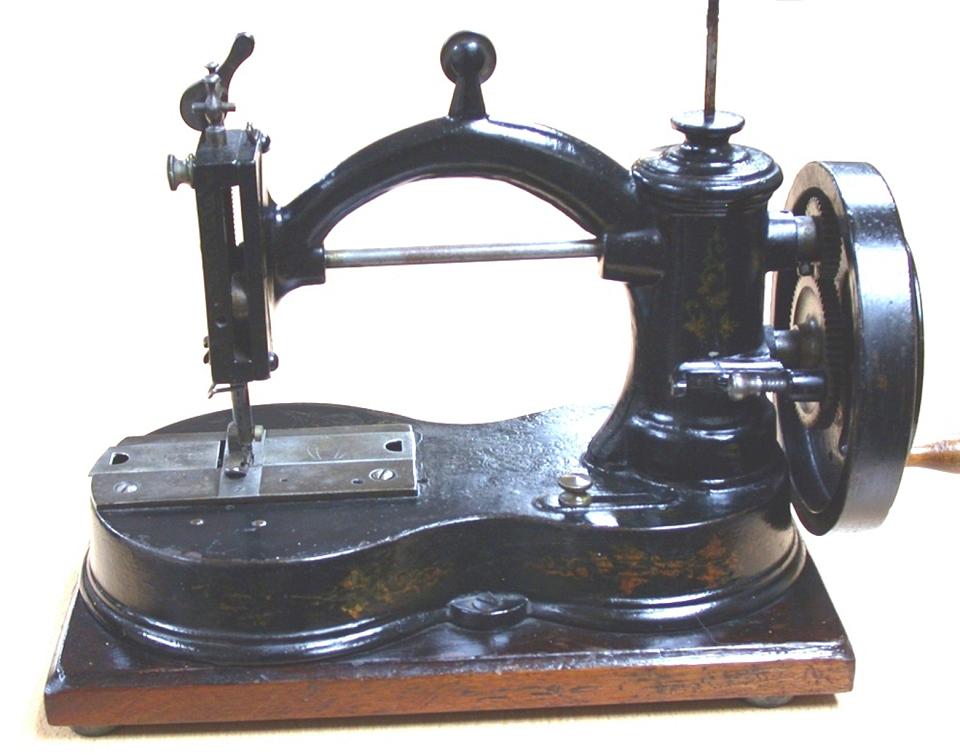
The ‘Family’ machine (JvanMS). This example does not carry a Gates stamp or name
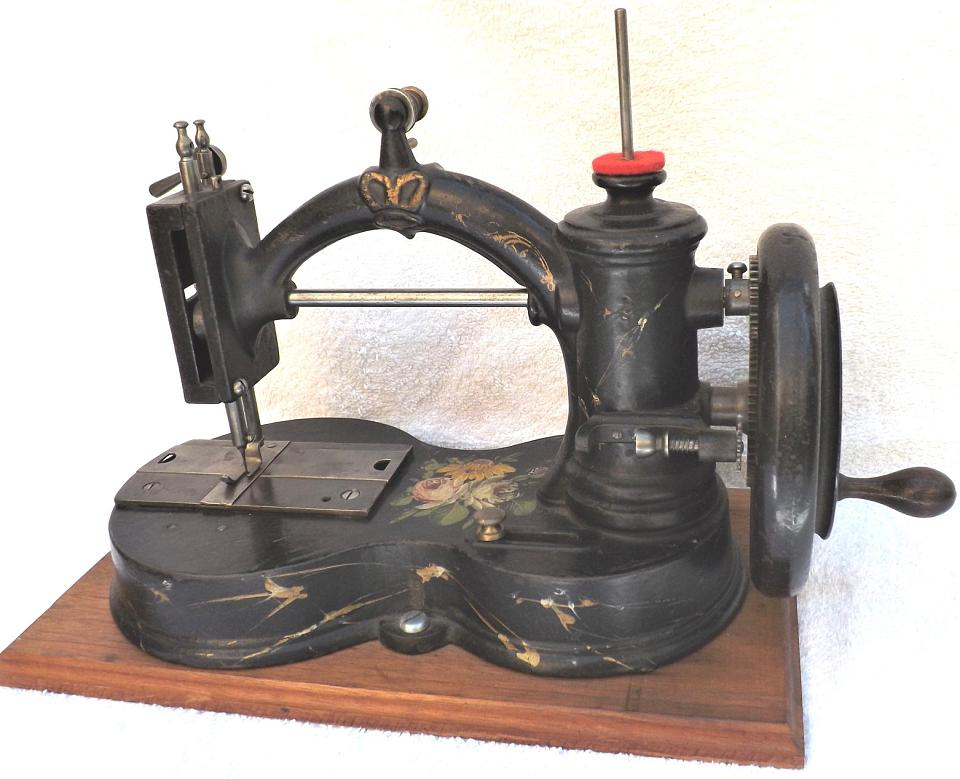
The ABC machine marketed in England by G. W. Jennings
This article started from a discussion with Linda Mulvaney (LM) about her recently acquired Gates machines. My thanks are due to her and to Diane Anderson (DA) who provided all the research material on Gates and his factory, to Jacqui van Meppelen Scheppink (JvanMS) who provided the picture of the ‘Family’ machine and to Harry Berzack (HB) for further data and pictures.
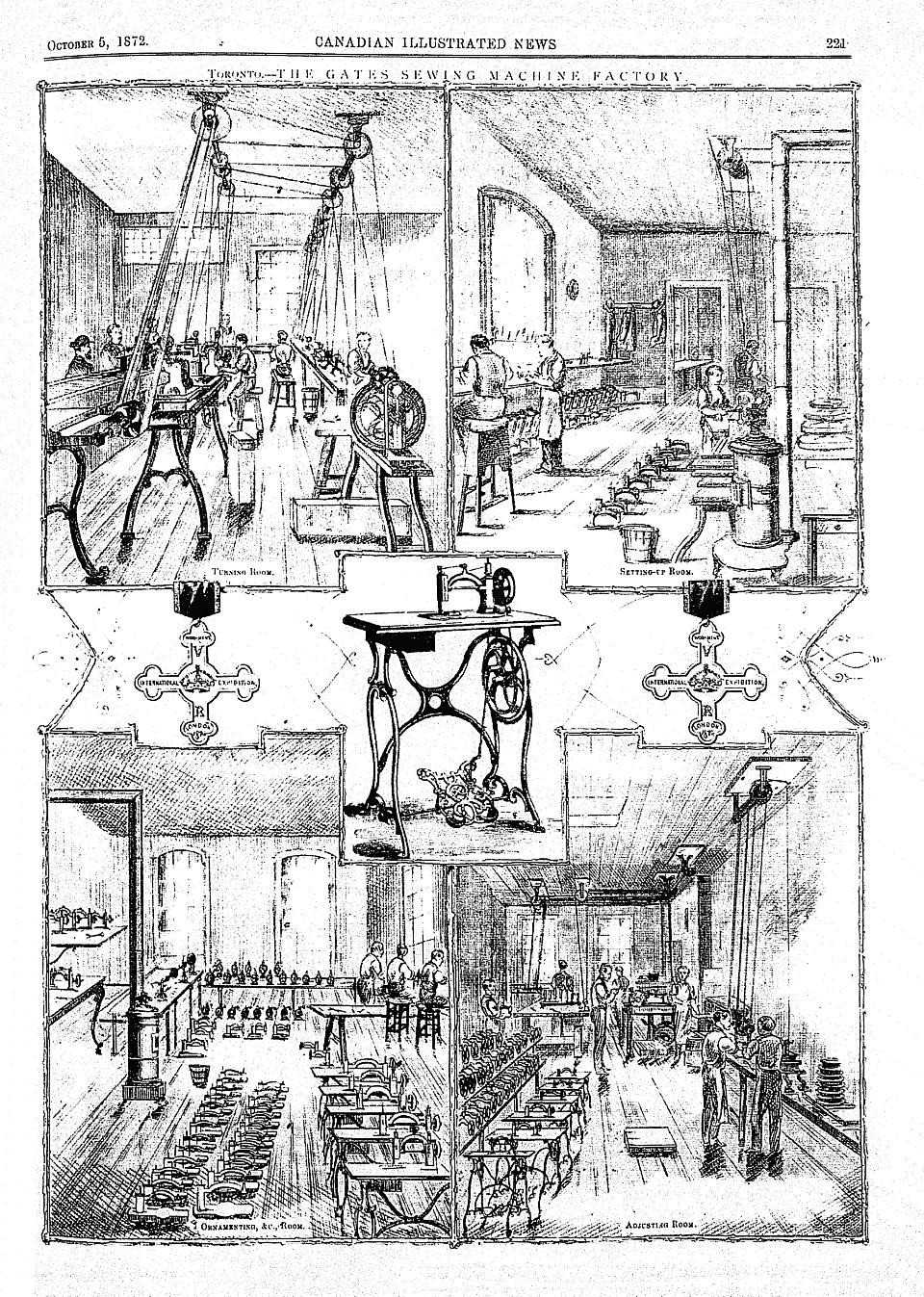
Toronto, The Gates Sewing Machine Factory, Canadian Illustrated News, October 5, 1872