Practical, Durable, Simple and Beautiful—The “Beckwith Family”
by Rita and Manfred Koym
Originally published in ISMACS News, Number 138, June 2020. Copyright ISMACS (2020).
This article has been adapted from the original ISMACS News layout for web presentation; line-break hyphenation and formatting have been normalized.
Our promise to send our collector friend Ludger Halbur more photos of our “big” sewing machines for the European Schlingenfänger homepage in the future brought us the idea of researching the variants of Beckwith sewing machines.
Surely every collector has seen such a machine, but did you know that there are nine variants? Since we have no official model numbers, we have numbered the machines by construction or patent year for simplicity. Marked by the frustration of finding out about the “rare” name Müller in Berlin, we thought that it would be much easier with William Gould Beckwith. The language difficulties, as in our French reports, were thus a thing of the past and in the US considerably more old documents have already been digitised than in Europe and are accessible to the general public. We had already stored the various patents and the design patent from Beckwith in one of the past long winter seasons. So, of course, we were the first to ask the publisher of the Toy Stitcher, Faye Beckwith, if she was related to W. G. Beckwith. She wrote “it would be nice, but unfortunately not”.
Beckwith is, in the United States of America and in England a common name—similar to the name Müller in Germany. And in the 1870s there were many gentlemen by the name William.
Well then. The manufacturer of the first Beckwith sewing machines, the company of Barlow & Son, was known in New York, yet the New York City Records Archive tells us that there is no record of Barlow & Son. Strange, because it’s in the 1872 New York Address Book.

The Beckwith Sewing Machine Company
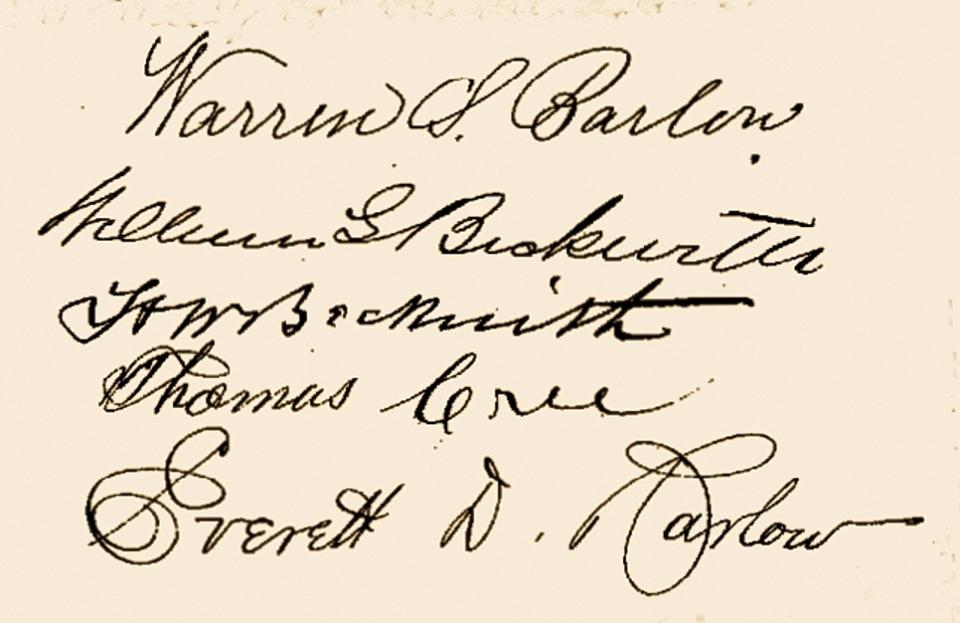
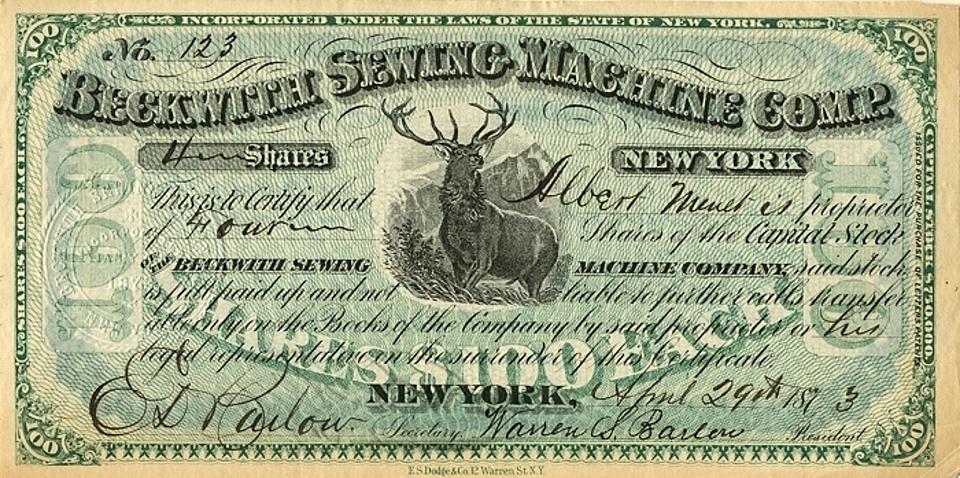
On December 30th 1871, a good eight months after the grant of the first patent, “The Beckwith Sewing Machine Company” was founded in the presence of Messrs. William G. Beckwith, Henry W. Beckwith, Thomas Cook, Warren S. Barlow and Everett D. Barlow at the relevant district court in New York.
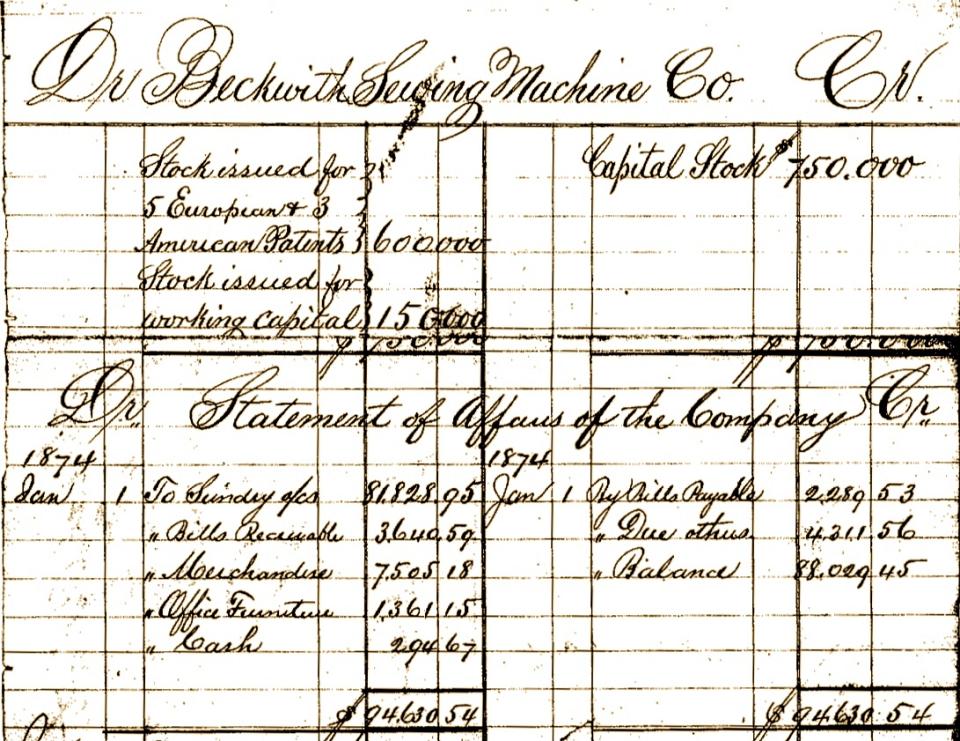
The capital stock was $100,000 divided into one thousand shares of $100 each.
The company officially started on January 1st 1872 and, as we can see from the district court record, it was to exist for the next 50 years. A pious wish. The company was managed by the five gentlemen mentioned above. The business went so well that the company’s capital was raised on April 7th 1873 to $750,000 US. At that time, W. S. Barlow was the president of the Beckwith Sewing Machine Company and W. G. Beckwith served as treasurer. Keep in mind that the little Beckwith cost $10, and you can gauge what a company’s capital of $750,000 meant at that time.
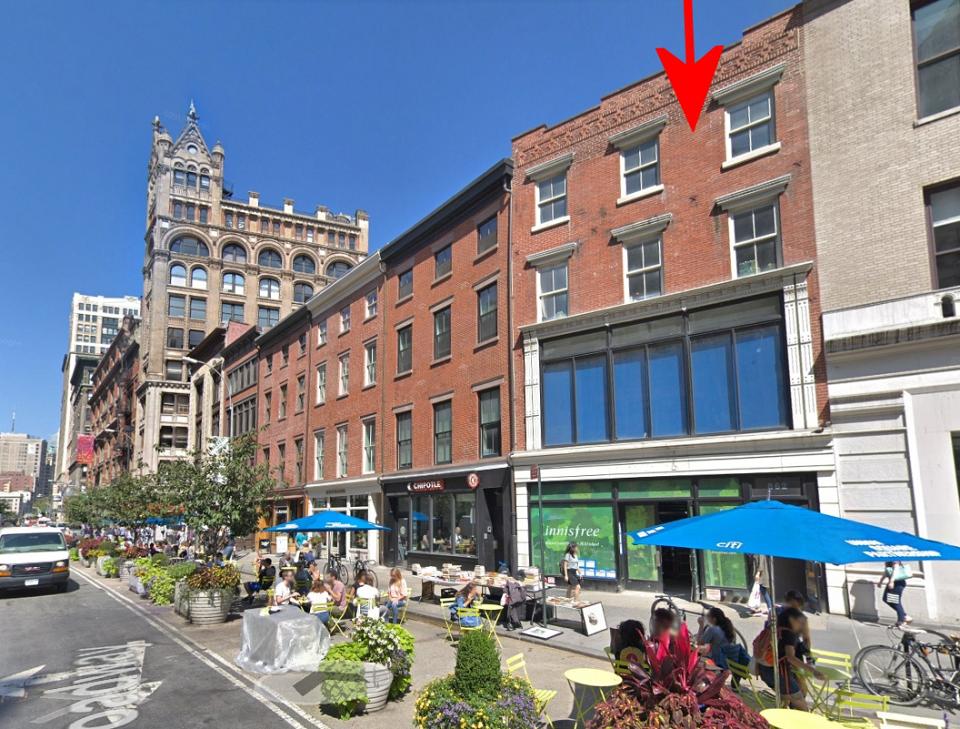
W. S. Barlow appeared in 1872 in New York’s address book at 26 West Broadway with the addition of ‘manufacturer of Beckwith sewing machines’. As of May 1st 1873, the Beckwith Sewing Machine Company moved to 862 Broadway, New York, near 17th Street.
The approximate production figures for the following years are listed by the Smithsonian Institution as follows:
- 1871: 3,500 machines
- 1872: 4,000 machines
- 1873: 5,000 machines
- 1874: 5,500 machines
- 1874-1876 (total): 3,000 machines
The year 1874 was obviously the most successful sales year, not least because of massive advertising. Nevertheless, production collapsed dramatically after 1874. We could not find out the reason for this. During this time we have discovered advertisements from sewing machine dealers who want to “clear their warehouse of Beckwith machines”. Whether the machines were sold off or considered bankrupt stock, we do not know. It is clear that in 1875, the Jewish community in New York thanked the company for the donation of free sewing machines to the “Young Ladies Charitable Sewing Society”. Despite the impending bankruptcy, this was a noble gesture.
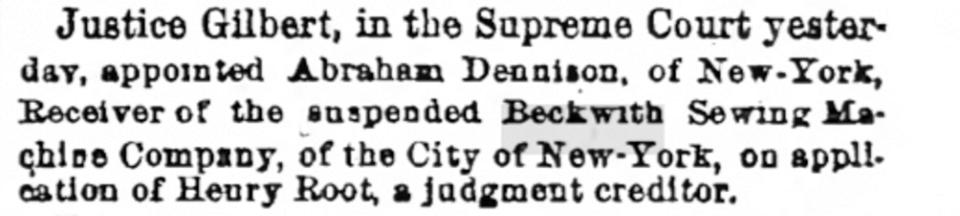
After only six years of production, the New York Times published the end of Beckwith on January 20th 1877.

And now to the “hardware”.
Model 1 – “Ring pull machine”
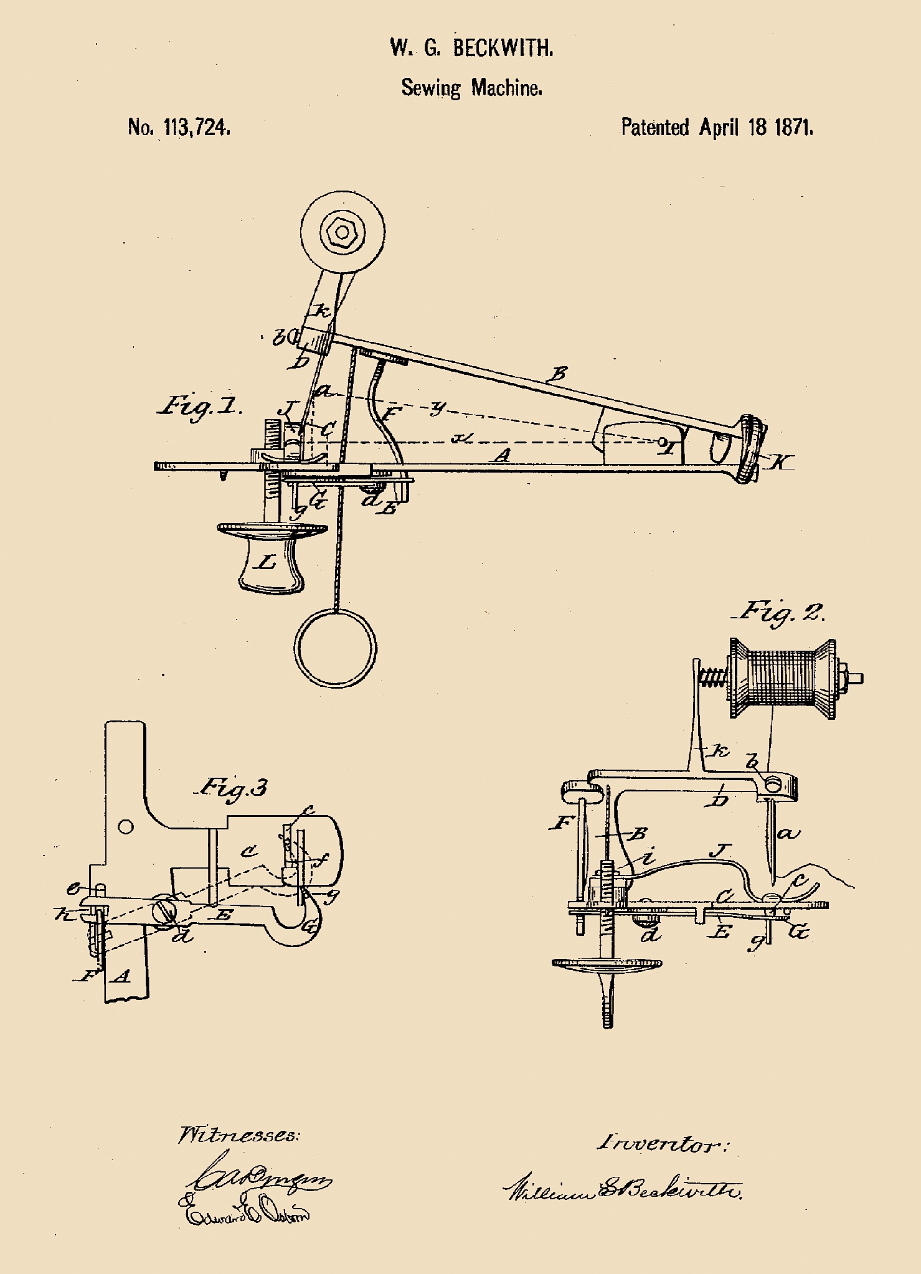
The first patent of W. G. Beckwith, number 113,724 of April 18th 1871, shows a very simple machine which clamped to the table and was inexpensive to produce. This first model already carried all the signs of the later Beckwith sewing machines. It was a single-thread chain stitch machine with a cloth feed by movement of the needle. The machine was not driven by a crank, but by pulling on a metal ring attached to a 1.5 mm diameter hardened steel wire. This wire is attached to the upper movable arm. On pulling the ring down, the straight needle moves down. To raise the arm and the needle, the thick wire with the ring is raised. At the very back, according to the patent, a “rubber spring” is attached as a “hinge”. If you look at the patent drawing, you see a double wound spiral spring, which is filled inside with rubber. The reel holder is horizontal and the machine has no thread tension.
This small sewing machine weighed almost exactly one pound (0.45 kg) and was therefore easy to transport. It could be attached to any table with the help of a simple cast wing screw. All this points to a cheap to produce and thus an inexpensive sewing machine. The targeted clientele certainly consisted to a large extent of the thousands of immigrants from Europe. This small, light machine was easily stowed in the covered wagon for the journey out west. It should not be forgotten that all sewing machines were high-tech items at the time. Everyone wanted to own something like that.
Model 2 – “Ring pull machine”
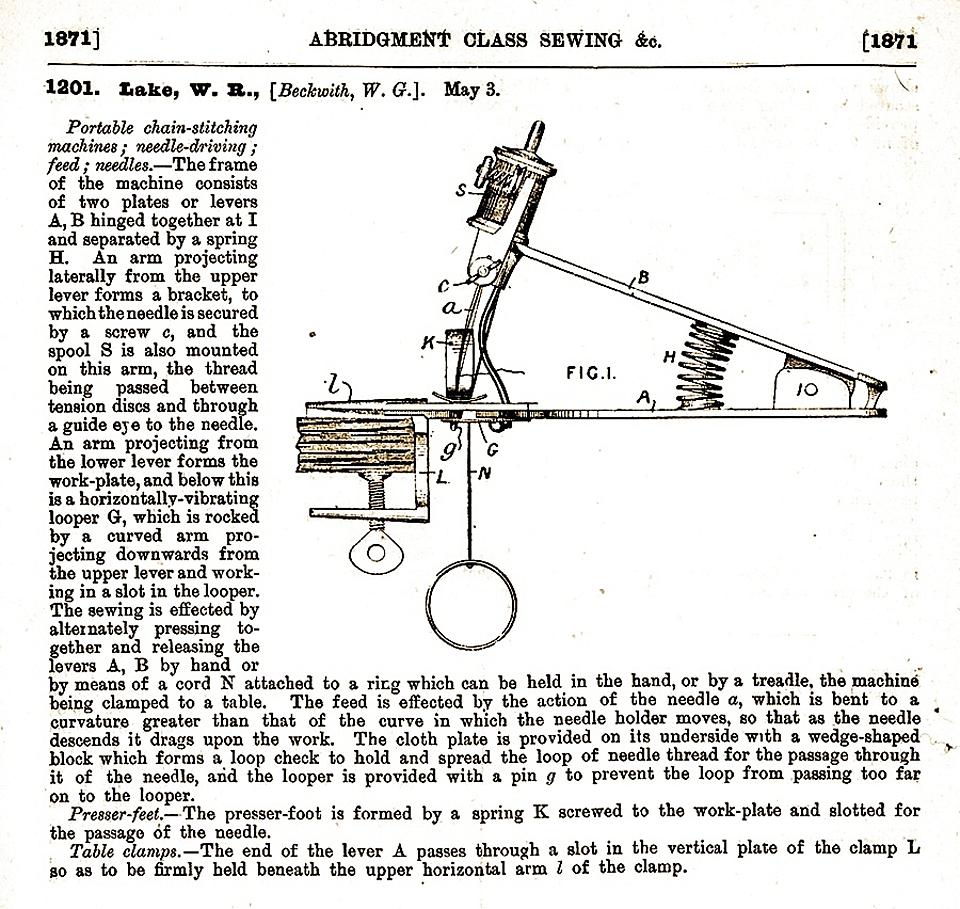
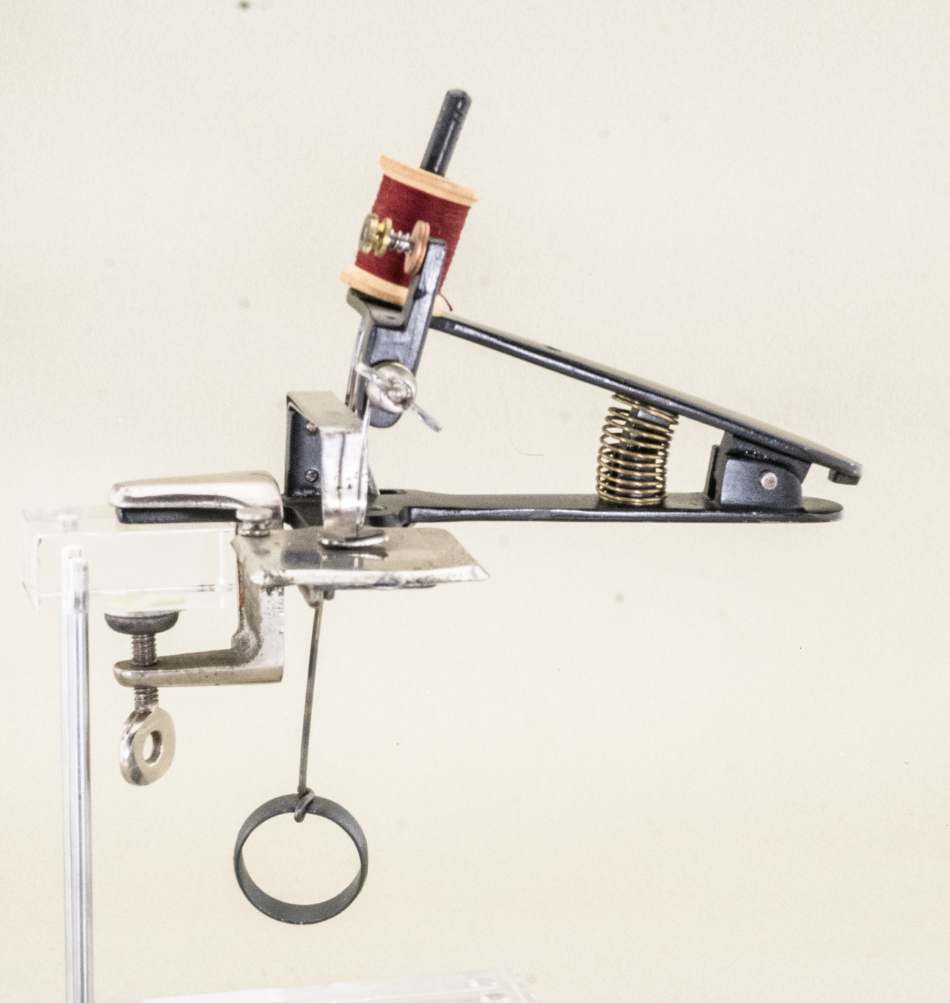
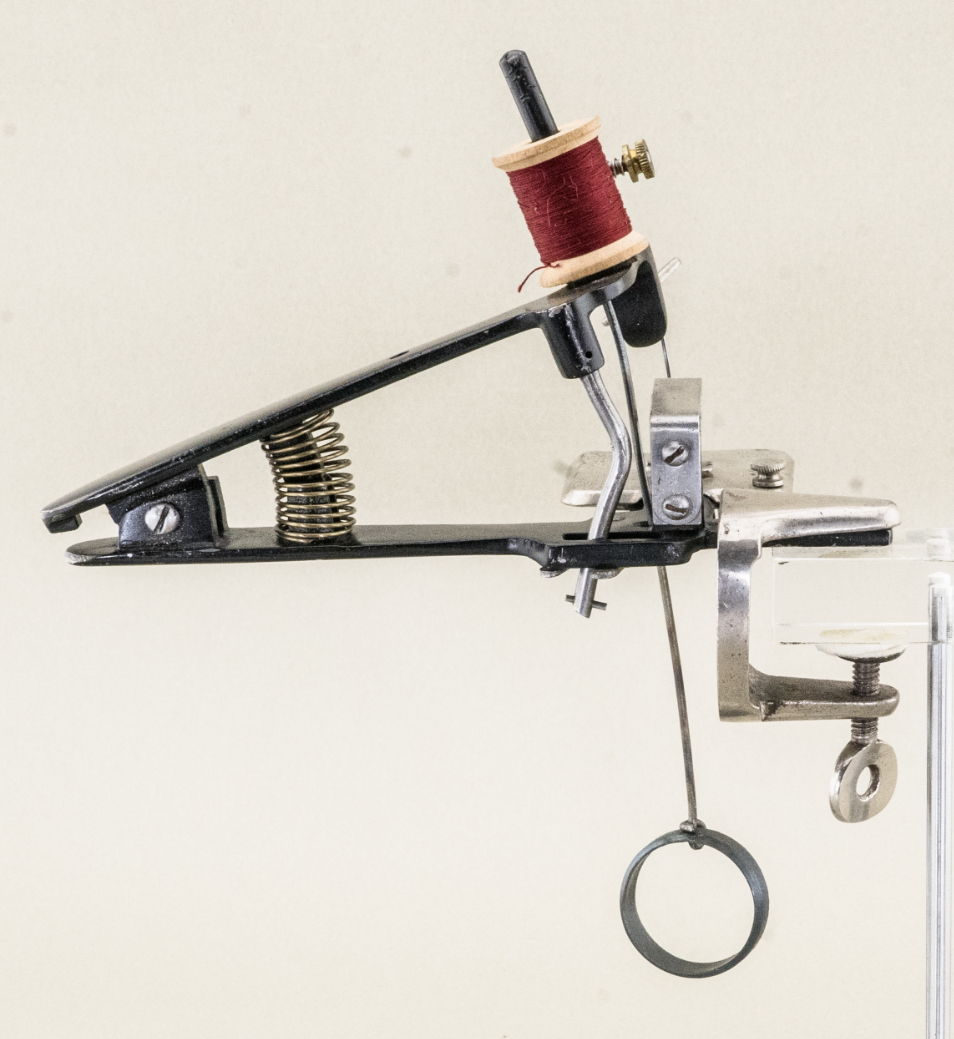
In the British patent abridgements for 1871 we found a drawing and information that Beckwith had patented his machine in England less than one month later (W. R. Lake was his English Patent Agent). When viewing this English patent drawing, there are significant changes from the US patent of April 18th 1871. We now see a vertical reel holder and an additional thread tension. Was the machine in the US patent drawing, equipped with a table-locking screw with a large round flange, ever manufactured as the machine in the English drawing already uses a table-clamp. Another improvement is in the way the upper arm is raised. The “rubber spring” has been replaced by a spiral spring mounted in front of the hinge. The needle is now curved and attached in a user-friendly way to the right hand side with a wing nut. In the old version, the seamstress had to use a screwdriver. As you can see, the ring to operate it remained. All the machines that have survived, to the best of our knowledge, fit the drawing of the English patent.
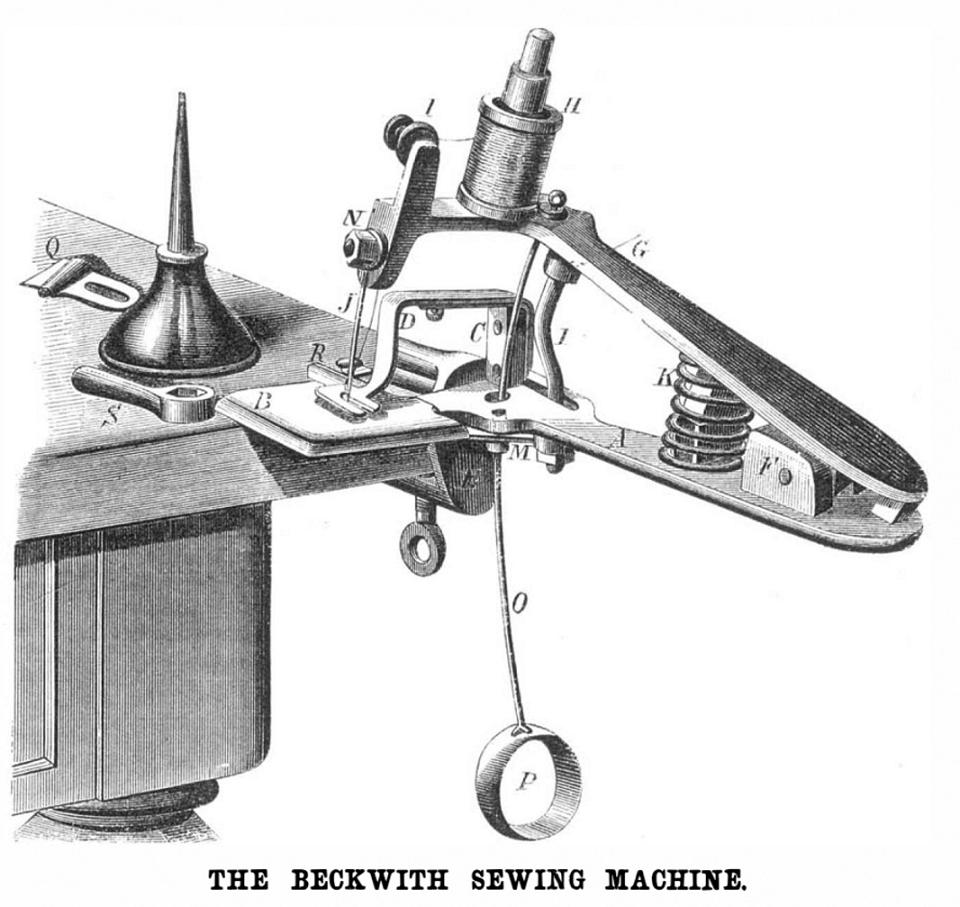
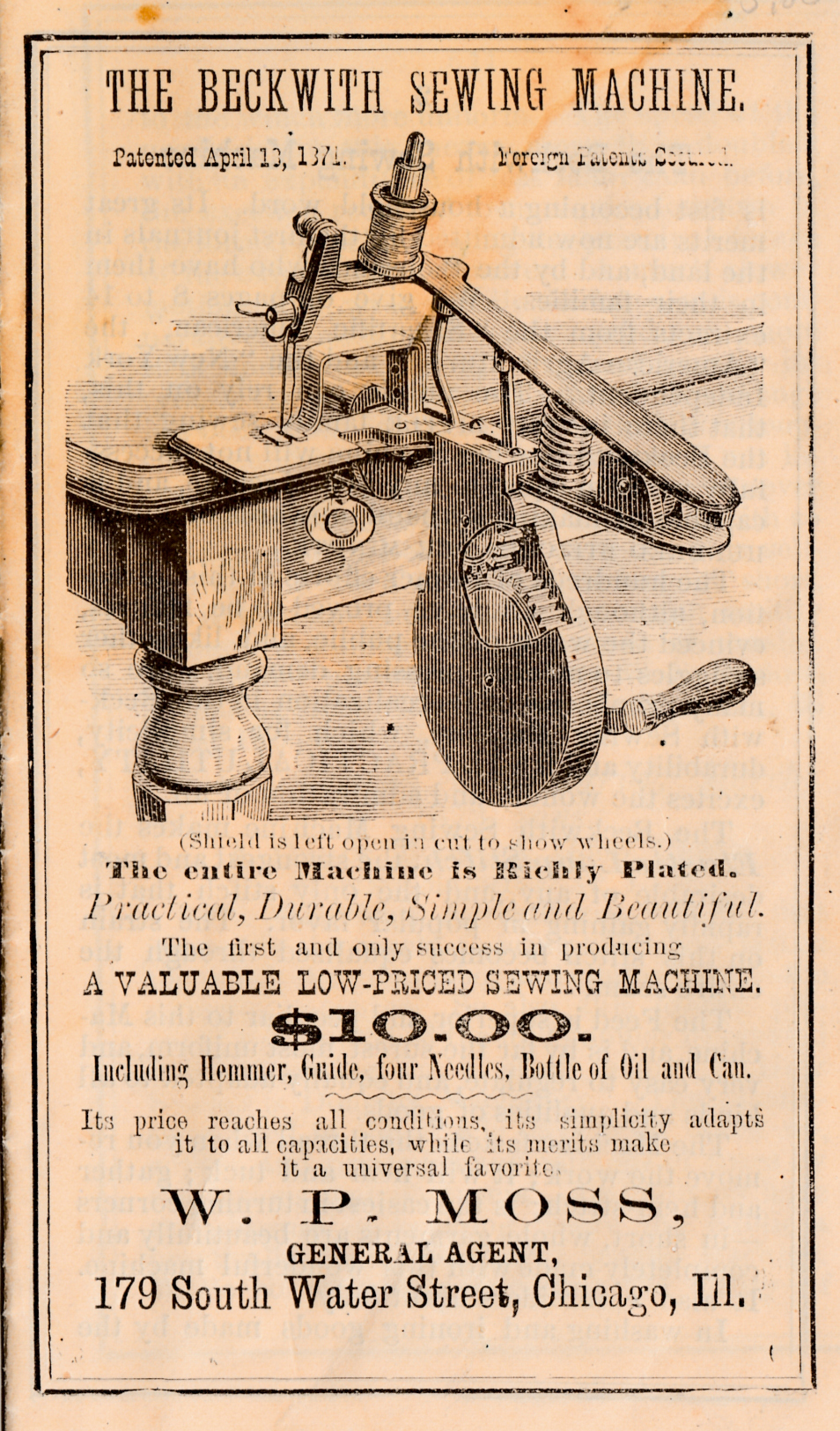
Exactly this variant—and not the machine shown in the first US patent—was illustrated in many American magazines such as the Scientific American of January 27th 1872 as the Beckwith sewing machine, which produces an “elastic chain stitch”. It was advertised as the “$10 machine”. In the same year, 1872, the novelty is also described in the Polytechnic Journal.
Also in the Smithsonian Institution’s book The Sewing Machine, Its Invention and Development, we only see this model, which, by the way, has been bought from England by the Smithsonian. Too bad that the prototype machines submitted for the US patents have been destroyed by patent office warehouse fires or were sold off later.
Model 3 - “Gear Machine”
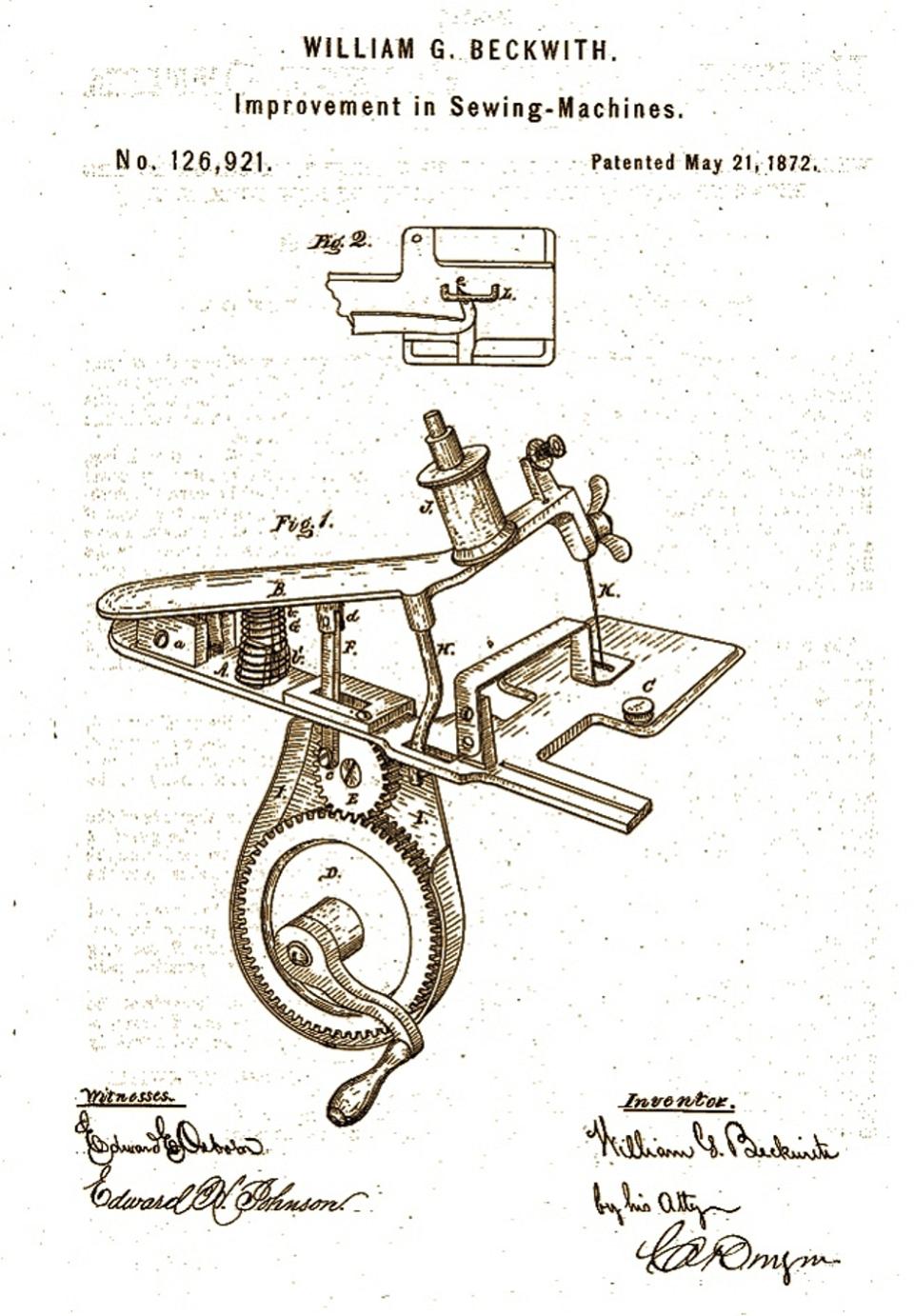
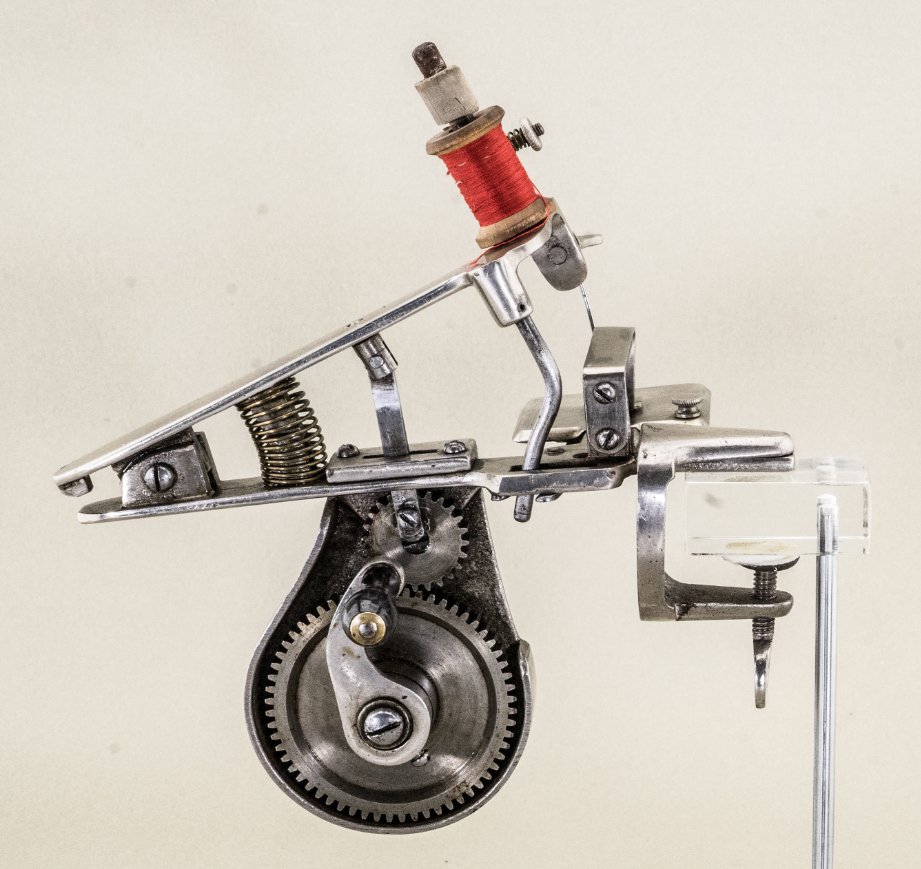
The issue of Scientific American in March 1872 criticised the Beckwith, writing that it required some wrist exercises to sew reasonably evenly with the “ring puller”. It was also noticed that the speed, of course, left something to be desired. Therefore, a modified machine was presented in the same issue. Instead of the Ring you now found an additional gear attachment, driven by a hand crank. Now you could sew evenly, smoothly and quickly. If the “Ring pull” machine only reached about 240 stitches per minute (4 strokes per second!), the performance of the modernised model increased to 600 stitches per minute.13, 14
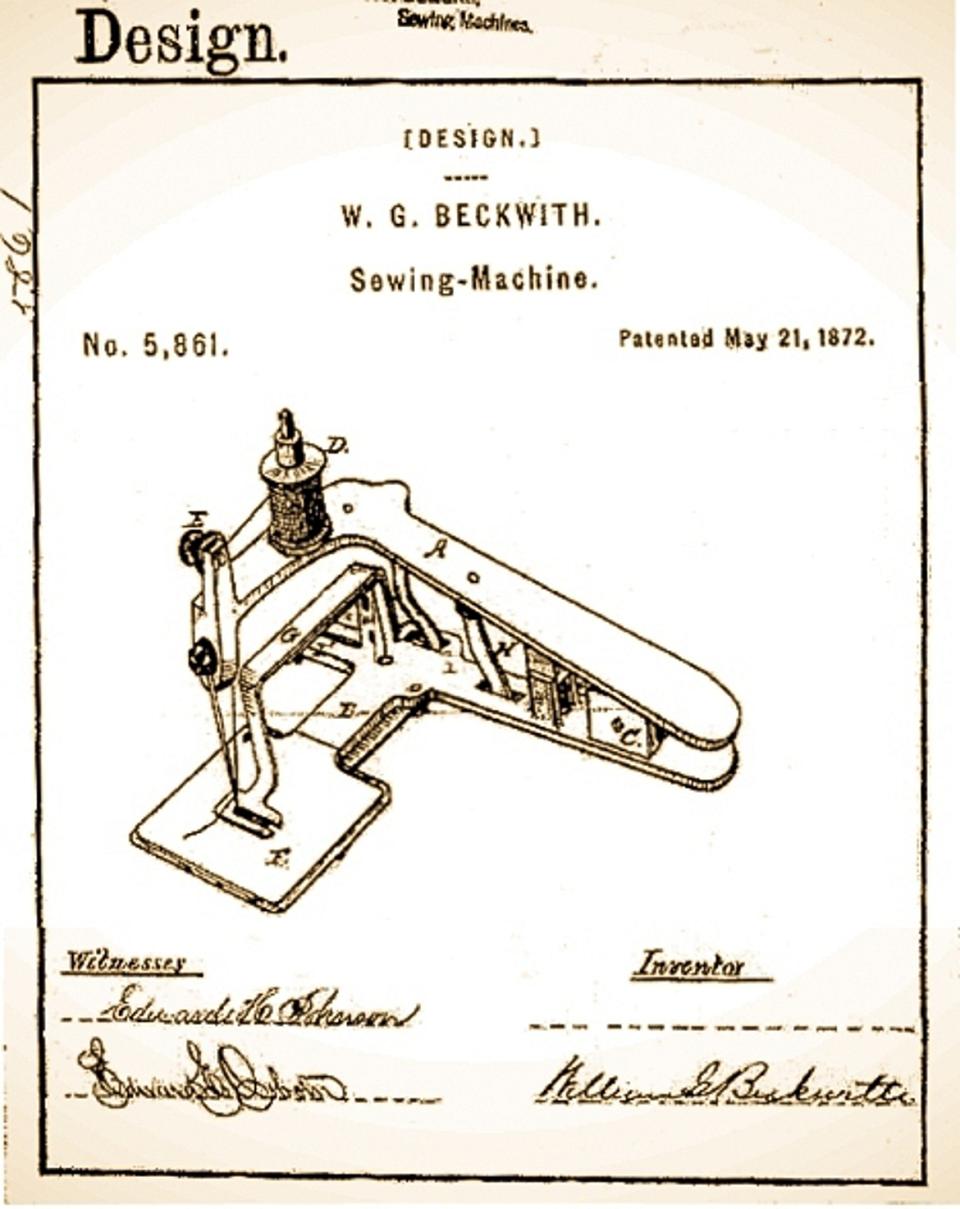
On May 21st 1872, this “Improvement in Sewing Machines” was registered in America as patent number 126,921. On the same date it was also protected by the design patent No. 5861 for the top section (i.e. without the gears). The complete machine was supplied in a high-gloss nickel-plated finish. Despite these significant improvements, the machine was still offered for $10 and shipped in a box with instructions, hemmer, oil can, oil bottle and four needles.
Although the magazine American Agriculturist had initially advised against the purchase of the Beckwith sewing machine, in March 1872, it warmed to like the improved machine. In it we read: “now we are ready to recommend the $10 Beckwith sewing machine as one that deserves to be bought immediately by anyone who cannot afford the expensive machines. And as we’ll see below, many of those who already have a bigger machine will want it as an extra.” Beckwith could not hope for better advertising.
Towards the end of 1872, the little Beckwith was also advertised in England as “The Gem”, the only good and cheap sewing machine. This was probably the result of lobbying.
Model 4 - With improved hinge and new presser foot assembly
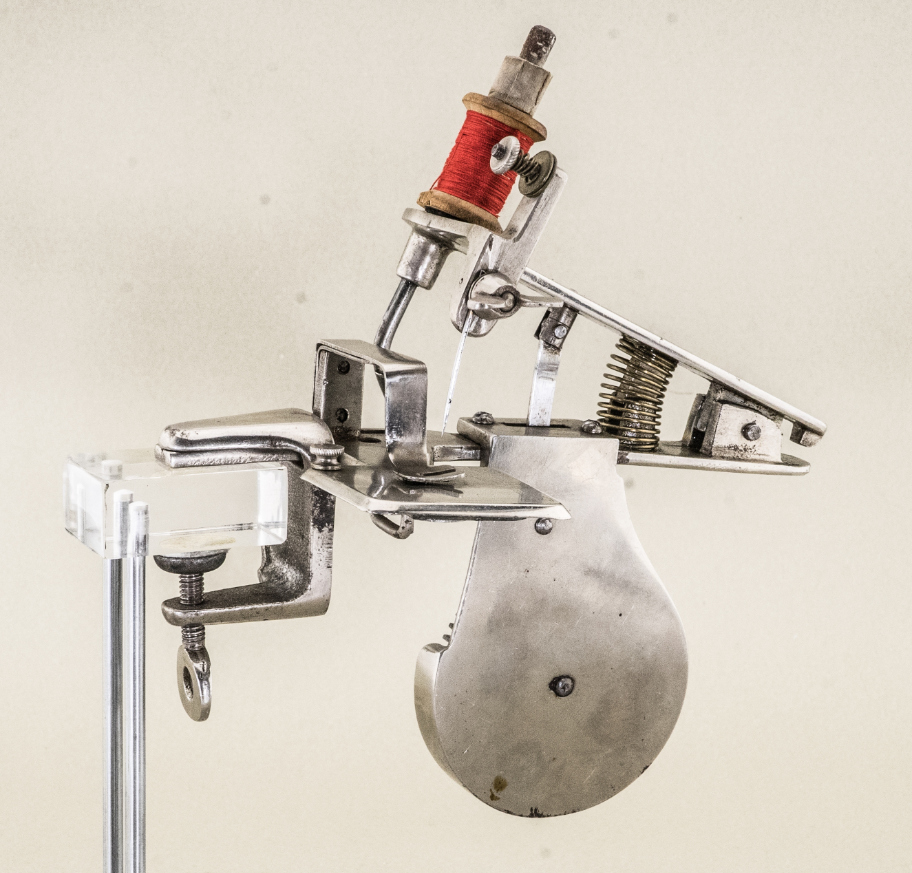
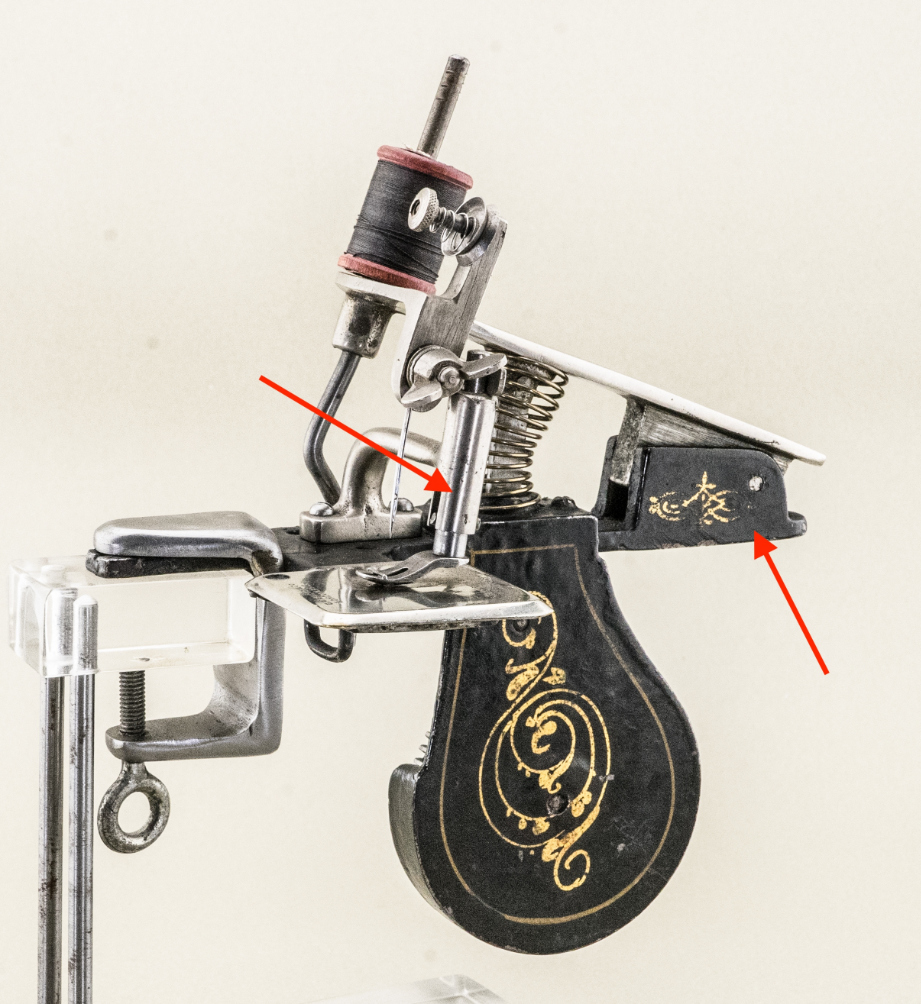
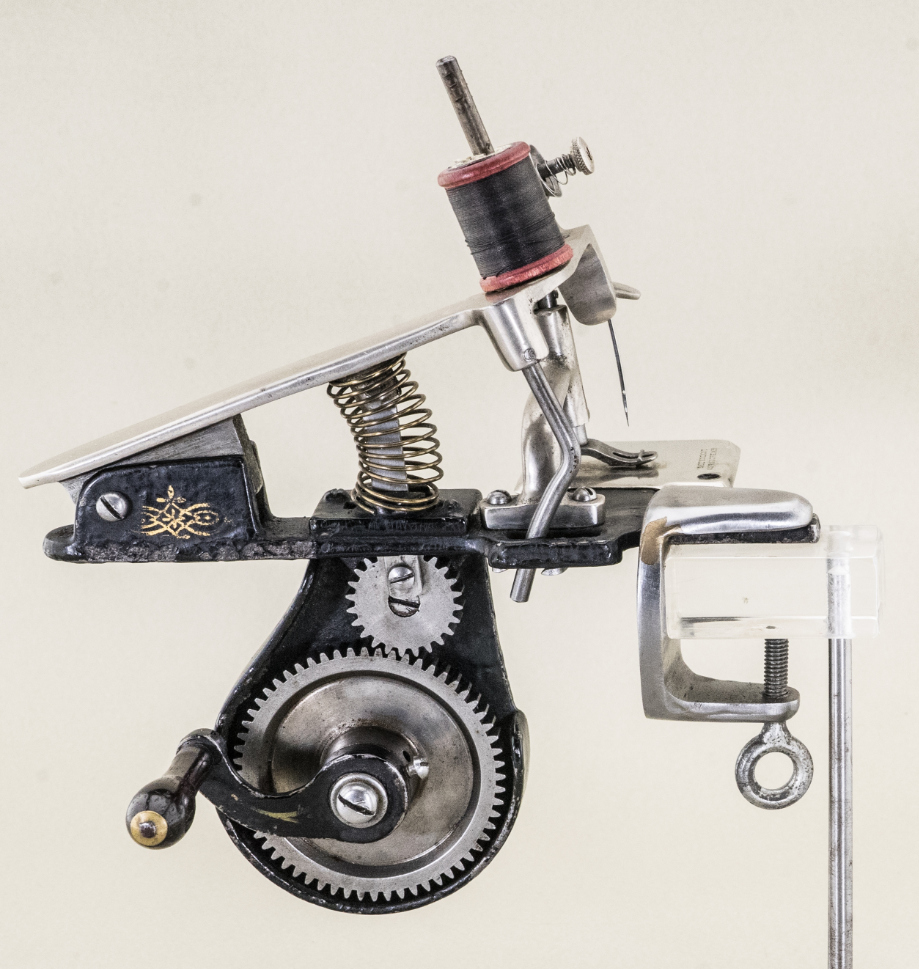
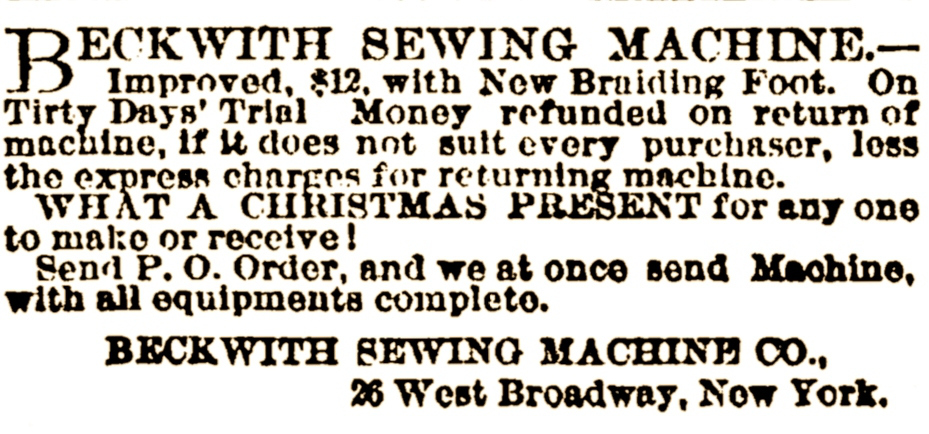
The Beckwith Model 3 was cumbersome to set up. With one finger you had to lift the presser foot strip to slide the fabric in place underneath it. This defect had been recognised and a cure was offered on an improved $12 machine. (The presser foot and its mounting were previously made of bent spring steel sheet.) In the improved variant, the holder of the presser foot was made of cast iron and the foot was lifted up and fixed by a lever. In order to eliminate the lateral play of the needle a slotted larger hinge was cast to replace the relatively small hinge at the end of the “rocking” lever. Now the lateral needle movement was almost eliminated. The return spring moved a little further to the left and covered the pitman, the rod which transfers the rotational movement of the small upper gear in an up and down movement of the upper part. Obviously this improved mechanism could not be patented.
In the American Agriculturist this $12 machine was advertised as follows:
“A new and very easy to use foot was made, with the help of which even a child can sew with ease without any difficulty. In addition, there is a new arm, a spiral spring and a lever for lifting the presser foot. Thus, the needle is free to be threaded. The joint was strengthened and the whole machine is built more stable overall. But the modified foot surpasses the value of the entire machine.”
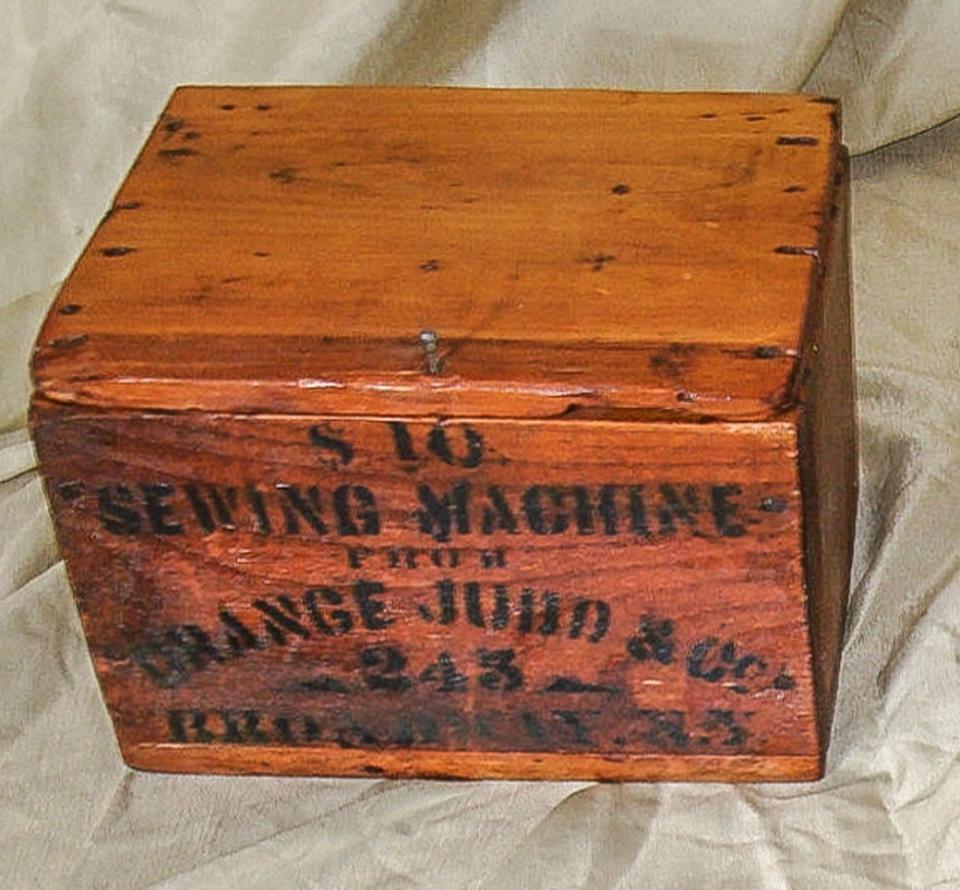
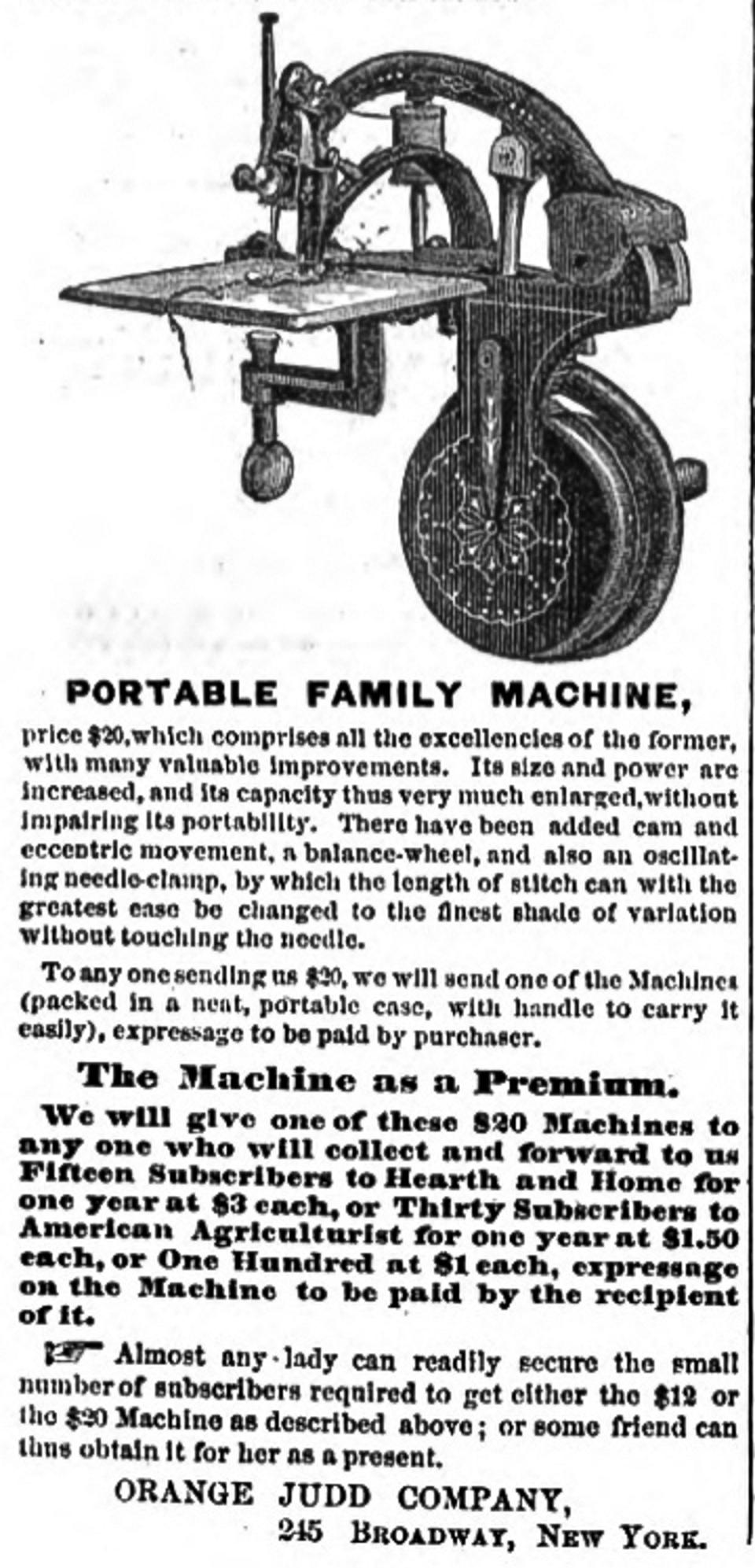
This new improved sewing machine was also available in black lacquer with beautiful gold-coloured, hand-painted decoration. Beckwith states in December 1872 that this improved $12 machine is so good that they will not be able to make the $10 machine anymore. Together with the introduction of the $12 machine, there is also a 30 day returns policy if you do not like the machine. The editor of American Agriculturist magazine, Orange Judd, even offers to deliver the Beckwith machine for free to a number of subscribers to its Hearth & Home or American Agriculturist magazines.
Orange Judd (1822 – 1892), was an agricultural chemist who first worked in teaching as a lecturer in agriculture. In 1853 he became editor, and in 1856, owner and publisher of the magazine American Agriculturist. As early as 1872, Orange Judd’s company advertised the Beckwith $10 sewing machine in its magazines. He advertised not only for the Beckwith sewing machine, but also offered various other items such as baking pans, pocket knives, knitting machines and much more as incentives for a subscription to his magazines. Our newspapers do the same today, but unfortunately they do not offer a Beckwith sewing machine.
Model 5 - Re-modified model
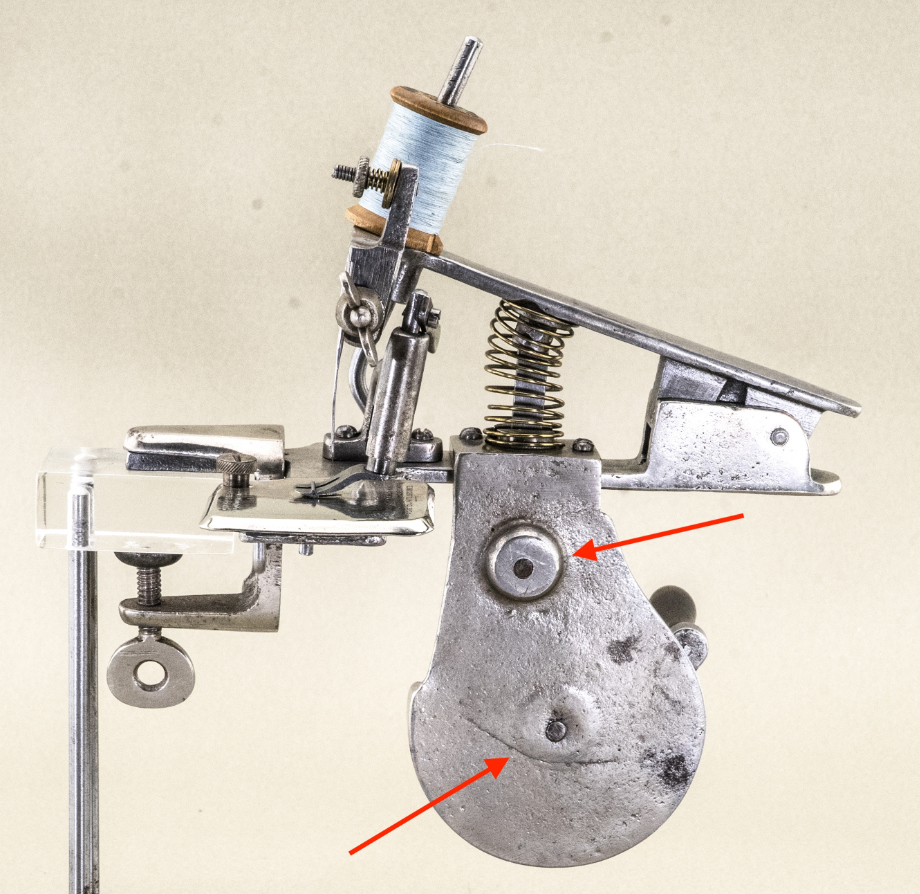
But even this “highly praised” machine had a decisive quirk. The axle screw of the small upper gear only had a few turns of thread in the cast-iron case of the gear pair. With frequent and heavy use, it could happen that the upper small gear broke out of the screw. As this defect became known, the cast bracket and cover of the gears was significantly reinforced at least on the screw of the small gear. This improvement was not seen as worthy of a patent, although you had to produce a new pattern for it. Incidentally, our reinforced machine does have damage in the reinforced area, but the axle bracket underneath shows a long crack. It would have been clever to also strengthen the lower gear cover.
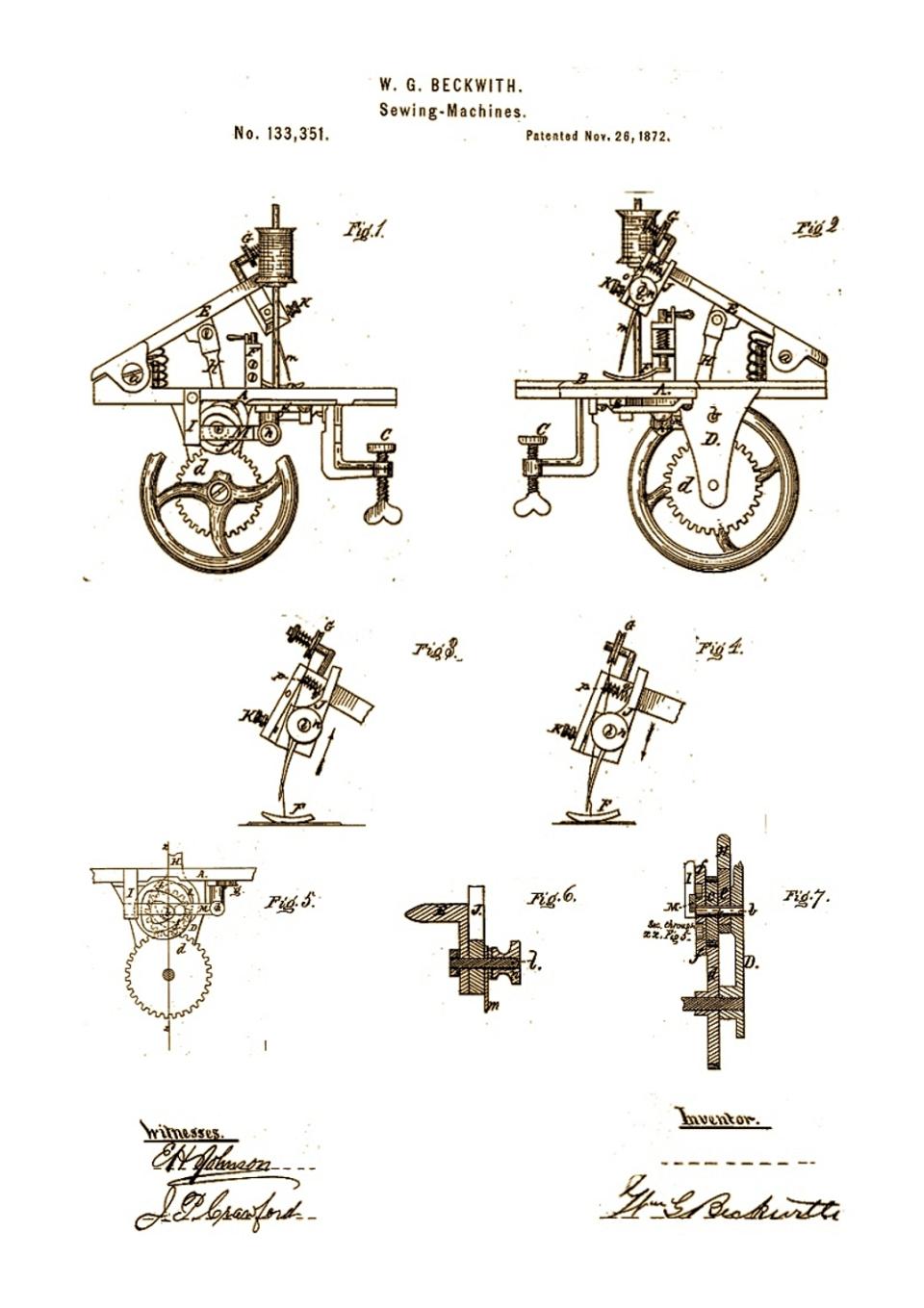
There was another flaw in the old Beckwith machines, namely the very simple needle attachment via wing nut. The seamstress sometimes overtightened it and bent the needle at the right height and angle. To combat this, patent No. 133,351 of November 26th 1872 was issued.
Model 6 - The “intermediate model”
Clearly a Beckwith, but many things are completely different. On closer examination, only the basic form is still like the machines described above.
In this patent, an attempt has been made to eliminate all previous defects. A machine fitting this version is still not known to us and has not shown up, so no photo! Similarities to the big Beckwith show up everywhere. The technical details of the patent drawing we will try to describe for the following model. By way of example, we would like to mention here a few of the changes shown in this patent:
- The spool pin is no longer attached to the upper movable arm, but to the frame,
- A modified table clamp, now screwed to the frame,
- A large hand wheel with integrated gear and curved spokes replaces the old hand crank,
- A new needle holder and adjustment.
Model 7 - The big single thread machine
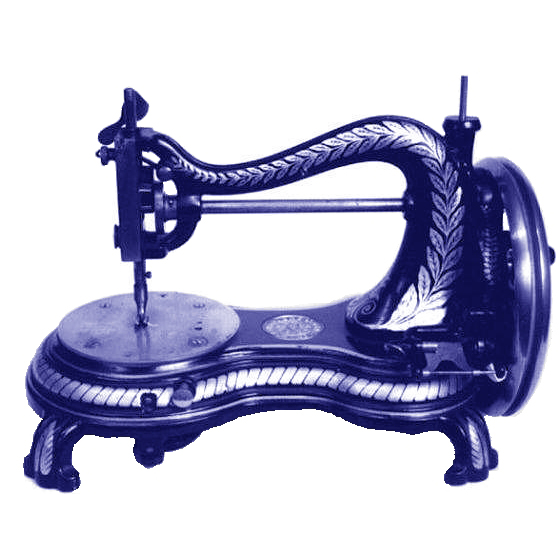
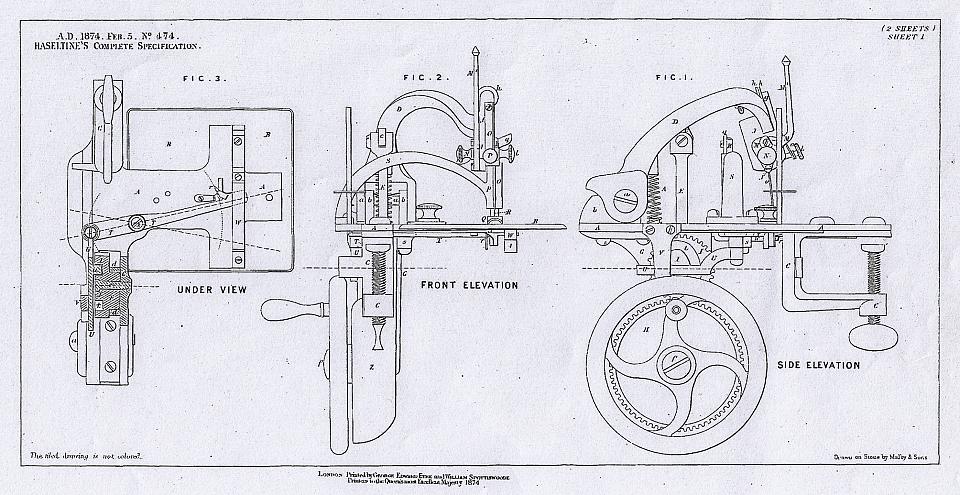
The Beckwith sewing machine development probably reached its peak in 1874 with the idea of a larger portable sewing machine. Many changes to the previously shown US patent were incorporated into this novelty and were additionally patented in England with patent No. 474 of February 5th 1874.
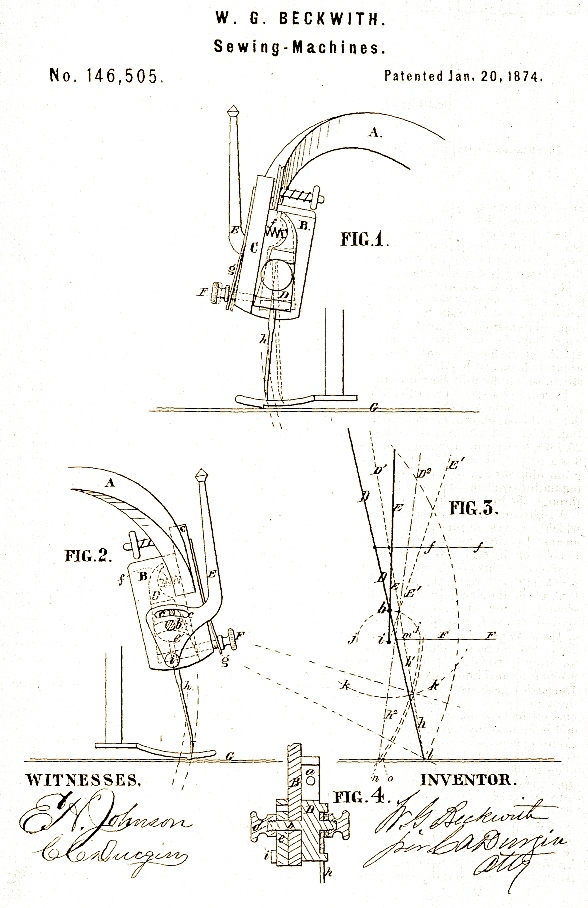
So far Beckwith had emphasised in his advertisements again and again that his sewing machine was small and light, but could still keep up with the “big” and heavy machines. With this new design, he not only offered an easy-to-transport sewing machine, but also a competitor to the full sized machines, all for only $20. It is surprising that the patent in America for it has not been found. Patented in the US is only the needle holder and guide; Patent No. 146,505 of January 20th 1874.
In an 1874 publication Beckwith points out that, from now on, only the portable, “7 pound” (3.175 kg) heavy sewing machine will be produced. In the same year, the American Agriculturist magazine offered to take back the $10 and $12 machines and offered a $2 deposit on the $20 machine.
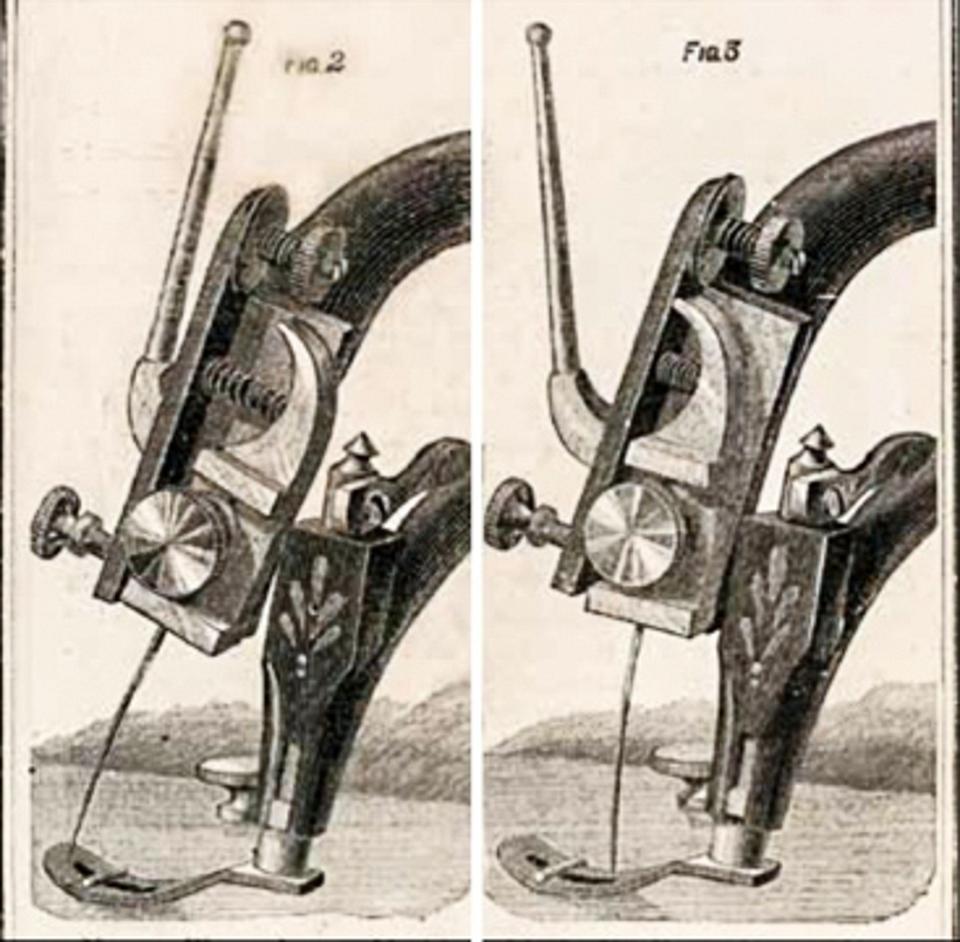
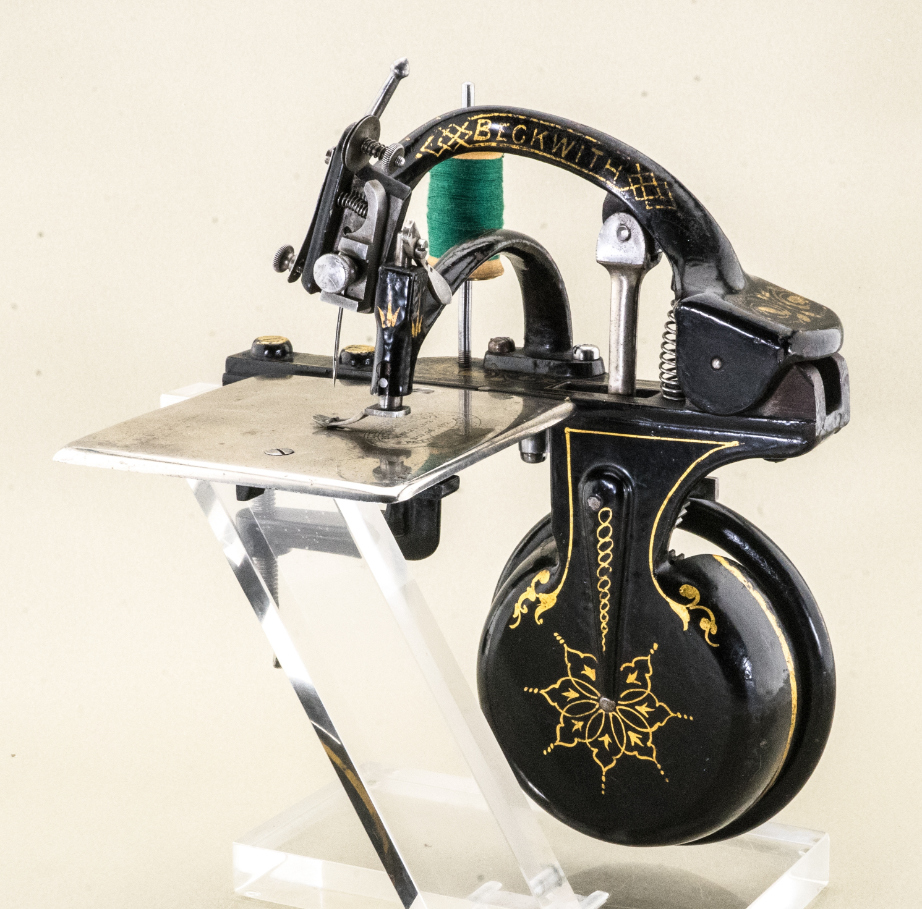
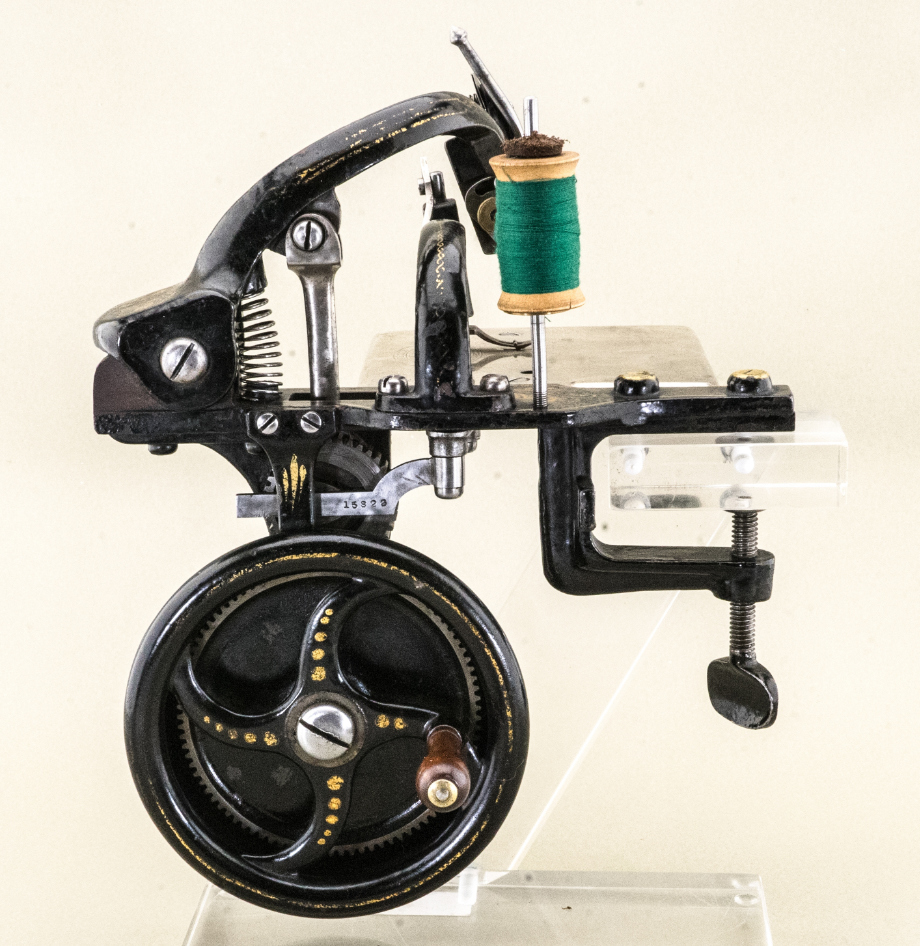
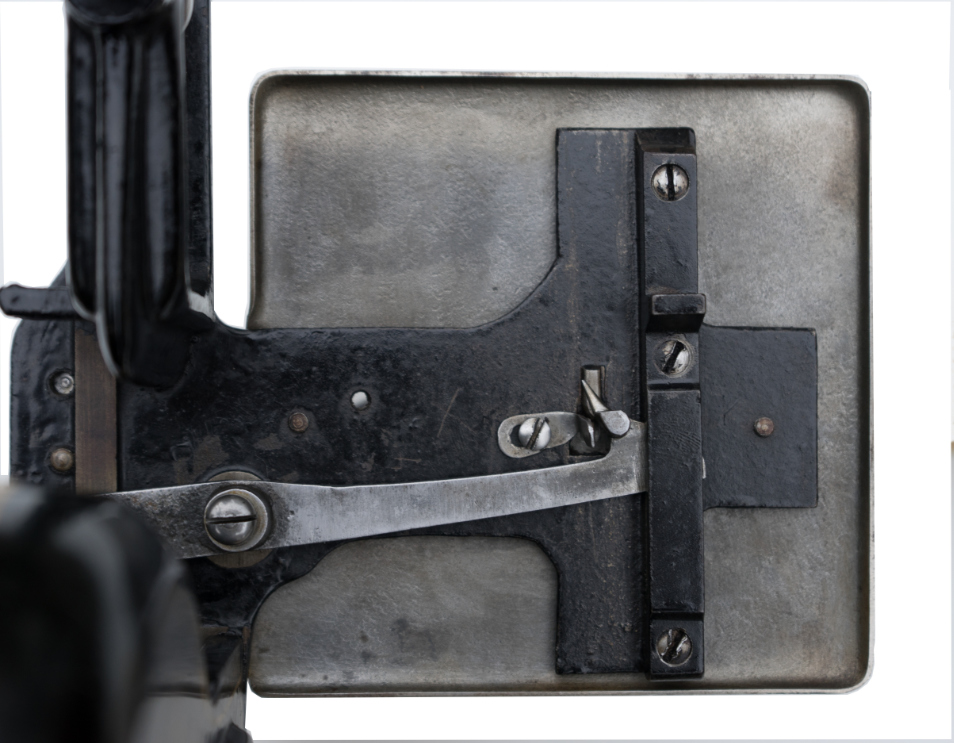
The production of this model was certainly a good idea as it was much more attractive compared to the old Beckwith machines. The entire technology runs smoothly. The gear ratio between the big and the small gear remained the same. The cloth feed is now no longer driven by the upper arm via the curved bar but via an eccentric in the small gear; things are much more precise and, so to speak, “underground”. The table clamp is now attached from below with two fixed screws on the extended sewing machine base plate and is thus significantly more stable. The needle plate is now much larger. Interesting is the now easily adjustable angle of insertion of the needle in the fabric. The picture on the left side below shows the function in detail.
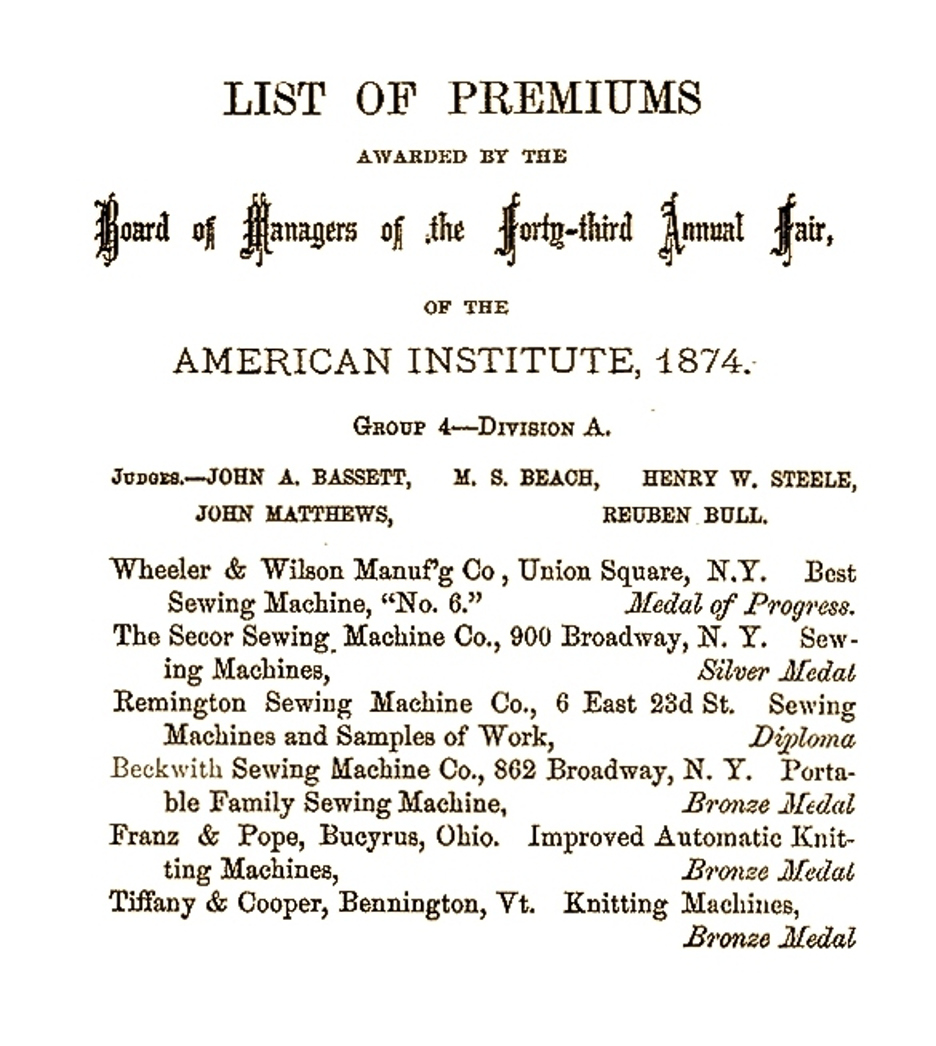
Even the new model in a box was not too big to stow away and take on trips. At the 43rd Annual Fair of the American Institute—also in 1874—Beckwith received a bronze medal for the $20 machine—after all, you have to do that first!
Model 8 - double thread machine
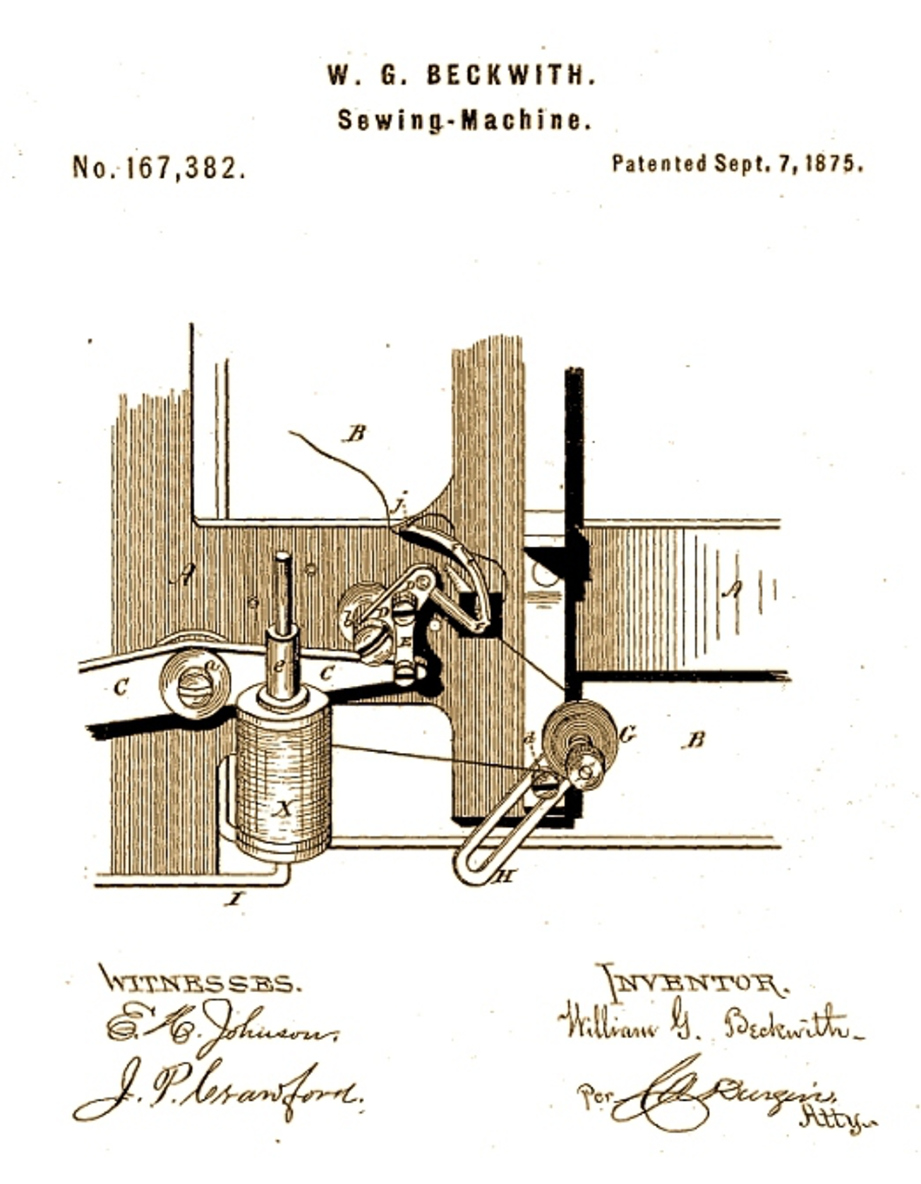
In a magazine from 1875, the Beckwith Sewing Machine Company advertises the large model as a single or twin thread sewing machine. The single thread sewing machine is available for $20 and the double thread sewing machine for $25. US Patent No. 167,382 of September 7th 1875, discloses the improved new two-thread function. In the picture on the left we see the single thread machine and on the right the mechanism of the two-thread machine.
We have tried both online and through various collectors’ magazines to find out more about the two-thread sewing machine. Was it ever built? If there is one still out there, we would be very grateful for information.
Model 9 - The Beckwith foot-operated sewing machine
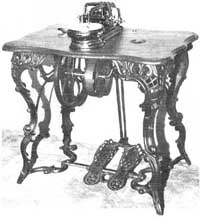
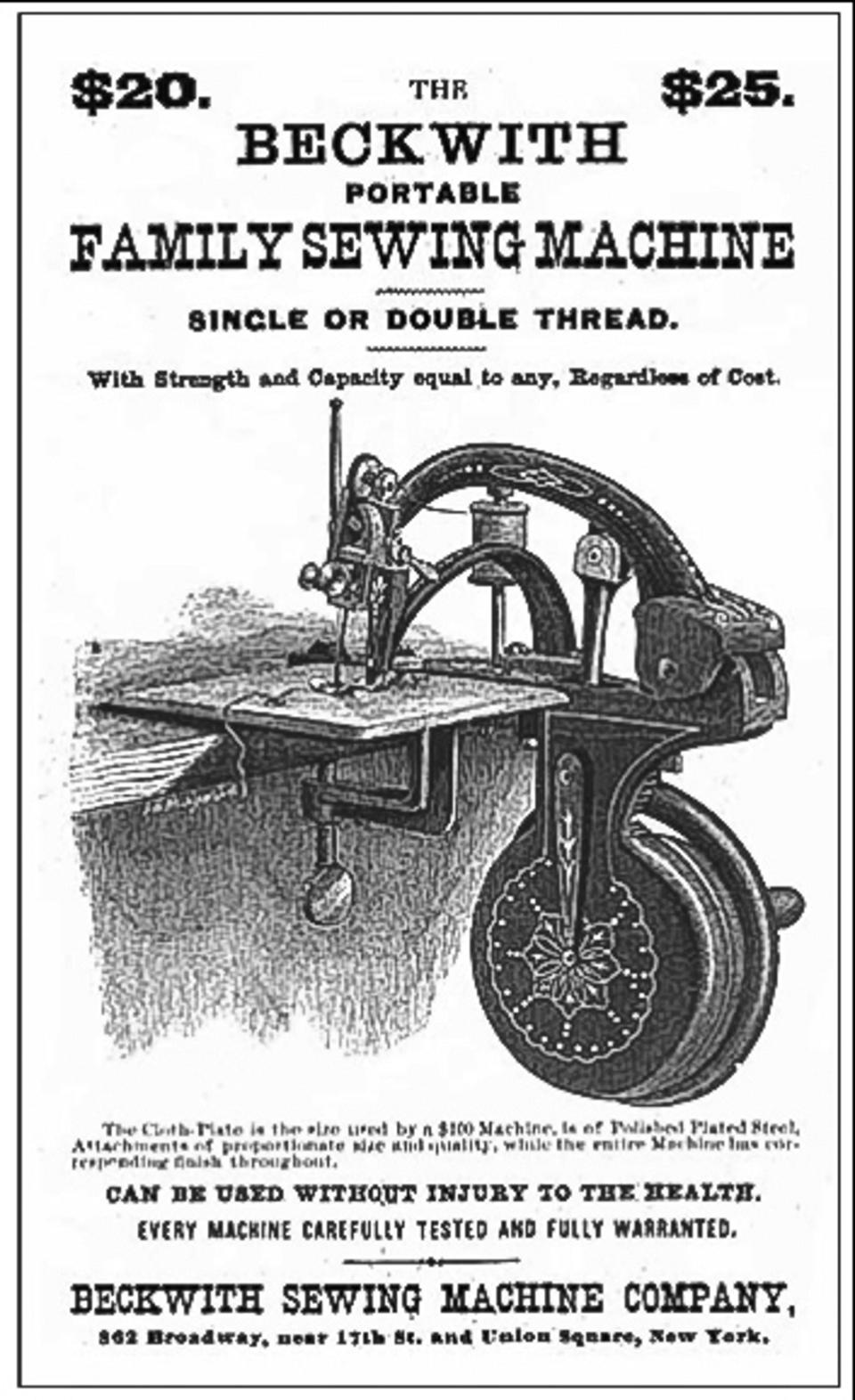
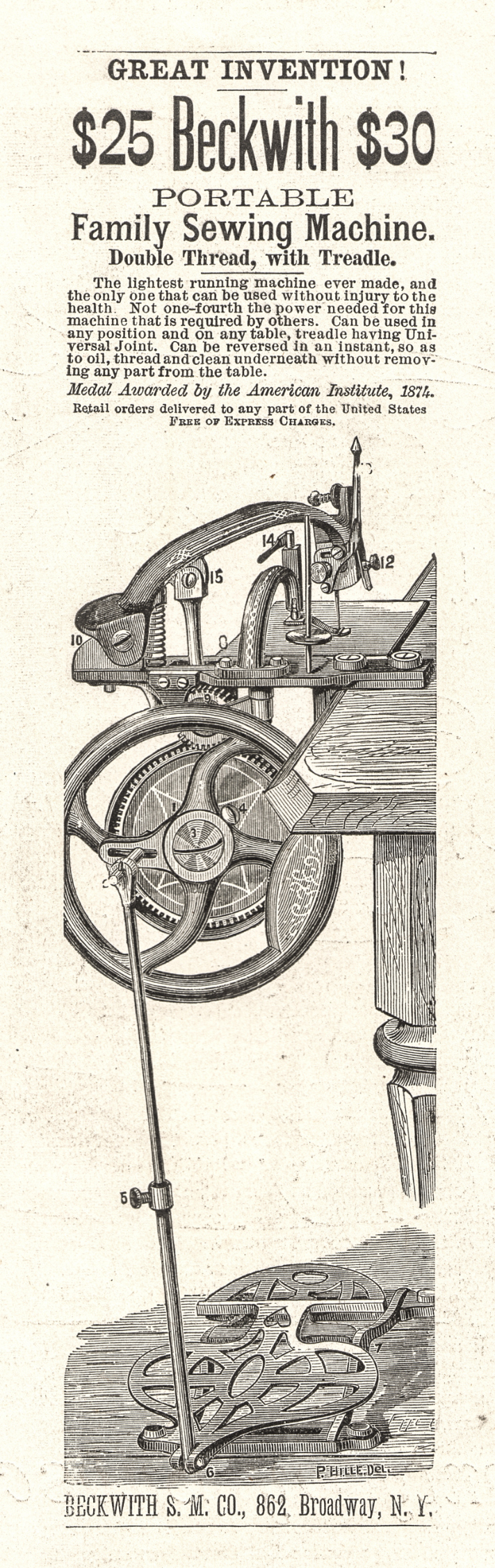
We were amazed when, in an American magazine, we found this advertisement for a large Beckwith foot-operated sewing machine. We could not find an associated patent. The portable double-thread sewing machine with “frame” is advertised here. A closer look reveals that the machine is clamped to a table. So it was not a treadle machine. An additional, larger flywheel was mounted under the machine, which was driven by an adjustable rod from a foot pedal on the floor. The double-thread sewing machine with the new foot drive cost $30. The foot drive has never appeared.
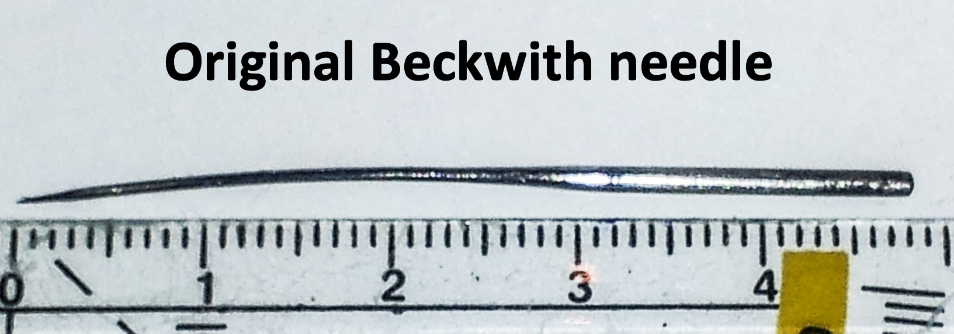
By the way, in the Sewing Machine Gazette of 1889—years after the end of the Beckwith Company—we find that the curved Wheeler & Wilson needle can also be used on the Beckwith machine. Manfred Blöchl was also helpful with the information that the No. 2½ needle by Joseph Perkins & Sons Ltd. fits the big Beckwith.
For those who travel to New York, the former Beckwith S. M. Co. offices can still be seen at 862 Broadway.
Sources
Information for this report has come from ISMACS News No. 103, www.fiddlebase.com, various websites and from Manfred Blöchl.
ISMACS is an organization totally independent of all sewing-machine manufacturers, past or present and is not affiliated with any of the companies mentioned in these pages. Please Note: Do not contact any ISMACS official in an attempt to solicit a valuation - it is not possible other than by hands-on assessment and your request will be ignored.
All rights reserved by ISMACS, under International and Pan American copyright conventions. Reproduction or copy of this page, in any form, in part or in whole, is strictly prohibited, without prior, written permission.